
i’m writing this the way we write incident summaries: stripped of theater, anchored in what failed, what almost failed, and what we chose to ignore because it was inconvenient to measure.
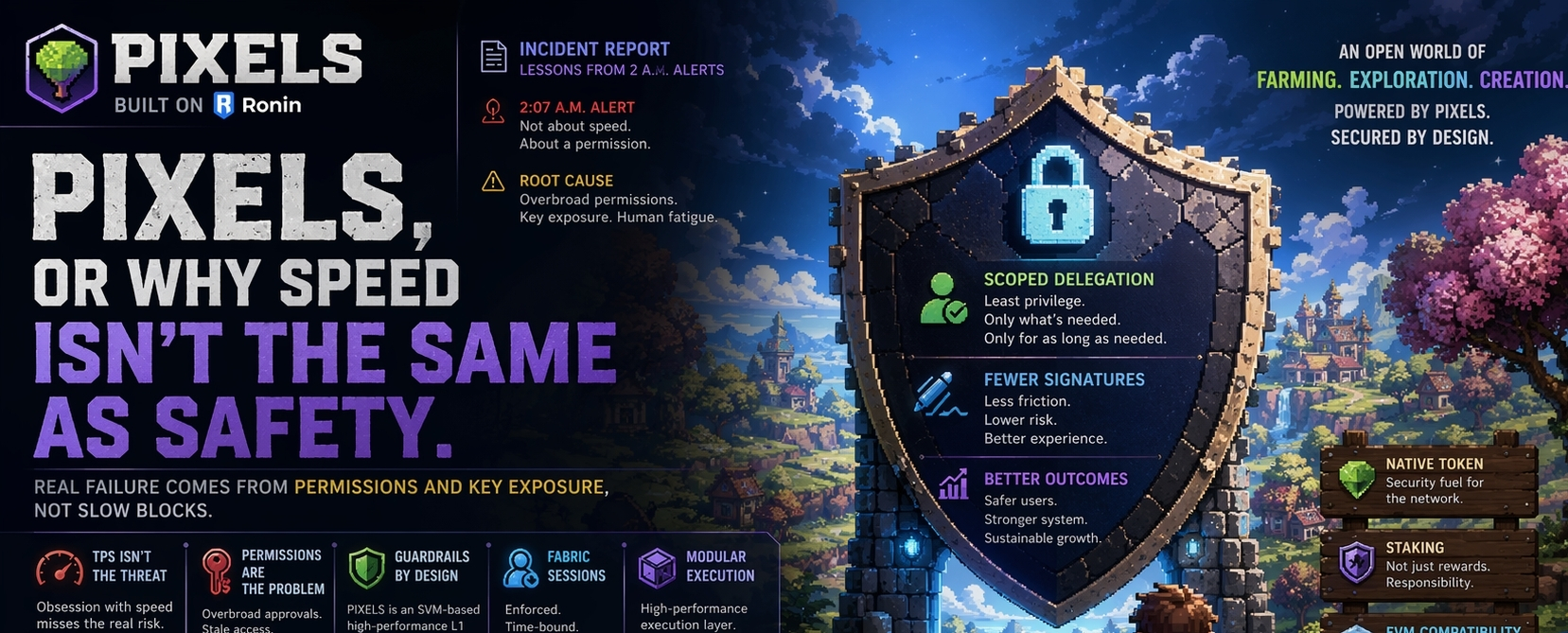
At 02:07, the alert wasn’t about throughput. It never is. No one gets paged because blocks are “only” fast enough. The alert was about a permission that outlived its purpose, a signature requested in a context it didn’t belong to, a wallet approval that slipped through because it looked routine. The kind of thing that passes audits on paper and still ends up on the postmortem.
PIXELS, for all its color and motion, runs underneath this reality. A social, casual world—farming, exploring, creating—built on a high-performance L1 that speaks in speed but survives on restraint. It’s easy to describe it as SVM-based, optimized, efficient. It’s harder—and more honest—to describe the guardrails that make that efficiency survivable.
Because the recurring lesson is blunt: systems don’t fail at their peak throughput; they fail at their edges of trust.
There’s a persistent fixation in this space—transactions per second as a proxy for competence, latency as a proxy for safety. Risk committees hear it every quarter. “Faster is safer,” someone implies, because congestion is visible and therefore frightening. But the quiet failures don’t announce themselves with slow blocks. They arrive through overbroad permissions, stale approvals, keys exposed in moments of fatigue. They arrive because we optimized the path of execution and neglected the path of authority.
The audit trail reflects this. Not the headline metrics, but the small, compounding decisions: how many signatures were required, how often users were prompted, how much scope a single approval carried, how long it lived. The 2 a.m. alerts are almost always downstream of those choices.
PIXELS approaches this from a different angle—not by rejecting performance, but by refusing to confuse it with safety. The architecture leans into modular execution layered above a conservative settlement base. Execution moves quickly where it can, but finality inherits discipline. It’s a separation that reads technical on a slide and operational in practice: one layer absorbs velocity; another absorbs risk.
And then there’s delegation—not the hand-wavy version, but the enforced kind. Fabric Sessions are where the theory becomes policy. Time-bound. Scope-bound. Explicit. Permissions that expire because they are designed to expire, not because someone remembered to revoke them. Capabilities that do one thing and stop doing it when they should. It’s the difference between borrowing a key and being handed the building.
Inside the debates, this is where friction shows up. Wallet approval flows are political spaces: product wants fewer prompts; security wants narrower scopes; engineering wants something that doesn’t collapse under edge cases. The compromise used to be additive—more signatures, more confirmations, more noise. But noise isn’t control. It’s just fatigue wearing a uniform.
The better direction is subtraction with precision. “Scoped delegation + fewer signatures is the next wave of on-chain UX.” Not because it feels smoother, but because it reduces the surface area where mistakes become irreversible. Fewer decisions, each with tighter bounds. Less ambient authority, more intentional access.
In PIXELS, this matters more than it sounds. A game economy is a network of small, frequent actions—harvesting, trading, crafting. If each action demands full authority, users either disengage or overexpose themselves. If each action inherits just enough authority for just long enough, the system becomes both usable and defensible. The difference shows up not in benchmarks, but in the absence of incidents.
EVM compatibility exists here, but only as a concession to reality: developers bring tools, habits, and code that expect it. It reduces friction at the edges, not risk at the core. Compatibility doesn’t secure anything; it just lowers the cost of entry. The security posture lives elsewhere—in how execution is constrained, how permissions are defined, how quickly authority decays.
And then there’s the token—mentioned less often in incident reports, but always present in their implications. It functions as security fuel, aligning incentives, pricing misuse, underwriting the cost of validation. Staking, in this frame, stops being yield theater and becomes what it always should have been: responsibility. Skin in the game, measured not just in returns, but in the consequences of failure.
The cinematic version of this story would end with a breach narrowly avoided, a last-minute revocation, a hero line in the logs. The real version is quieter. A session expires on time. A signature is never requested because the scope doesn’t allow it. An approval cannot be reused because it was never meant to be. Nothing happens, and that’s the point.
Speed is visible. Safety is often the absence of an event. PIXELS sits in that tension—fast where it needs to be, constrained where it must be. Not because it distrusts performance, but because it understands what actually breaks systems in production.
The report closes the way they all do: no single root cause, just a chain of permissions that could have been tighter, a few assumptions that should have been challenged earlier. Action items assigned. Reviews scheduled. Guardrails adjusted.
No one asks for higher TPS in that meeting.
They ask who can do what, for how long, and with which key.
