
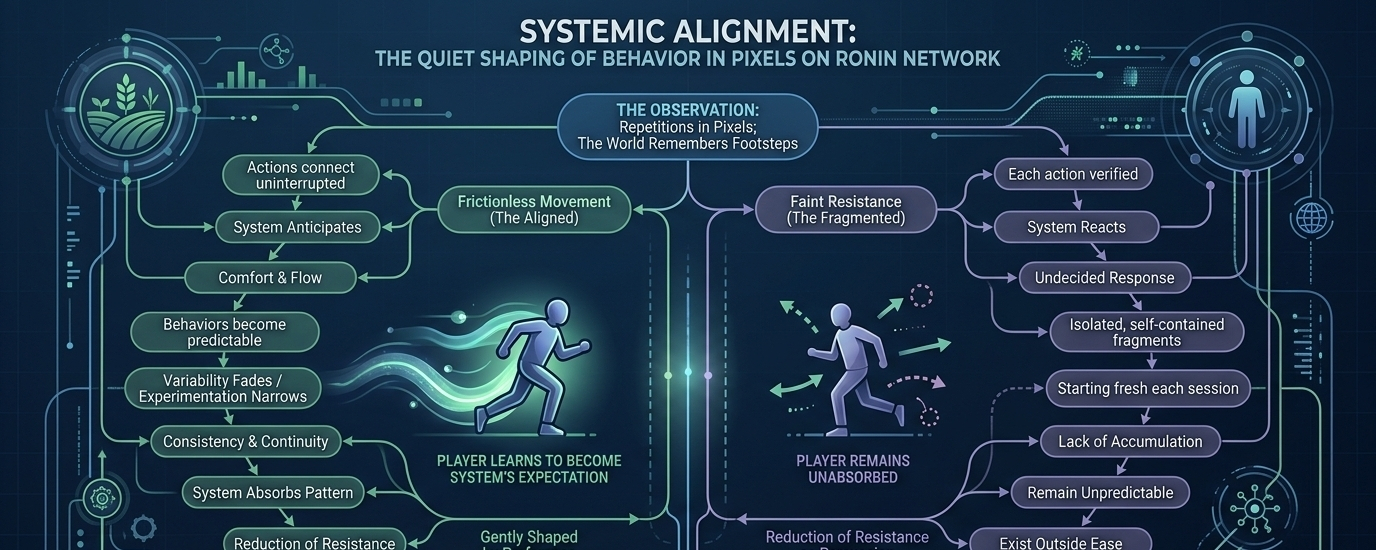
I’m waitingI’m watchingI’m lookingI’ve noticedI focus on the small repetitions, the way the same patch of land in Pixels seems to remember footsteps even when it shouldn’t, the way certain players return and everything around them settles more quickly, as if the world exhales in recognition rather than surprise.
There is something quiet about how the fields respond over time. At first it feels evenly distributed, almost mechanical in its fairness. Seeds grow, tasks complete, resources cycle. The logic appears flat, accessible, indifferent. But the longer I stay, the more the edges begin to soften around certain patterns. Not outcomes—patterns. The distinction is easy to miss unless you linger.
Some players move through the environment without friction. Not faster, not more efficient in any obvious way. Just… uninterrupted. Their actions seem to connect, one into the next, without hesitation from the system. It’s subtle enough that it could be dismissed as familiarity, or routine, or even coincidence. But repetition sharpens it. The same behaviors, performed the same way, begin to feel less like actions and more like something already understood.
In contrast, others—equally active, equally invested—carry a faint resistance with them. Nothing that stops progress, nothing that breaks the experience. Just a slight delay in how the world responds, as though each action still needs to be verified before it can belong. It doesn’t feel punitive. It feels… undecided.
Inside Ronin Network, where permanence is often framed as a feature, there’s an expectation that everything recorded holds equal weight. But what I’m seeing doesn’t contradict that—it bends around it. The records may persist, but the way they are received begins to diverge. Some histories seem to carry forward with a kind of quiet priority, while others remain isolated, self-contained, starting fresh each time.
It’s not about success. That becomes clearer the longer I watch. Effort doesn’t translate cleanly into continuity. Instead, there’s a kind of filtering that feels almost organic. Behaviors that repeat without deviation start to lose their individuality. They become predictable, and in that predictability, something shifts. The system no longer reacts to them as events. It begins to anticipate them.
And anticipation changes everything.
When an action is no longer treated as new, it stops demanding attention. It slips into the background, becoming part of the system’s ongoing rhythm. What once required input begins to feel pre-aligned. The player is still there, still acting, but their behavior has been absorbed into a larger pattern that doesn’t need to be reconsidered each time.
There’s a comfort in that, I think. A sense of flow. But it carries a quiet implication. To reach that state, something has to stabilize. Variation fades. Experimentation narrows. The edges of possibility tighten just enough to make consistency easier to maintain.
I notice how some players begin to mirror this without realizing it. Their movements grow more deliberate, less exploratory. Not because the game demands it, but because the system seems to respond more smoothly when they do. It’s not a reward in the traditional sense. It’s a reduction of resistance. And that’s often more persuasive than any visible gain.
Over time, the difference becomes less about what players achieve and more about how they are understood. Those whose patterns align with the system’s expectations begin to carry a kind of continuity that others don’t. Their presence feels extended, as if each session is not a reset but a continuation of something already in motion.
The others remain present too, but in fragments. Each interaction stands on its own, complete but disconnected. There’s no penalty in that, no explicit disadvantage. Just a lack of accumulation in the way the system perceives them.
It makes me wonder what the system is actually preserving. Not outcomes, not effort, not even time spent. Something quieter than that. Something closer to reliability. A behavior that can be depended on, not because it is optimal, but because it is consistent enough to become part of the system’s internal expectations.
And once something becomes expected, it no longer needs to be processed in the same way.
I keep watching, and the thought doesn’t settle. If the system leans toward what it can predict, then the players who remain unpredictable will always exist slightly outside of that ease. Not excluded, just… unabsorbed.
There’s a subtle shift in what it means to play. Not a movement toward mastery, but toward alignment. And alignment has a cost, even if it doesn’t feel like one at first.
I’m still looking at the same fields, the same loops of action, the same quiet repetitions. But it doesn’t feel as open as it did before. Not closed either. Just shaped, gently, by something that prefers what it already knows.
And I can’t quite tell if the system is learning the players, or if the players are slowly learning how to become something the system no longer needs to question.