
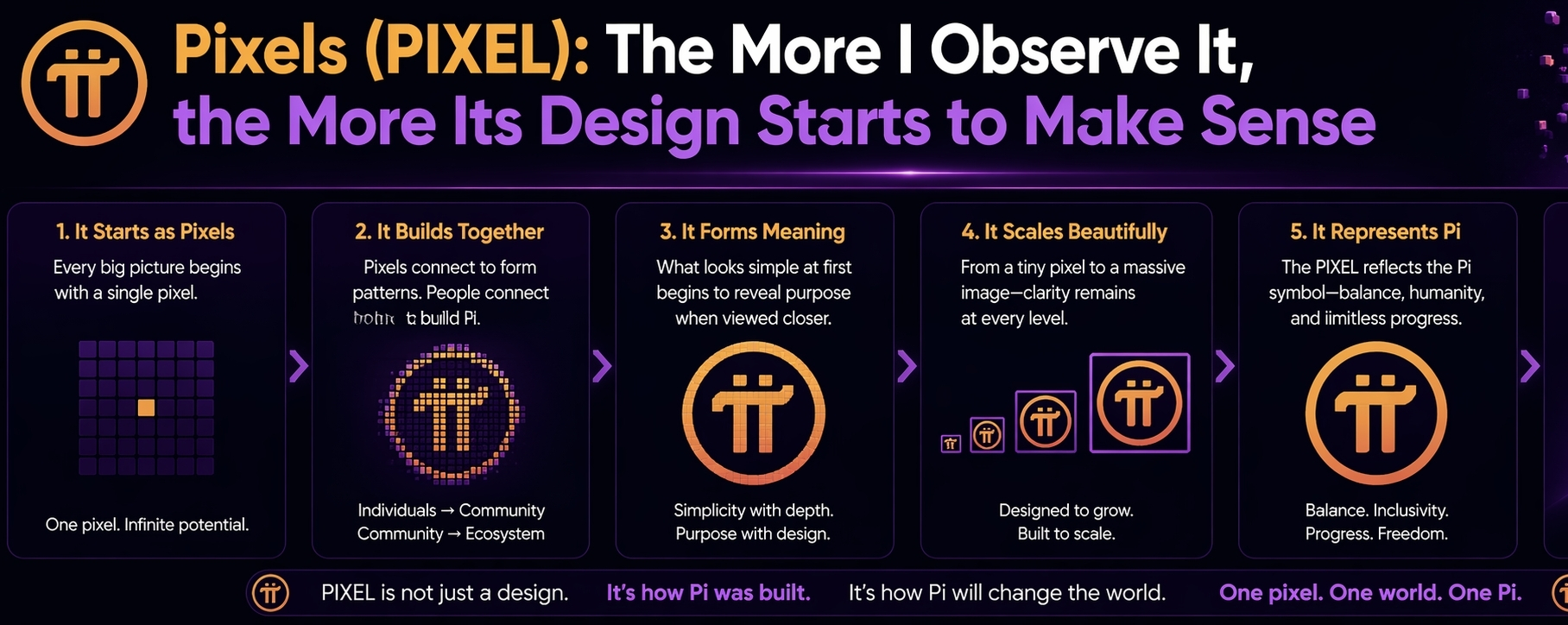
I’ve been spending more time thinking about Pixels (PIXEL) lately, and the more I sit with it, the more it starts to feel different from the way I first looked at it.
At first, I saw it as a social Web3 farming game on the Ronin Network—open world, resource gathering, exploration, creation. That part is still true, of course. But I’ve been noticing that the project begins to make more sense when I stop looking at it as a simple game loop and start paying attention to how all the smaller systems quietly work together.
What keeps standing out to me is how natural the world feels. The farming, trading, and movement across the map don’t just seem like features added for engagement. I’m starting to realize they function more like a living economy, where time, effort, and decision-making slowly turn into value. The more I observe it, the more I feel like it mirrors something familiar: people contributing consistently, building routines, and gradually shaping a shared environment.
It’s beginning to make sense to me that the infrastructure underneath matters just as much as the gameplay itself. Lately, I’ve been noticing small improvements that don’t scream for attention but still leave an impression—transactions feeling smoother, wallet actions requiring less friction, assets loading more cleanly, and the overall system appearing more stable than before. These are quiet details, but they’re the kind of details that make a platform feel trustworthy over time.
I’m also starting to understand the PIXEL token in a more grounded way. Earlier, I think I was looking at it too much from the outside, almost as if it were just another in-game asset with market value. But now it feels more like a coordination layer. It helps connect activity, rewards, ownership, and long-term participation. The more I reflect on it, the more I see it less as a promotional feature and more as a structural part of how the ecosystem keeps moving.
The same goes for staking and the validator structure on Ronin. I’ve been noticing that these systems only really start to make sense when I think about reliability in everyday use. A game world that people return to daily needs consistency. If transactions fail or confirmations slow down, it affects the entire experience. So I’m beginning to understand these technical choices not as abstract blockchain concepts, but as practical decisions made to keep the world stable and usable.
I’m also coming to terms with the compromises behind the design. EVM compatibility, legacy architecture, and gradual migrations once felt like limitations to me. Now they feel more honest—like the kind of trade-offs any real system has to make when balancing innovation with continuity. It’s starting to feel less about perfection and more about what can realistically scale without breaking user trust.
The more I think about it, the more I appreciate how grounded the whole project feels. Nothing about it needs to be exaggerated. Its strength seems to come from the way each layer supports the next: the game supports the economy, the economy depends on infrastructure, and the infrastructure is shaped by real operational needs.
I wouldn’t say I’ve reached a final conclusion yet. But I do feel a quiet sense of clarity forming. The longer I observe Pixels, the more I understand why its design choices are there, and the more confident I become that the project has been built with durability in mind rather than short-term attention.
