
i remember the 2:03 a.m. alert more clearly than the dashboard that justified it. nothing was red. latency held. blocks were final. the system, on paper, was behaving. but a wallet had signed what it didn’t fully understand, and somewhere between urgency and routine, a boundary dissolved. the incident report would later call it “user-side exposure.” the risk committee called it something simpler: preventable.
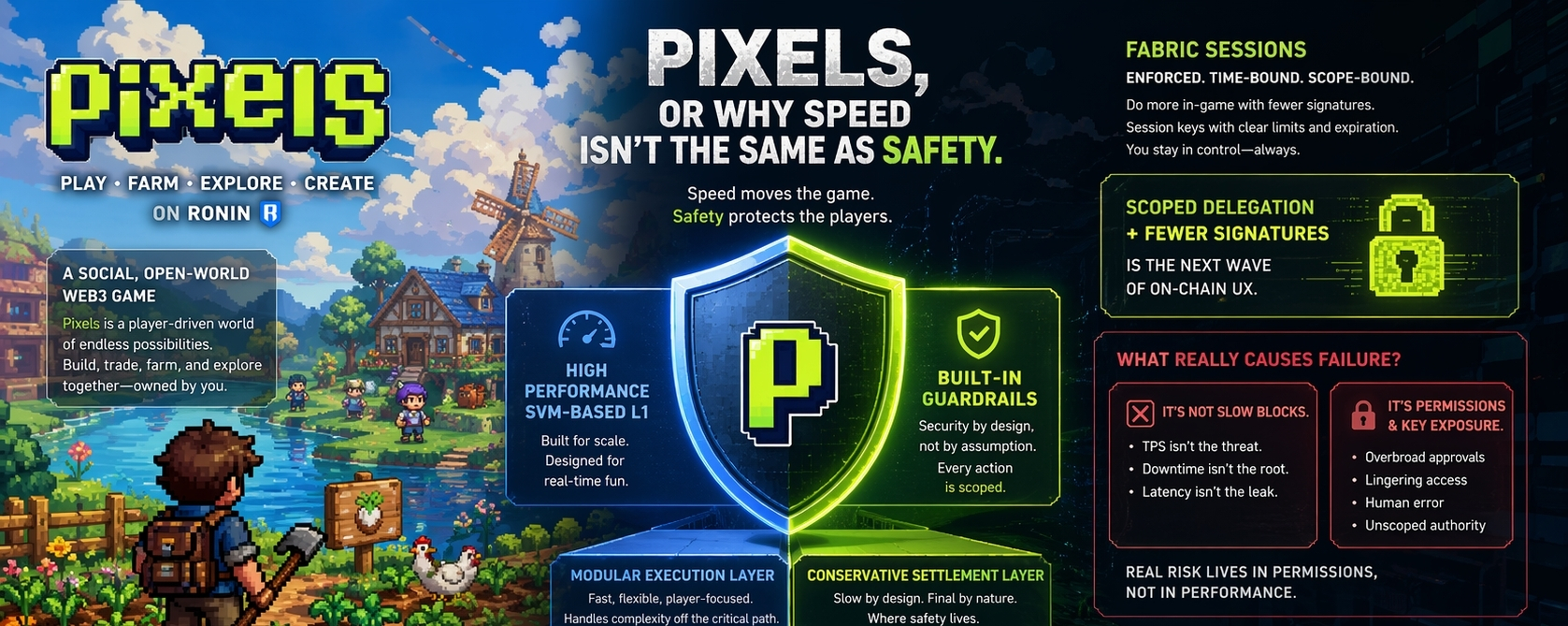
PIXELS runs fast. that’s not marketing; it’s architecture. an SVM-based, high-performance L1 designed to feel immediate—plant, harvest, trade, move—without the drag that used to define on-chain interaction. players don’t wait for a system to think. the system keeps up.
but speed is not the control plane. it never was.
in the weeks after the alert, the audits read like déjà vu. no catastrophic consensus failure. no chain halt. no reorg spiral. just permissions granted too broadly, approvals left too open, keys used in contexts they were never meant to touch. we were measuring the wrong thing with precision. TPS graphs were clean; the blast radius was not.
the uncomfortable truth is that most real failures don’t begin with slow blocks. they begin with misplaced authority.
that’s where PIXELS feels different—not because it’s fast, but because it treats permissions as first-class. the guardrails aren’t decorative. they’re enforced.
Fabric Sessions changed the tone of our internal conversations. not as a feature announcement, but as a constraint we had to learn to respect. time-bound, scope-bound delegation. sessions that can do exactly what they’re allowed to do, for exactly as long as they’re allowed to exist, and nothing more. no lingering approvals. no silent expansions of intent.
it sounds modest until you watch it in practice. fewer signatures, fewer prompts, fewer chances for a human to approve something out of habit instead of understanding. the system carries the constraint forward so the user doesn’t have to remember it later.
“Scoped delegation + fewer signatures is the next wave of on-chain UX.”
we didn’t write that line for a blog post. it showed up in a review doc after a week of tracing how permissions actually move through a game that never pauses. it read less like a slogan and more like a conclusion.
there’s a structural reason this works. PIXELS separates what needs to be fast from what needs to be final. execution lives where it can move—modular, responsive, forgiving of iteration. settlement stays conservative, where it can be slow on purpose, opinionated about correctness, resistant to surprise. you don’t ask the settlement layer to feel good. you ask it to be right.
that separation changes what you optimize. you stop pretending that every millisecond saved is a victory. you start asking whether each action had the right to happen in the first place.
we still talk about throughput in meetings. old habits don’t disappear; they get quieter. someone will point to a chart and ask if we can push it higher. someone else will ask what that buys us if approvals remain over-scoped. the room usually settles on the same answer: not much.
EVM compatibility shows up in the footnotes—useful, pragmatic, a way to reduce tooling friction for developers who already know the terrain. it’s not the story. the story is whether the system can say “no” with precision.
the token appears once in most documents, almost reluctantly. it is security fuel. it is what anchors the cost of misbehavior and the weight of participation. staking isn’t framed as yield; it’s framed as responsibility. if you help secure the system, you inherit the consequences of its design choices. that tends to focus the mind.
i keep coming back to that first alert because it didn’t look like a failure until it was one. the dashboards were honest. they just weren’t measuring the thing that broke.
since then, the questions have changed. not “how fast can we go,” but “who is allowed to act, and under what constraints.” not “how many transactions per second,” but “how many opportunities for accidental authority exist per session.” not “did it execute,” but “should it have been possible.”
PIXELS answers those questions with structure rather than slogans. fast where it should be, strict where it must be. guardrails that don’t rely on perfect users. sessions that expire before trust does.
the system still wakes me up sometimes. alerts always do. but the tone is different now. fewer surprises that trace back to a single, overbroad approval. fewer postmortems that read like we optimized the wrong layer.
speed is a feature. safety is a posture.
and posture is what holds when everything else is moving.
