


Most Web3 games fail because they feel like spreadsheets with character skins.
Pixels is different.
Not perfect. Not magical. Not immune to token drama. But different.
I’ve spent enough time around Web3 gaming to know the usual pattern: a project launches, everyone farms the token, Discord gets loud, floor prices pump, bots arrive, rewards get nerfed, and suddenly the “game” does not feel like a game anymore. It feels like a job with worse pay and more wallet risk.
Pixels.xyz somehow avoided becoming only that.
The reason is simple: people actually hang out there.
That sounds small, but in Web3 gaming it is huge. Pixels is not just about clicking buttons to extract value. A lot of the appeal comes from the routine. You log in, check your farm, deal with your resources, maybe plant some Popberries, wander around Terravilla, bump into other players, see what your guild is doing, and get dragged into whatever new event or meta everyone is talking about.
It has that “one more task before I log off” feeling.
That is dangerous in the best gamer way.
Pixels is a social farming game running on Ronin Network, but calling it only a farming game undersells it. Farming is the base layer, sure. You plant, harvest, craft, sell, upgrade, repeat. The grind is familiar if you have played Stardew Valley, FarmVille, Animal Crossing, or any cozy game where the day disappears because you wanted to finish “just one more thing.”
But Pixels adds Web3 ownership, NFTs, token utility, land, pets, guilds, and a player-driven economy on top of that cozy grind. That is where it gets interesting.
The world has a low-pressure vibe. You are not dropped into some hardcore RPG where you need a 40-minute tutorial before understanding the first button. You start small. You learn by doing. You farm. You gather. You craft. You figure out what matters. Then, before you notice, you are checking prices, optimizing your land, watching updates, and thinking about whether your time is better spent grinding materials or chasing whatever event is currently hot.
That is the hook.
Pixels works because it creates routine. And routine is what keeps games alive.
A lot of people say they play for rewards, and yes, rewards matter. Let’s not pretend otherwise. Web3 gamers love yield. They love airdrop possibilities, token farming, rare assets, whitelist chances, and anything that feels like early access to upside.
But that is not the full story.
People play Pixels because of the social vibes. Because Terravilla feels alive. Because there is FOMO when everyone else is doing something and you are not. Because guild chats make even boring tasks feel less boring. Because your farm becomes part of your identity. Because pets are cute and weirdly status-driven. Because land ownership makes people feel like they have a stake in the world.
And because sometimes, after dealing with real life, planting digital crops is just chill.
That is underrated.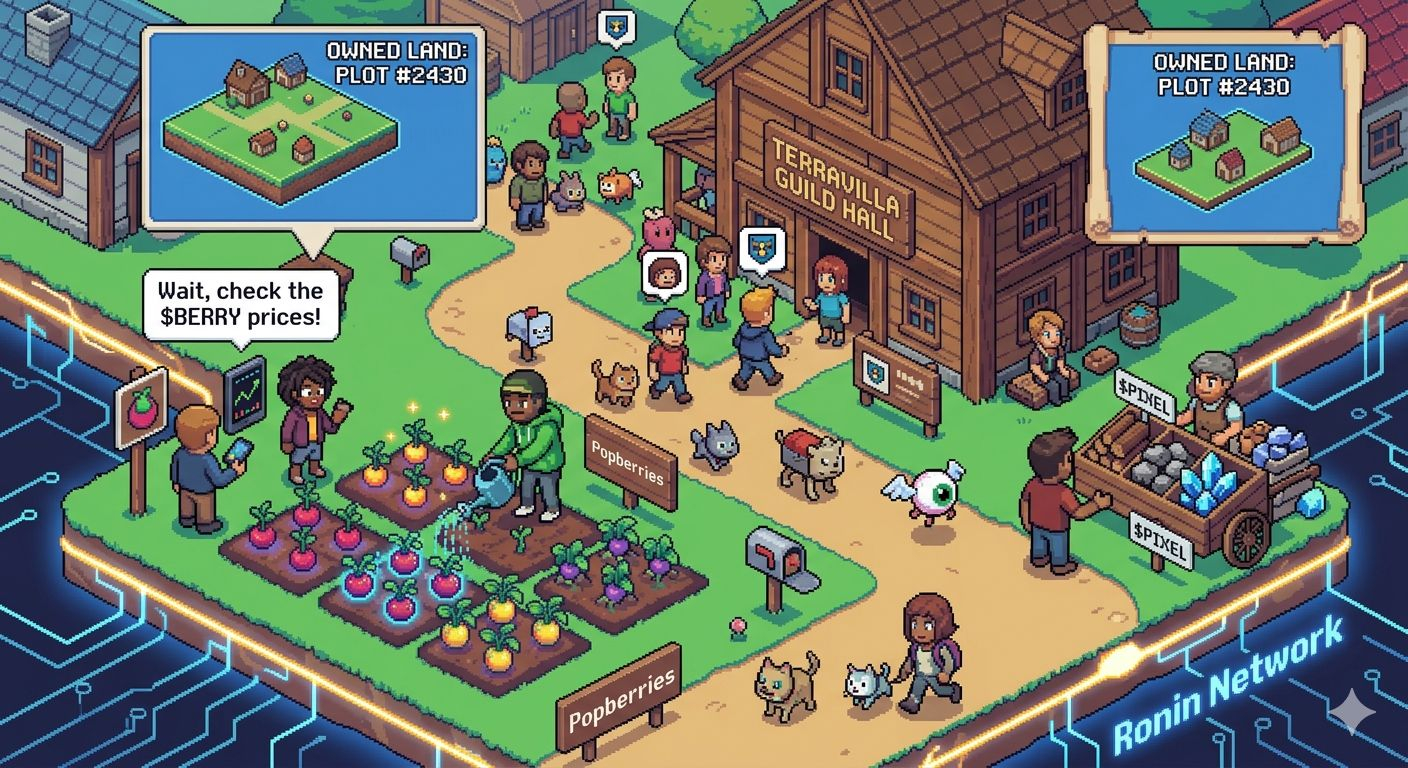
The farming side is simple on the surface, but it becomes a time-sink fast. Popberries, resources, crafting materials, recipes, upgrades, quests it all feeds into the same loop. You gather stuff so you can make better stuff. You make better stuff so you can progress. You progress so you can unlock more things to grind. Classic game design. It works.
The trick is that Pixels wraps this loop in a social Web3 economy. Your effort can connect to assets, tokens, guild activity, and marketplace behavior. That makes small actions feel more meaningful than they would in a totally closed game.
Land is a big part of that.
In Pixels, land is not just decoration. It is your base, your production zone, your flex, and sometimes your economic engine. A good piece of land tells people something about you. Maybe you are efficient. Maybe you are rich. Maybe you are chaotic and just placing stuff wherever. Either way, it becomes yours in a way that matters more than a normal game plot.
That is the Web3 promise when it actually makes sense: ownership that connects to gameplay.
Not every NFT needs to exist. We all know that. Web3 gaming has sold players plenty of useless JPEGs with “future utility” attached like a cheap sticker. But Pixels’ land and pets at least make sense inside the game world. Pets especially hit that sweet spot between utility, collection, and personality.
A pet following you around is not some revolutionary mechanic.
But players care.
They always have. Give gamers a companion, a skin, a badge, a rare cosmetic, or a weird collectible with status attached, and they will obsess over it. Pixels Pets fit naturally because they are not just floating financial assets. They belong in the world. They add personality. They give people something to show off.
Now, the Ronin part matters a lot.
Pixels moving to Ronin was one of the smartest things the project did. The post-Axie migration era left Ronin with a community that already understood Web3 gaming. These were not random users trying to figure out what a wallet is for the first time. They knew about tokens, NFTs, marketplaces, bridges, scams, pumps, dumps, and all the emotional damage that comes with blockchain games.
That audience was ready.
Ronin gave Pixels infrastructure, visibility, and a player base that was already trained for this kind of ecosystem. It also gave Ronin something it badly needed after Axie: another major game that could prove the chain was not a one-hit wonder.
Pixels benefited from Ronin.
Ronin benefited from Pixels.
That kind of ecosystem fit matters more than people admit.
Then there is $PIXEL, the main token.
pixel is basically the premium token of the Pixels ecosystem. It is used across things like upgrades, pets, guilds, VIP-style perks, staking, cosmetics, and other higher-level features. It is not supposed to be the whole game. That distinction matters.
When a game token becomes the only reason to play, the game is already in trouble.
Pixels seems to understand that. pixel is useful, but the actual gameplay needs to carry the experience. The token should support the world, not replace it. That is the difference between a game economy and a dressed-up Ponzi farm.
The token launch got a lot of attention, especially because of Binance Launchpool. That was a major visibility boost. Suddenly, people who had never touched Pixels were watching $PIXEL. Traders came in. Farmers came in. Speculators came in. The hype cycle did what hype cycles do.
And then reality showed up.
The price volatility has been scary. Anyone who has held gaming tokens through a full cycle knows the feeling. One month everyone is calling it the future of gaming. Later, the chart looks like it got hit by a meteor. That is crypto gaming. It is brutal.
This is why I never look at a token like $PIXEL only through price. Price matters, obviously. Nobody likes watching bags bleed. But for a game token, the better questions are:
Are people still playing?
Are guilds active?
Are players spending inside the ecosystem?
Are updates meaningful?
Are bots being handled?
Are new users coming in for the game, not only the chart?
That is where Pixels still has a case.
The economy has already gone through big changes, especially with $BERRY. Earlier on, $BERRY worked as an in-game utility token players could earn. But like many reward tokens, it had the obvious problem: if too much of it becomes liquid and farmable, people will farm and dump it. That is not a moral judgment. That is just what players do when incentives point that way.
So Pixels moved $BERRY off-chain.
Smart move, honestly.
Not painless. Not loved by everyone. But probably necessary.
Web3 games have to fight extraction constantly. If the reward system is too generous, bots swarm in. If it is too stingy, real players complain. If the token is too liquid, sell pressure becomes ugly. If everything is off-chain, Web3 people ask where the ownership went.
There is no clean answer.
Chapter 2 was Pixels trying to rebalance that mess. Less mindless farming. More strategy. More cooperation. More controlled rewards. More emphasis on actual gameplay instead of just token emissions.
Did it fix everything? No.
But it showed the team understood the danger.
The botting issue is inevitable in any game with rewards. Let’s be honest. If there is money on the table, bots will come. Multi-account farmers will come. People will script, optimize, exploit, and squeeze every possible edge. That is not unique to Pixels. That is the default state of Web3 gaming.
The real question is whether the team can keep the game playable for humans while making life harder for extractors.
That balance is tough.
Too many anti-bot systems can punish normal players. Too few and the economy gets drained. Pixels has to keep walking that line.
Guilds help because they make the game less lonely and more human. A solo farming grind can get boring fast. But when you are in a group, suddenly the same grind feels like participation. You are not just collecting resources. You are helping your people. You are comparing progress. You are asking what the meta is. You are getting pulled back in because someone mentioned a new opportunity.
That is why guilds matter.
Not because some whitepaper says “community engagement.”
Because gamers like belonging to a crew.
The FOMO is real too. Pixels has that live-game energy where missing a few days can make you feel behind. Maybe there is an event. Maybe people are farming something new. Maybe a strategy changed. Maybe a reward window opened. Maybe everyone is suddenly talking about staking or pets or land again.
You log back in because you do not want to miss the thing.
That is powerful.
And a little exhausting.
Pixels sits in a strange middle zone between cozy game and crypto economy. One side is relaxing. The other side is stressful. You can be chilling in Terravilla one minute, then checking token charts, marketplace listings, and unlock schedules the next.
That contrast is very Web3.
Traditional farming games do not make you think about circulating supply. Pixels does.
That can be exciting, but it can also ruin the vibe if you let the financial side take over. The healthiest way to enjoy Pixels is probably to treat the game as the main dish and the crypto layer as the spice. Once the token becomes the whole reason you log in, every nerf feels personal and every price drop feels like betrayal.
Players need to be realistic.
$PIXEL can have utility and still be volatile.
NFTs can be fun and still lose value.
Land can feel meaningful and still be illiquid.
Pets can be cute and still not moon.
That is the truth most hype threads avoid.
The good news is that Pixels has more going for it than a token. The game has an actual world, recognizable social spaces, active routines, and mechanics people understand. That gives it a better shot than projects that launch with a cinematic trailer, sell NFTs, and then spend two years “building.”
Pixels is already playable.
That matters.
It also has a visual identity that works. Pixel art is not just nostalgia bait. It makes the world approachable. It lowers the pressure. It lets the game run on more devices and feel casual without looking unfinished. In a space full of overpromised AAA Web3 games that never ship, Pixels being simple and playable is a strength.
The game does not need to look like Unreal Engine 6 to be sticky.
It needs to give players a reason to come back.
Pixels does that through routine, community, ownership, and progression.
You log in to manage your farm.
You stay because people are there.
You care because your stuff feels like yours.
That is the loop.
Security is still a real concern. Anyone playing Pixels through the Web3 side needs basic wallet discipline. Use official links. Do not sign random approvals. Do not trust fake airdrops. Do not paste your seed phrase anywhere. Do not connect your main wallet to every site some stranger posts in Discord.
Boring advice.
Life-saving advice.
Crypto gaming attracts scammers because players are often distracted. They are thinking about rewards, events, and marketplace deals. That makes them easy targets. Pixels players need to stay sharp, especially when hype picks up.
So why do people actually play Pixels?
Not just because of $PIXEL.
They play because it gives them a daily digital habit. They play because farming is relaxing. They play because the social layer makes the grind feel shared. They play because owning land or pets adds identity. They play because Ronin users love being early to ecosystem plays. They play because there is always some little FOMO trigger pulling them back.
And yes, they play because there might be upside.
Let’s not act too pure.
Web3 gamers love potential upside. That is part of the fun. Pixels understands that, but the better part of the game is that it does not rely only on that. It gives players something to do while they wait, speculate, build, or vibe.
That is why Pixels matters.
It is one of the rare Web3 games that feels like it has a real community instead of just a holder base. It has survived beyond the first wave of hype better than many projects because people can actually play it, talk about it, optimize it, and make it part of their daily routine.
The future is still uncertain. The token has to deal with market pressure. The team has to keep improving the economy. Bots will keep testing the system. Players will complain about nerfs. Speculators will rotate in and out. Ronin’s overall health will matter. Updates need to keep landing.
But Pixels has something many Web3 games never had.
A reason to log in that is not only “number go up.”
That is the whole game.
And honestly, in this sector, that is already a big win.