
It’s late, and I’ve read enough whitepapers this week to start recognizing the same sentences before I finish them. “Revolutionizing gaming.” “Player ownership.” “Next-generation economy.” You know the script.
So when something like Pixels comes up, the instinct is to dismiss it quickly. Farming game. Pixel graphics. Social world. Token attached. It sounds familiar in a way that usually ends in disappointment.
But the annoying thing is… it doesn’t fully collapse under that first impression.
And that’s where it gets interesting.
First impression: deceptively simple
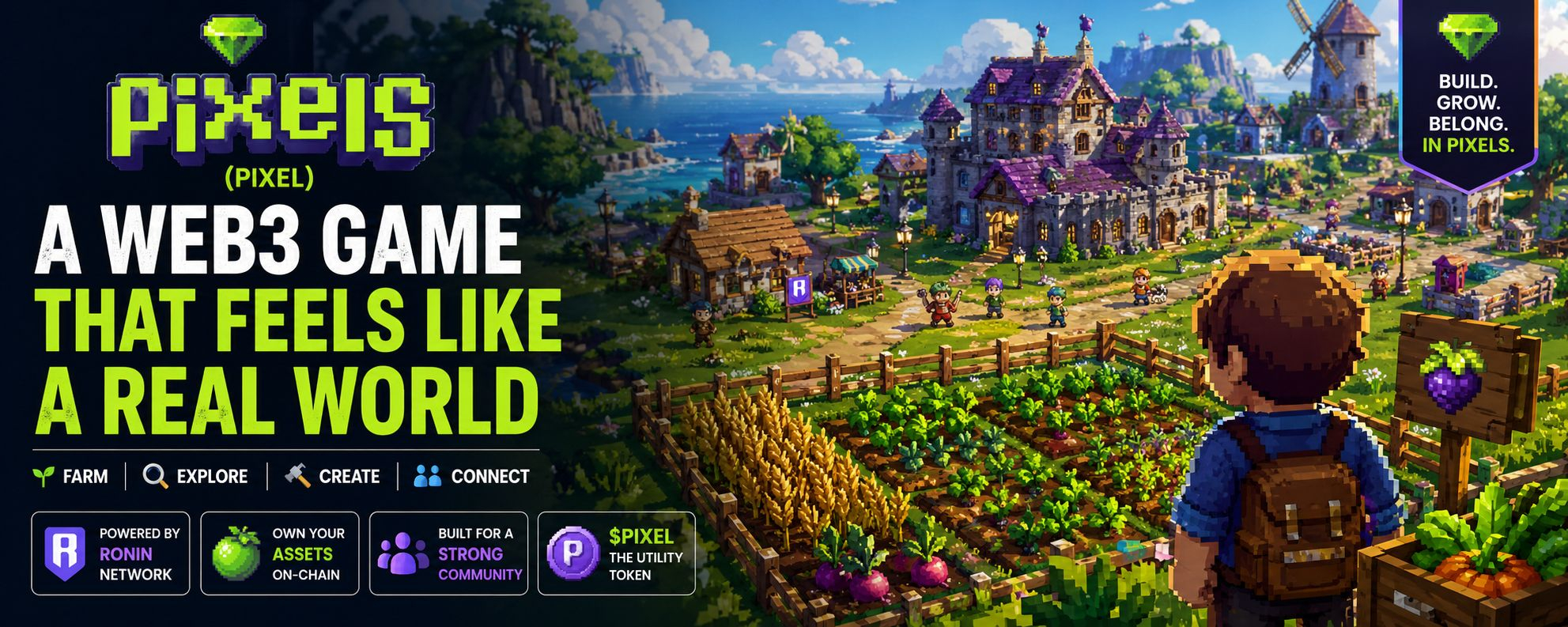
On paper, Pixels doesn’t try to impress you. It’s not throwing around complex mechanics or promising some radical redesign of gaming. It’s just… farming, exploring, building, interacting.
Which, honestly, is either a red flag or a good sign.
Because at this point, complexity in Web3 games usually hides something broken underneath. Either the economy doesn’t work, or the gameplay isn’t strong enough to stand alone. So teams stack layers on top until it sounds deep.
Pixels doesn’t do that. It almost feels like it’s underselling itself.
And that makes you pause.
The farming loop — simple, but not empty
You plant something. You water it. You wait. You harvest.
That’s it. No magic trick.
But here’s the thing: loops like this have survived decades of game design for a reason. They work. Not because they’re exciting, but because they’re stable. Predictable. Habit-forming in a quiet way.
After seeing so many GameFi experiments try to reinvent engagement with token incentives, it’s oddly refreshing to see a game lean back into something this grounded.
It’s not trying to hack your attention. It’s trying to earn it slowly.
Still… that raises a question.
Is this enough to keep people long-term, or just enough to make a good first impression?
The world actually feels like a world (which is rare here)
Most Web3 “worlds” aren’t really worlds. They’re lobbies with branding.
Pixels, at least from what you can observe, is trying to build something closer to an actual environment. Not just mechanics, but space. Movement. Interaction. A sense that things exist beyond your immediate task.
That matters more than it sounds.
Because once a game feels like a place instead of a system, player behavior changes. People explore without needing a reward. They return without needing a reason. They start forming routines that aren’t directly tied to profit.
And that’s usually where most crypto games fail. They optimize for extraction, not presence.
Pixels seems to lean the other way.
Not fully. But enough to notice.
The Web3 layer… surprisingly quiet
This is probably the most unexpected part.
The blockchain side is there — obviously. Tokens, ownership, economy, progression. But it’s not screaming at you every second. It’s not aggressively pushing “earn” mechanics into every action.
After DeFi summer, play-to-earn cycles, and everything that followed, that restraint feels… intentional.
Almost like the team realized something most others didn’t:
If the game only works when the token works, it doesn’t really work.
So instead, Pixels feels like it’s trying to let the game stand first — and let the economy support it quietly in the background.
That’s a better model. In theory.
In practice… it depends on whether the economy can hold without constant external pressure.
Social systems — the real test
Here’s where things usually get exposed.
You can design loops. You can design economies. But social systems either emerge naturally or they don’t. You can’t fake them for long.
Pixels puts a lot of weight on this idea of being a “social” game. Shared spaces, interaction, community presence.
If that works — if players actually care about being there with others — then the game has a chance to last.
If it doesn’t, then it becomes just another solo grind with a chat box attached.
Right now, it feels like it’s somewhere in between. Not empty, but not fully alive either.
Which is normal, to be fair. These things take time.
The bigger question: does it actually matter?
This is where the fatigue kicks in.
Because we’ve seen cycles like this before. GameFi rises, gets financialized too quickly, collapses under its own incentives, then resets with a “better” version.
Pixels feels like part of that reset phase.
Less noise. More focus on gameplay. Slower economy. Softer onboarding.
All the right adjustments.
But the real question isn’t whether it’s better designed.
It’s whether that design can survive scale.
Can it keep players without turning into a grind machine? Can the economy stay balanced without becoming extractive? Can it remain a game… once money starts flowing through it at volume?
Those are the questions that don’t have answers yet.
What’s hard to ignore
Despite all the skepticism, there is something here that’s difficult to dismiss completely.
Pixels doesn’t feel like it’s chasing a narrative.
It feels like it’s trying to correct one.
That alone puts it slightly ahead of most projects in the same space.
Not because it’s revolutionary, but because it’s… aware.
Aware of what didn’t work before. Aware of how fragile these systems are. Aware that players won’t stay just because there’s a token involved.
And in this space, awareness is rare.
Conclusion
I’m not convinced. Not fully.
But I’m also not dismissing it.
Pixels sits in that uncomfortable middle ground where it’s too thoughtful to ignore, but too early to trust completely. It borrows familiar mechanics, wraps them in a quieter Web3 structure, and tries to build something that feels sustainable instead of explosive.
Maybe that’s exactly what the space needs right now.
Or maybe it’s just another iteration that will eventually bend under the same pressures.
Hard to say.
But at the very least… it doesn’t feel like noise.
And these days, that’s already something.
