
There was a time when “on-chain” felt like a clear destination.
You perform an action, it gets recorded on the blockchain, and that’s what makes it real. That’s what gives it weight, ownership, and permanence. Everything else feels temporary, forgettable, just part of the process.
That idea used to make sense.
But lately, it feels incomplete.
Because when you look closely at systems like Pixels, you start to notice something unusual. Most of what players do never actually reaches the blockchain at all. Farming, crafting, trading loops — the majority of activity exists off-chain. And yet the system doesn’t feel empty. The economy still moves. Players still invest time. Value still seems to exist.
That contradiction is where things become interesting.
It suggests that “on-chain” is no longer just about recording everything. It’s about deciding what deserves to be recorded.
Pixels seems to operate exactly in that space.
At first glance, it feels open and unrestricted. You can log in, play freely, farm, trade, and optimize your gameplay over time. There are no hard barriers forcing you to spend. Compared to many GameFi systems, it feels calm and accessible.
That’s part of what makes it appealing.
It creates the impression that everyone is progressing on equal terms, that effort naturally translates into growth.
But that perception slowly begins to shift.
Because over time, you notice that not all actions carry the same weight.
Some actions seem to echo and build over time. Others quietly disappear without leaving much behind.
This difference is subtle at first.
You begin to see it when two players invest similar effort but end up with completely different outcomes. Not just in rewards, but in what actually persists.
One player’s progress compounds. It becomes something that can be extended, reused, or even traded later.
The other remains in a loop that looks productive but resets silently.
That difference doesn’t feel random.
It feels like a system making decisions.
At the core of this is a simple limitation.
Not everything can go on-chain.
Not because it shouldn’t, but because it can’t. Recording every action would be too expensive, too slow, and technically inefficient. A system like Pixels would struggle to function if every small interaction was pushed onto the blockchain.
So naturally, something has to decide what crosses that boundary.
And this is where Pixel starts to feel different.
At first, it behaves like a typical in-game token. It helps you move faster, unlock certain paths, and improve efficiency. That’s expected.
But over time, its role feels deeper than that.
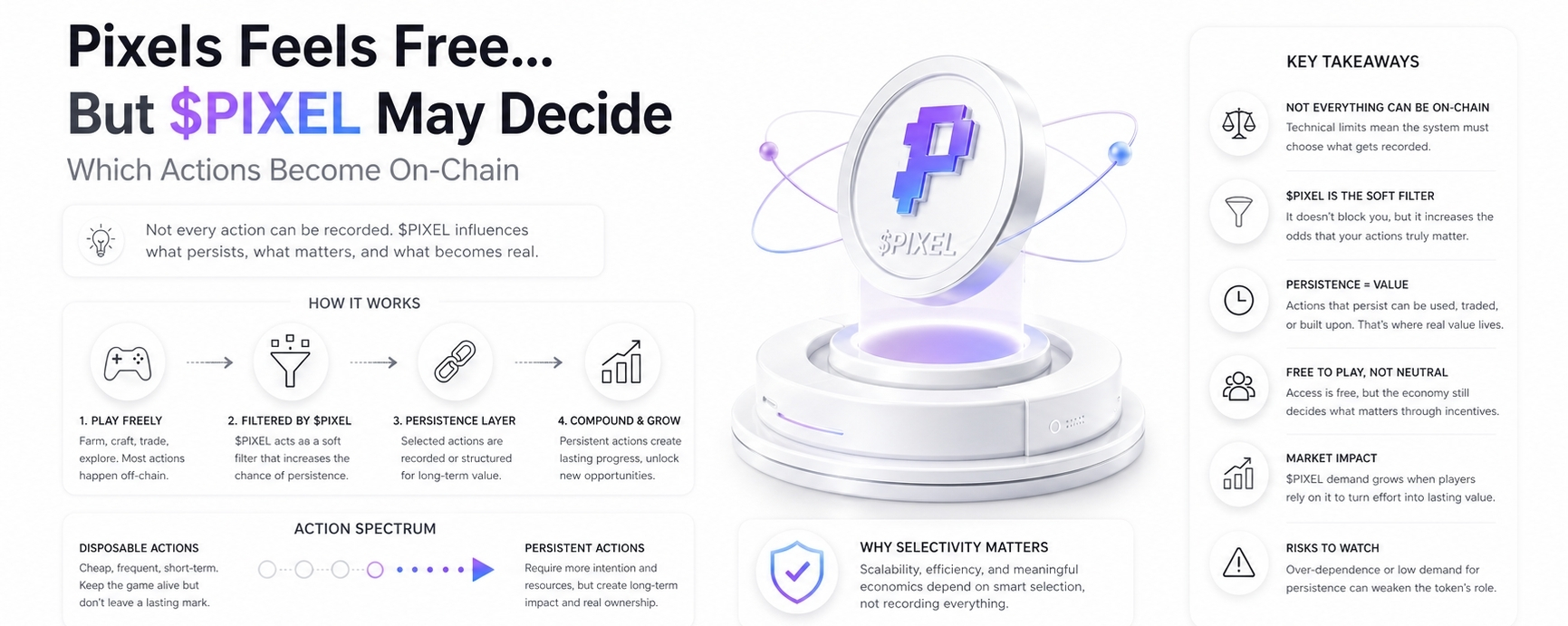
It starts to act less like a tool and more like a filter.
Not a hard gate that blocks you from playing, but a soft influence that increases the chances that your actions actually matter beyond the moment.
You can still play without it. You can grind, wait longer, and repeat cycles. Nothing breaks.
But when $PIXEL is involved, something shifts.
It’s not just about speed.
It’s about persistence.
Actions begin to carry more weight. They feel more likely to be recognized and carried forward.
And recognition here isn’t about visibility.
It’s about whether something lasts.
In most systems, recognition is tied to rewards or attention. In Pixels, it feels tied to whether an action stays within the gameplay loop or moves into a layer where it continues to matter.
Once an action becomes persistent, it changes its role entirely.
It stops being temporary gameplay and becomes part of the system’s evolving state.
This creates a spectrum rather than a simple yes-or-no structure.
Some actions are frequent and disposable. They keep the system active but don’t leave a lasting impact.
Others require more intention, more resources, or more commitment. These are the actions that persist and shape the long-term system.
Players move along this spectrum constantly, often without realizing it.
And the system quietly guides them.
This is where the idea of a “free economy” becomes more complex.
Pixels is free in terms of access. Anyone can participate without immediate cost.
But economically, it is still selective.
It still determines what matters.
The difference is that it does so through incentives instead of restrictions.
That makes the system feel open, even while it’s shaping behavior underneath.
From a market perspective, this changes how $PIXEL should be understood.
It’s not just tied to user numbers or transaction volume.
It’s tied to behavior.
Specifically, how often players choose to turn temporary effort into something that lasts.
If that behavior is rare, the token remains secondary.
But if it becomes habitual, if players start relying on it to make their actions meaningful, then the token becomes deeply integrated into the system.
It becomes part of the core loop.
This kind of design has clear strengths.
It allows the system to scale without overwhelming the blockchain. It maintains player freedom while still creating structure. It encourages valuable actions to rise naturally over time.
But it also carries risk.
If players begin to feel that their actions only matter when $PIXEL is used, the sense of freedom can weaken. The system may start to feel less open and more controlled.
Players are quick to sense that shift.
There’s also another possibility.
Many players may simply not care about persistence at all. They may prefer to stay within the gameplay loop, enjoying the experience without worrying about long-term impact.
If that happens, the demand for pushing actions into a persistent layer may never fully grow.
And if that demand doesn’t grow, the importance of the token may remain limited.
All of this points to a larger shift in how blockchain systems should be understood.
The focus is no longer just on how much gets recorded.
It’s about what gets selected.
Which actions are worth keeping?
Which ones shape the system over time?
And how are those decisions being made?
Pixels doesn’t answer these questions directly.
Instead, it allows player behavior to define the answer.
And within that process, Pixel appears to sit at a very important boundary, quietly influencing what the system chooses to remember.
That doesn’t make it just a currency.
It makes it part of the system’s memory.
And in a system where not everything can be recorded, memory becomes one of the most valuable resources of all.
