
I sometimes notice the quieter parts of a game before the bigger ones.
Not the main system. Not the biggest update. Not the feature everyone immediately points at. More the smaller activity that sits near the edge of the world and slowly gives players another reason to return. Fishing often feels like that in games. It is simple. It is repetitive. It does not always demand attention. But when it is done well, it gives a world a softer rhythm.
That is what I was thinking about with Pixels today.
Pixels is a social casual Web3 game powered by the Ronin Network. It is built around farming, exploration, creation, crafting, open-world movement, and the small routines players build over time. On the surface, it can look like a farming game first. You plant things, gather resources, complete tasks, and move through the world with other players around you. But after a while, the world starts to feel wider than farming alone.
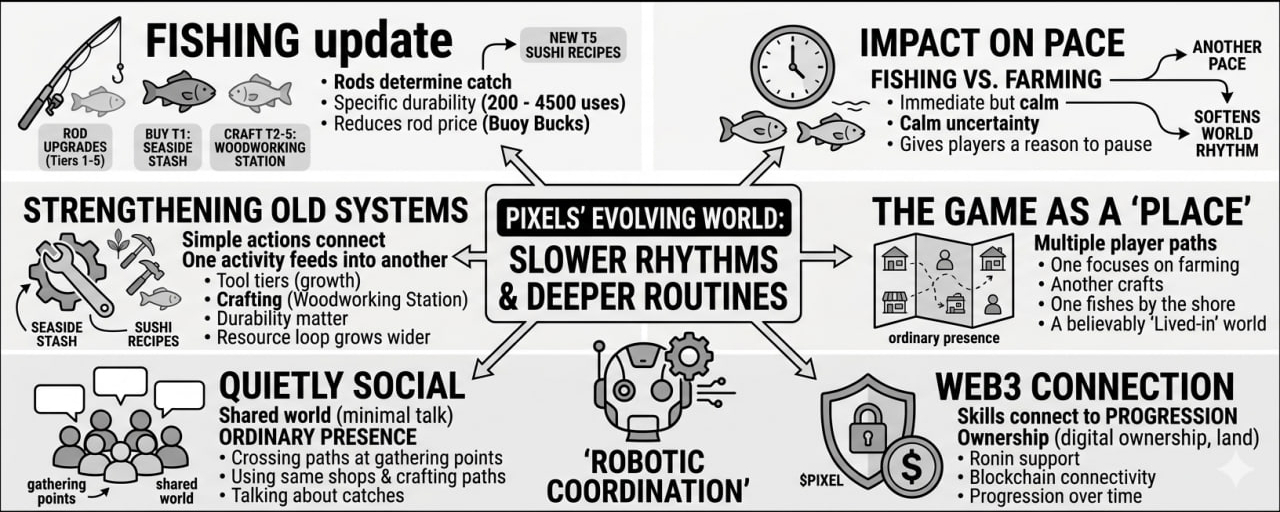
One recent update that caught my attention is the fishing change included in the Tier 5 update. The Pixels Post said Fishing Rods now have five tiers and can be upgraded. Players can buy a Tier 1 rod at the Seaside Stash, then craft Tier 2 through Tier 5 rods at the Woodworking Station. The rod tier decides which fish can be caught, and each tier also has its own durability, going from 200 uses at Tier 1 up to 4,500 uses at Tier 5. The same update also reduced the Fishing Rod price to 2,200 Buoy Bucks and added Sushi Kit Tier 5 recipes to the Seaside Stash. (pixelspost.substack.com)
I do not think every update needs to feel huge to matter.
Sometimes a system like fishing says something about the game’s direction. It shows that Pixels is not only adding more tasks, but also giving older activities more structure. A simple rod becomes something that can grow with the player. A fish is not just a random catch. It connects to tool tiers, crafting, durability, recipes, and the wider resource loop.
That is where it becomes interesting to me.
Fishing has a different feeling from farming. Farming is about waiting. You plant something and come back later. Fishing feels more immediate, but still calm. You stand somewhere, use a tool, and see what the world gives back. It has a small uncertainty to it. Maybe that is why it fits so naturally inside casual games. It gives the player something to do when they are not trying to rush.
Pixels already has many loops. Farming. Crafting. land management. Taskboard habits. Seasonal events. Social movement. But fishing adds another pace. It gives players a reason to spend time near a different part of the world. It makes the Seaside Stash feel more useful. It makes woodworking matter in another way. It gives sushi recipes more texture. A small system begins touching other systems.
I like that kind of design when it feels natural.
The best casual games are often built from simple actions that connect quietly. One activity feeds into another. One tool opens another routine. One resource becomes part of something the player did not fully think about at first. Pixels seems to be doing that with fishing now. The update does not turn fishing into the whole game, but it gives it a clearer place inside the world.
That matters because routine can get flat if every day feels the same.
A player may log in for crops. Then maybe they check tasks. Then maybe they move toward the shore because their rod has a purpose now. Maybe they start thinking about upgrading it. Maybe they craft a better one. Maybe they care about which fish they can catch. Maybe sushi becomes part of their routine. The change is not dramatic, but it creates another path through the day.
For me, that is where Pixels feels more like a place.
Not every player will follow the same loop. One person may focus on farming. Another may care about crafting. Another may spend time with land systems. Another may enjoy events. Another may start building a routine around fishing. The world becomes more believable when different players have different reasons to move through it.
The social side shows up quietly here too.
Fishing does not have to be a loud group activity to feel social. It can be enough to see other players near the same area, using the same space, following the same update, or talking about what they caught and what they need next. A shared world does not always need constant conversation. Sometimes it only needs small overlapping routines.
That is something Pixels understands better than many Web3 games.
The social feeling is not only about big communities or official campaigns. It is also about ordinary presence. People being there. People returning. People using the same shops, resources, and crafting paths. A game starts to feel lived in when players have enough little reasons to cross paths.
Fishing can help with that.
It gives the world another gathering point without needing to force it. It makes the shore, the Seaside Stash, and related crafting stations feel more connected to daily life. It also gives players who enjoy slower play another activity that fits the tone of the game.
The Web3 side is still present, but I think it works best when it stays grounded. Pixels has digital ownership, land, assets, and the PIXEL token. Ronin supports the game underneath. The Ronin marketplace describes Pixels as an open-ended world of farming and exploration where players gather resources, advance skills, build relationships, and connect blockchain ownership with progression. (marketplace.roninchain.com)
That description feels especially fitting here because fishing is not only a side action anymore. It connects to progression. It connects to skills and crafting. It gives the player another way to feel that their tools and choices matter over time.
Still, I do not think every player will care about the fishing update. Some may ignore it completely. Some may only care if it helps with tasks or recipes. Some may prefer farming because it feels more central. That is fine. A game like Pixels does not need every system to matter equally to everyone.
The point is that the world keeps gaining small layers.
That is what I keep noticing. Pixels does not become more interesting only through large announcements. It also becomes more interesting when a quiet activity gets more depth. When fishing rods have tiers. When durability matters. When a shop restock changes what people do. When a recipe gives an old routine a new reason to exist.
These are not loud changes.
But they can shape how players spend their time.
And in a game built around daily habits, time is the thing that matters most. A few minutes fishing. A few minutes farming. A few minutes crafting. A few minutes seeing what other players are doing. Slowly, those minutes become the texture of the world.
That is where Pixels feels strongest to me today.
Not because fishing suddenly explains the whole game, but because it shows how a simple loop can become part of a larger rhythm. The shore becomes a little more useful. The rod becomes a little more personal. The world gets one more quiet reason to feel familiar.
Still watching the small coastal routines forming around
$PIXEL #pixel @Pixels