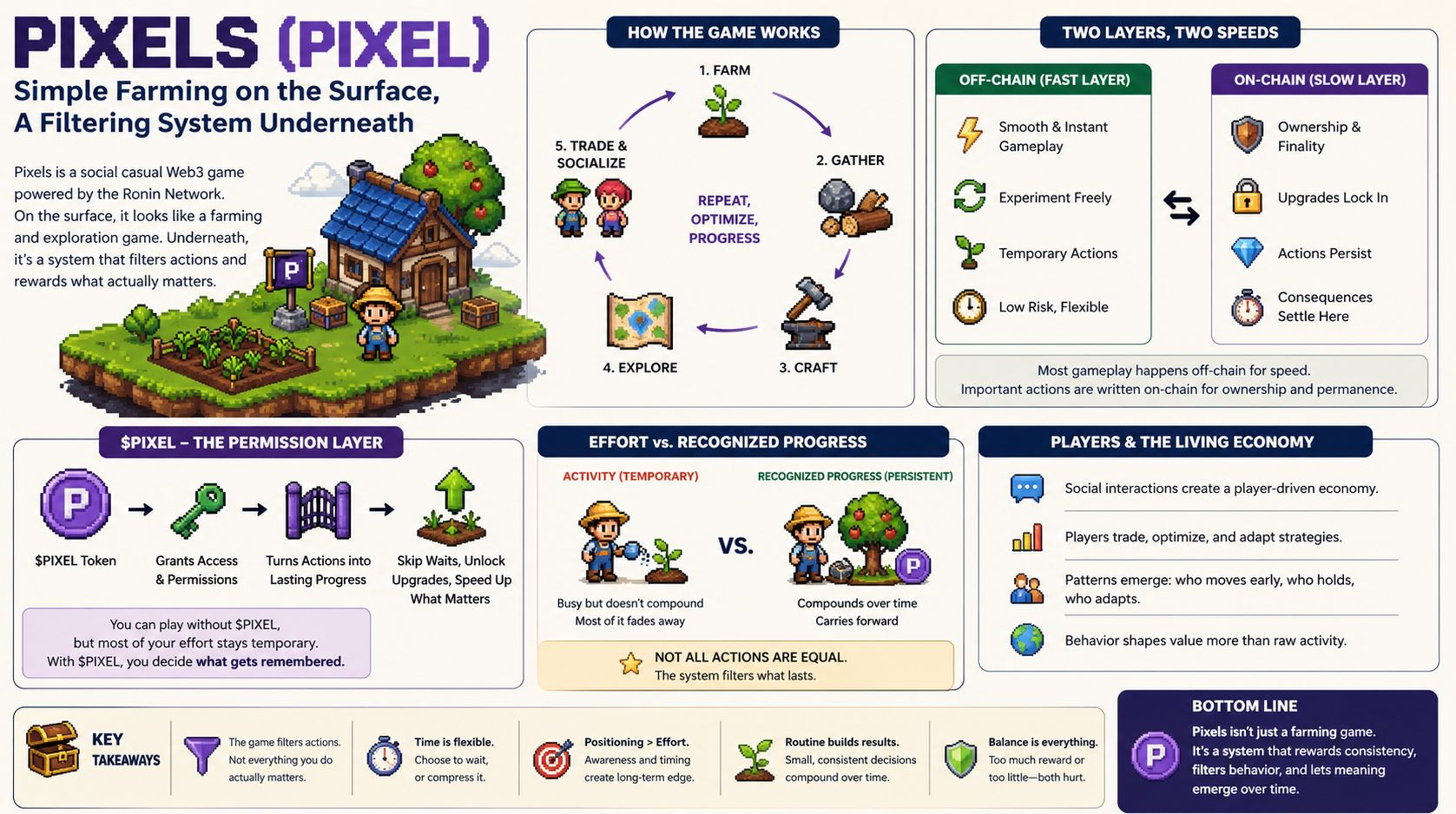

Let’s not overcomplicate it. Pixels looks like a simple farming game when you first open it. Plant crops. Harvest. Craft a few things. Walk around. Done.
That’s what most people see. And that’s exactly why they misread it.
Because the real system doesn’t show itself upfront.
The game runs on the Ronin Network, but here’s the part that actually matters—the chain stays out of your way most of the time. No constant wallet spam. No friction every two minutes. You play like it’s a normal game. Fast, smooth, almost too easy.
But that ease is selective.
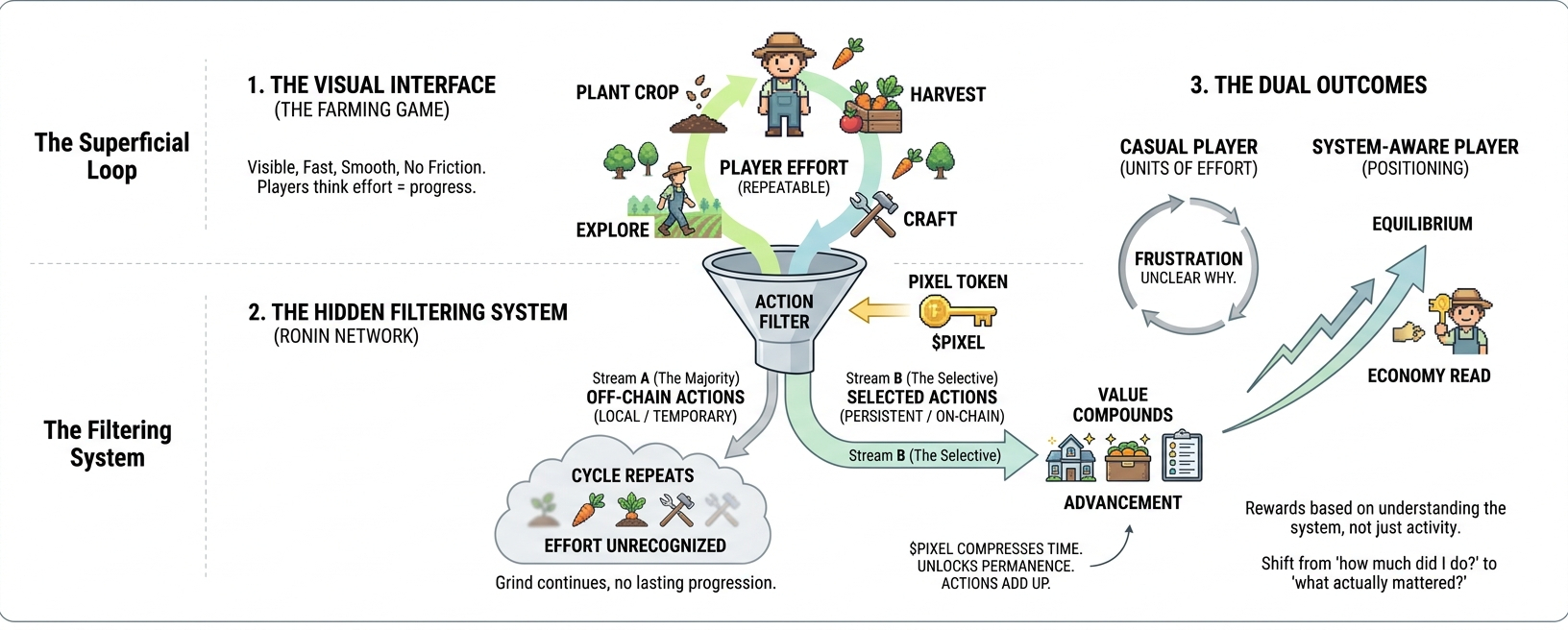
Most of what you do lives off-chain. It’s temporary. Flexible. You can grind, experiment, waste time if you want. Nothing stops you. But not everything you do is treated equally by the system. That’s the part people miss.
You think effort is enough. It’s not.
Spend a few days inside and you’ll start noticing something uncomfortable. Two players. Same hours. Same actions. Different outcomes. Not just in rewards—but in what actually sticks. One moves forward. The other just cycles.
Why?
That’s where things actually get interesting.
The system doesn’t reward activity. It filters it.
Some actions compound. Others get quietly ignored. No warning. No message saying “this didn’t matter.” It just… doesn’t carry forward. And if you’re not paying attention, you’ll keep repeating the same loop thinking you’re progressing.
You’re not. You’re just busy.
Now bring in $PIXEL.
Most people treat it like any other token—earn it, maybe sell it, move on. That’s a shallow read. In practice, it acts more like a gate. A way to push certain actions out of the temporary loop into something that actually persists.
You don’t need it to play. That’s true.
But without it? Most of your effort stays local. Useful in the moment, gone later.
With it, things change. You unlock upgrades, skip delays, speed up production. More importantly, you decide what gets remembered. That’s a very different role from a basic reward token.
It turns time into something flexible.
Wait… or pay to compress that wait. Grind slowly… or move at key moments. It’s not about winning instantly. It’s about positioning yourself better inside the system. And that gap—between effort and positioning—is where most players fall behind.
Here’s the part most people overlook.
The game never explains this directly.
There’s no tutorial saying “this is how value actually works.” You figure it out the hard way. Through missed opportunities. Through watching others move ahead with what looks like the same effort. That friction? It’s intentional.
Because if everyone understood it immediately, the system wouldn’t work.
There’s also a social layer, but it doesn’t scream for attention. You start recognizing names. Seeing patterns. Who trades early. Who holds. Who rotates strategies when things shift. It stops feeling like a solo grind pretty quickly.
It starts feeling like a quiet economy.
But let’s not pretend it’s perfect.
The real problem, though, is balance. Always is. If rewards lean too high, players extract value and leave. If rewards tighten too much, engagement drops. Pixels is sitting in that tension right now, adjusting as it goes. You can feel it in the pacing. Some days it flows. Other days it drags.
That’s not a flaw. That’s a live system trying to find equilibrium.
Still, there’s risk here.
If the gap between “effort” and “recognized effort” becomes too wide, casual players will lose interest. Not everyone wants to study a system just to keep up. And if only the most aware players benefit, the experience can start feeling uneven.
That’s a line they have to manage carefully.
What Pixels gets right, though, is restraint. It doesn’t chase hype. No constant noise, no forced excitement. It leans into routine. You log in, do small things, leave. Come back later. Repeat.
Sounds boring. It isn’t.
Because over time, those small decisions start stacking. And eventually, you notice the shift. You stop asking “how much did I do today?” and start asking “what actually mattered?”
That’s when the game changes.
Not on the screen—but in your head.
At that point, it’s no longer just a farming loop. It’s a system you’re trying to read, predict, and adapt to. And honestly, that’s what makes it interesting.
Not the crops. Not the crafting.
The fact that it doesn’t reward everyone equally—and doesn’t pretend to.