
I want to be honest about something first.
I came into this wrong.
When I started paying attention to Pixels I was doing what most people do with game tokens. Looking at the chart. Checking player numbers. Reading tokenomics summaries. Forming opinions based on the kind of surface information that feels like research but isn't really. I had a mental model of what Pixels was and I was fitting everything I read into that model rather than letting the information change the model.
That's a bad way to understand anything. It took me longer than it should have to notice I was doing it.
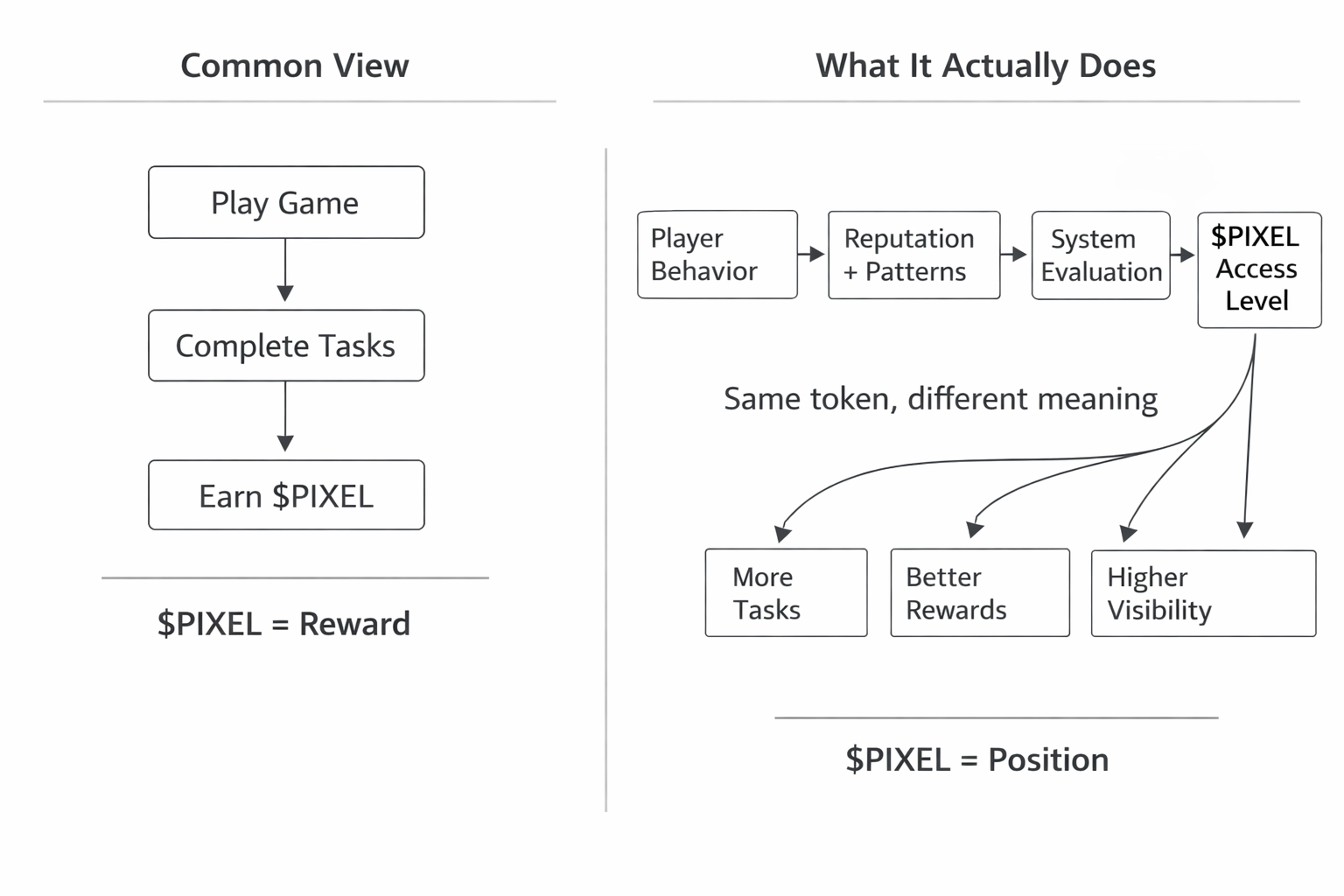
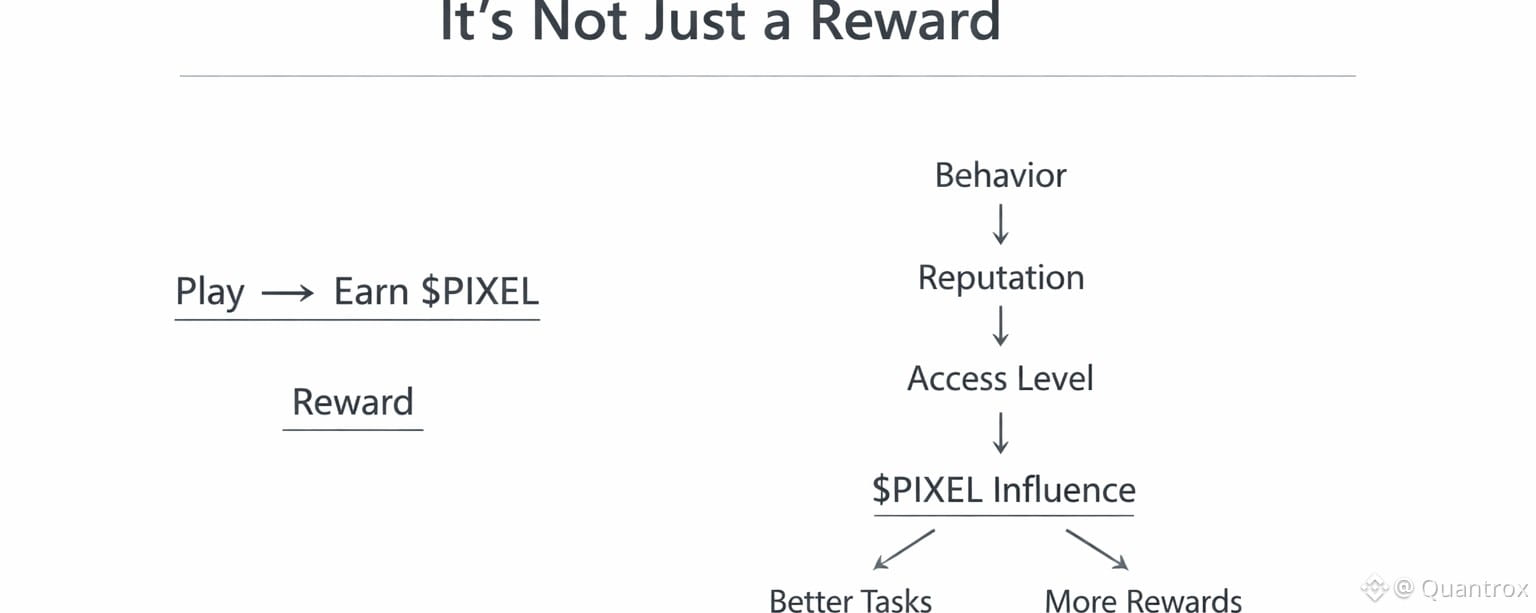
The thing that broke the model wasn't a price movement or a big announcement. It was something much smaller. I was reading through how the task board actually works — the specific mechanics, the 24 hour refresh, the way $PIXEL task access is distributed unevenly across the player base based on signals I didn't fully understand at first — and I realized I had been thinking about PIXEL as a reward.
Something you receive for doing things inside the game.
But that's not really what it is. Or at least it's not the most important thing it is.
The more I sat with it the more PIXEL started looking less like a reward and more like a positioning mechanism. Something that determines where you sit inside the ecosystem relative to everyone else. Not your wallet balance exactly. More like… how much of the ecosystem's attention you've earned. Which parts of it you get access to. How the system routes value toward you or past you depending on patterns you built over time.
That reframe sounds abstract until you look at specific details.
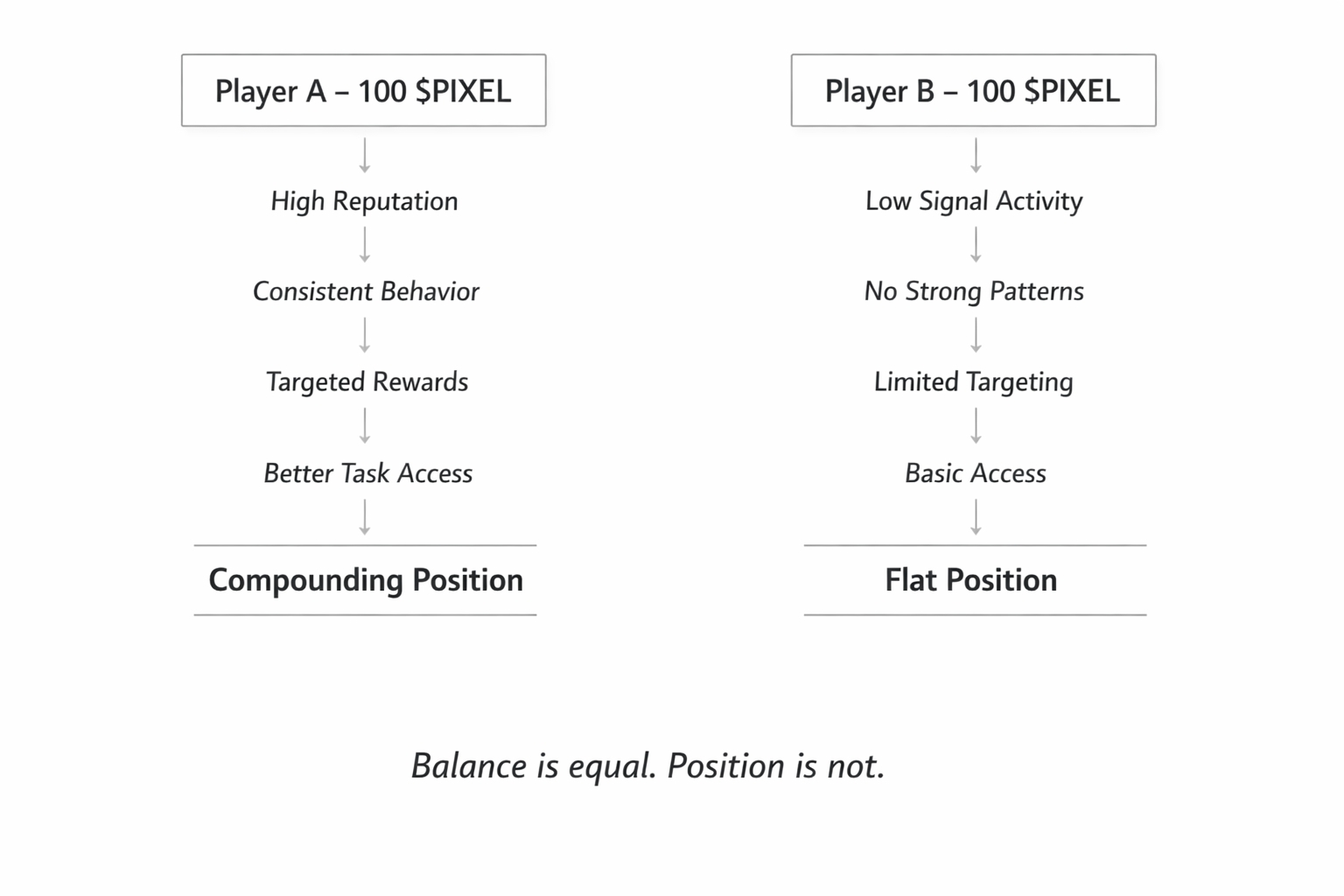
The reputation system doesn't just track what you did. It tracks how you did it. Whether your patterns look like someone who is genuinely inside the game versus someone running through it mechanically. And reputation affects PIXEL access in ways that compound over time. A player with strong reputation sitting on consistent activity gets routed differently by the system than a new player with identical token balance.
Same PIXEL. Different position.
That asymmetry kept nagging at me.
Because it means two people holding the same amount of PIXEL are not holding the same thing. The token balance is identical. But the ecosystem position those tokens represent is completely different depending on the behavioral history attached to the wallet holding them.
I haven't seen that framed explicitly anywhere in Pixels' documentation. But it follows from the design logic clearly enough that I'm fairly confident it's intentional rather than emergent.
And then Stacked adds another layer that makes this even stranger to think about.
Stacked's targeting system doesn't treat all players equally. It identifies which players are worth investing in at which moments. The players the system decides are worth a targeted reward are players whose behavioral patterns made them visible to the system as genuine. Players who never built that visibility — who stayed in the Coin loop, never interacted with the PIXEL layer in meaningful ways, never accumulated the kind of consistent patterns the system recognizes — those players exist inside Pixels but the system's most valuable interventions flow past them.
So there are effectively two games happening simultaneously inside Pixels.
The visible one. Farming, crafting, trading, exploring. Anyone can play it. The Coin loop runs. Progress happens. It's a real game and it's genuinely enjoyable on its own terms.
And then the less visible one. Where PIXEL is functioning as the medium through which the ecosystem decides whose behavior is worth amplifying, whose patterns are worth routing rewards toward, whose position inside the system compounds over time rather than resetting each session.
Most players are in the first game. Some players, probably without fully understanding why, are in both.
I'm not sure that's a problem exactly. It might be exactly right. A system that rewards genuine long term engagement over mechanical short term extraction should create these kinds of layered outcomes. The players who show up consistently and interact with the ecosystem's deeper mechanics should end up in a different position than the players who farm the surface and leave.
But it does mean PIXEL is doing something more interesting and more complicated than most token analysis acknowledges.
It's not just a currency. It's not just a governance mechanism. It's not just a staking asset.
It's the layer through which the ecosystem sorts players into positions it considers worth investing in versus positions it's largely indifferent to.
And the players who understand that — who recognize that their behavior inside Pixels is building something that their token balance alone doesn't capture — are probably the ones the system is quietly routing its most valuable attention toward.
I don't know if that makes PIXEL a good investment on any particular timeline. Honestly I've stopped thinking about it primarily in those terms. The price will do what it does based on factors that have very little to do with the elegance of the underlying design in the short run.
What I do think is that Pixels built something genuinely unusual. A game economy that treats player behavior as more valuable than player spending. That tries to distinguish between attention that compounds the ecosystem and attention that just passes through it. That routes its most valuable resources toward the former and lets the latter exist without particularly caring about it.
$PIXEL is the token sitting at the center of that sorting process.
And I think most people holding it are underestimating how strange and interesting that actually is.