
@Pixels I do not see Pixels as just another Web3 farming game anymore.
At first, it is easy to #pixel describe it that way. You plant crops, collect resources, craft items, walk around, and slowly build your place in a colorful online world. It has that soft farming-game feeling where small tasks become part of a routine.
But the more I look at Pixels, the more I think the real story is not the farming.
The real story is whether a game economy can learn how to reward people without destroying itself.
That is why Stacked, $PIXEL Pixels’ AI-powered reward system, stands out to me. It feels less like a normal feature and more like an experiment in economic discipline. In older play-to-earn games, rewards often worked like a leaking tap. Anyone who stood under it long enough collected tokens. The system did not always care whether the player was helping the game grow or simply draining value from it.
Pixels seems to be moving away from that.
With Stacked, the question becomes more intelligent:
Not “who played?” but “who made the world more valuable by playing?”
That is a very different way to think about rewards.
A player can be active without being useful to the ecosystem. Someone can grind tasks all day, sell everything, withdraw rewards, and vanish. On a dashboard, that may look like engagement. But inside the game, it can feel like someone harvesting from a field they never intend to care for.
Another player may not be the loudest grinder. They might join events, trade with others, decorate their land, bring friends in, craft items, spend inside the ecosystem, and simply make the world feel more alive. That kind of player is harder to measure, but much more valuable.
This is where I think Stacked becomes important.
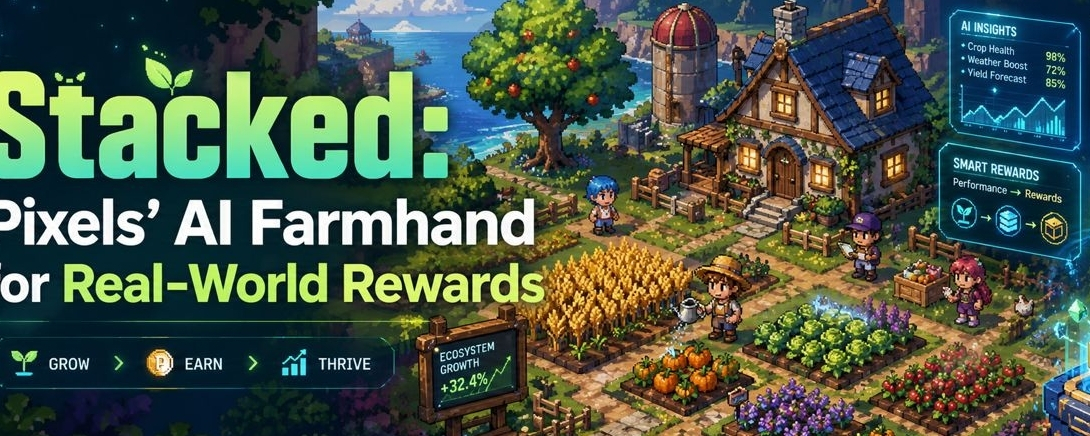
To me, Stacked is like a farmhand who has worked the same land for years. It does not just throw water everywhere. It notices which part of the field is dry, which crop is weak, which soil is overused, and which weeds are quietly spreading. The goal is not only to grow more crops today. The goal is to make sure the farm still produces next season.
That is exactly the kind of thinking Web3 gaming needs.
Because token rewards can be dangerous. They bring attention quickly, but they can also attract people who care only about extraction. If the reward system is too simple, players will optimize around it. And when players optimize only for withdrawal, the game slowly stops feeling like a world and starts feeling like a machine.
Pixels cannot afford to become a machine.
Its strength is that it feels like a place. Terra Villa, land ownership, farming loops, crafting, avatars, social activity, and the Ronin ecosystem all give Pixels a village-like identity. That identity is valuable because players do not stay in games only for payouts. They stay because the world gives them habits, status, community, and small reasons to return.
This is why I find the idea of Stacked more meaningful than a basic reward update. It suggests Pixels is trying to reward the behaviors that protect the village, not just the actions that empty the treasury.
The PIXEL token is central to this. PIXEL is not just a reward sitting at the end of a task. It connects to staking, governance, spending, ecosystem incentives, and player participation. With vPIXEL designed around in-game use, Pixels appears to be pushing toward an economy where value circulates instead of immediately leaving the system.
That detail matters more than many people realize.
A game economy dies when everything becomes an exit. If every reward becomes something to claim, sell, and forget, then the game is only a distribution channel. But if rewards lead players back into upgrades, crafting, events, social status, land progression, and marketplace activity, then the token becomes part of the world’s bloodstream.
That is the difference between a game that pays people and a game that has an economy.
Ronin also gives Pixels a useful base. Ronin was built around gaming behavior, not just speculation. Low-friction transactions, NFT ownership, marketplace activity, and a community already familiar with Web3 games all make it easier for Pixels to operate like a living economy. A game like Pixels depends on many small actions, so the chain underneath it needs to feel almost invisible.
Still, infrastructure is only the road. It does not decide where people go.
That is why Pixels’ reward design matters so much. A smooth chain can make rewards easier to move, but only a thoughtful economy can make rewards worth keeping inside the game.
What I like about Stacked is that it seems to recognize a truth that early GameFi ignored:
Not all activity is equal.
One click can be empty. Another click can create value. One player can farm resources in a way that weakens the economy. Another can farm, craft, trade, and reinvest in a way that supports the whole loop. The action may look similar from the outside, but the impact is different.
AI can help Pixels study that difference at scale.
Of course, this does not mean Stacked will automatically solve everything. AI is not magic dust. If the game lacks good sinks, meaningful progression, strong social reasons to stay, or fair communication, even a smart reward system will struggle. A clever farmhand cannot save dead soil alone.
Pixels still has to make the game itself deeper.
But Stacked gives the project a sharper tool. Instead of rewarding everyone with the same flat logic, Pixels can gradually move toward more personalized, behavior-aware incentives. Rewards can become less like a public faucet and more like targeted irrigation.
That is the version of Web3 gaming I find more believable.
Not a world where everyone gets paid for clicking.
A world where the system learns which actions make the game healthier and rewards those actions with more precision.
There is one risk, though, and it is important. If players do not understand why rewards change, Stacked could feel unfair. In crypto, people are sensitive to hidden systems. They want transparency, predictability, and proof that rules are not being changed against them. If an AI reward layer feels too mysterious, it may create suspicion instead of trust.
So Pixels has to walk carefully.
The system should be smart, but not invisible in the wrong way. Players do not need every technical detail, but they do need a clear sense of what the game values. If contribution matters, define contribution. If spending, crafting, social behavior, events, or retention influence rewards, communicate that clearly enough for normal players to understand.
Trust is part of the economy too.
My personal view is that Stacked matters because it shows Pixels trying to mature beyond the first generation of Web3 gaming. The first generation asked, “Can players earn?” The better question now is, “Can earning make the game stronger?”
That is the question Pixels is trying to answer.
And because Pixels is a farming game, the metaphor is almost perfect. You cannot harvest forever without caring for the land. You cannot reward forever without caring for the economy. You cannot build a lasting world if every player is trained to take more than they return.
Stacked is Pixels trying to care for the soil beneath its own token economy.
That is why I see it as more than an AI feature. It is a statement about where Web3 games may be heading. Less noise, less blind emissions, less reward farming for its own sake. More intelligent incentives, more ecosystem-aware participation, and more focus on the players who actually make the world worth returning to.
Pixels’ biggest challenge is not getting people to farm.
It is getting people to care about the farm.
If Stacked can help with that, then Pixels may become something more durable than a reward game. It may become a living economy where play, ownership, and contribution finally begin to work together.
