
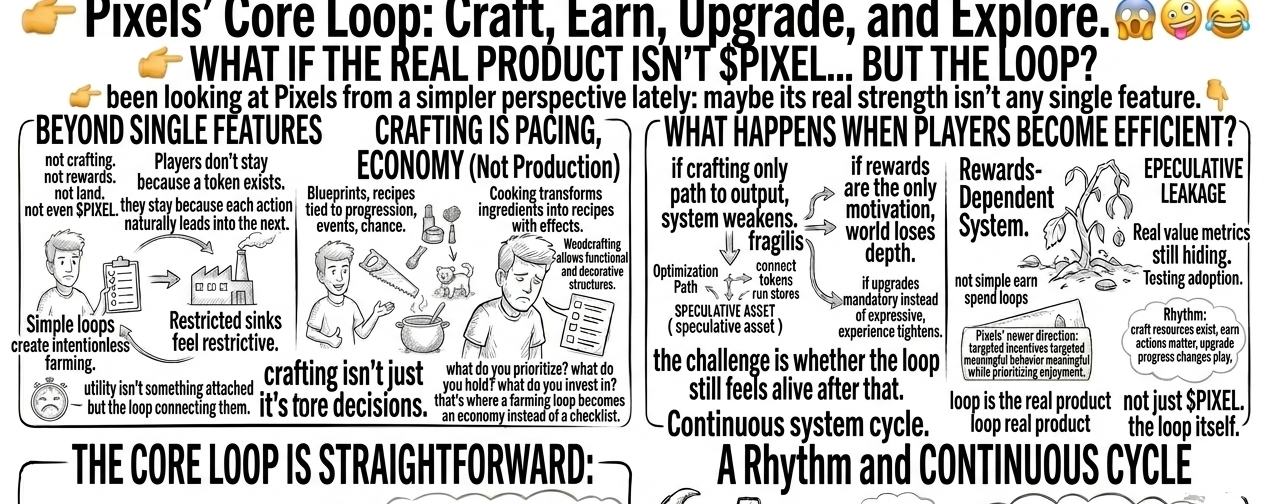
👉 what if the real product isn’t $PIXEL… but the loop?
been looking at Pixels from a simpler perspective lately: maybe its real strength isn’t any single feature.
not crafting.
not rewards.
not land.
not even $PIXEL.
it’s the loop connecting them.
a lot of Web3 projects treat “utility” like something you can attach later. add rewards, plug in staking, launch a marketplace, introduce sinks—and suddenly the system is expected to feel complete. but that’s not how games hold attention. players don’t stay because a token exists. they stay because each action naturally leads into the next.
that’s where Pixels stands out.
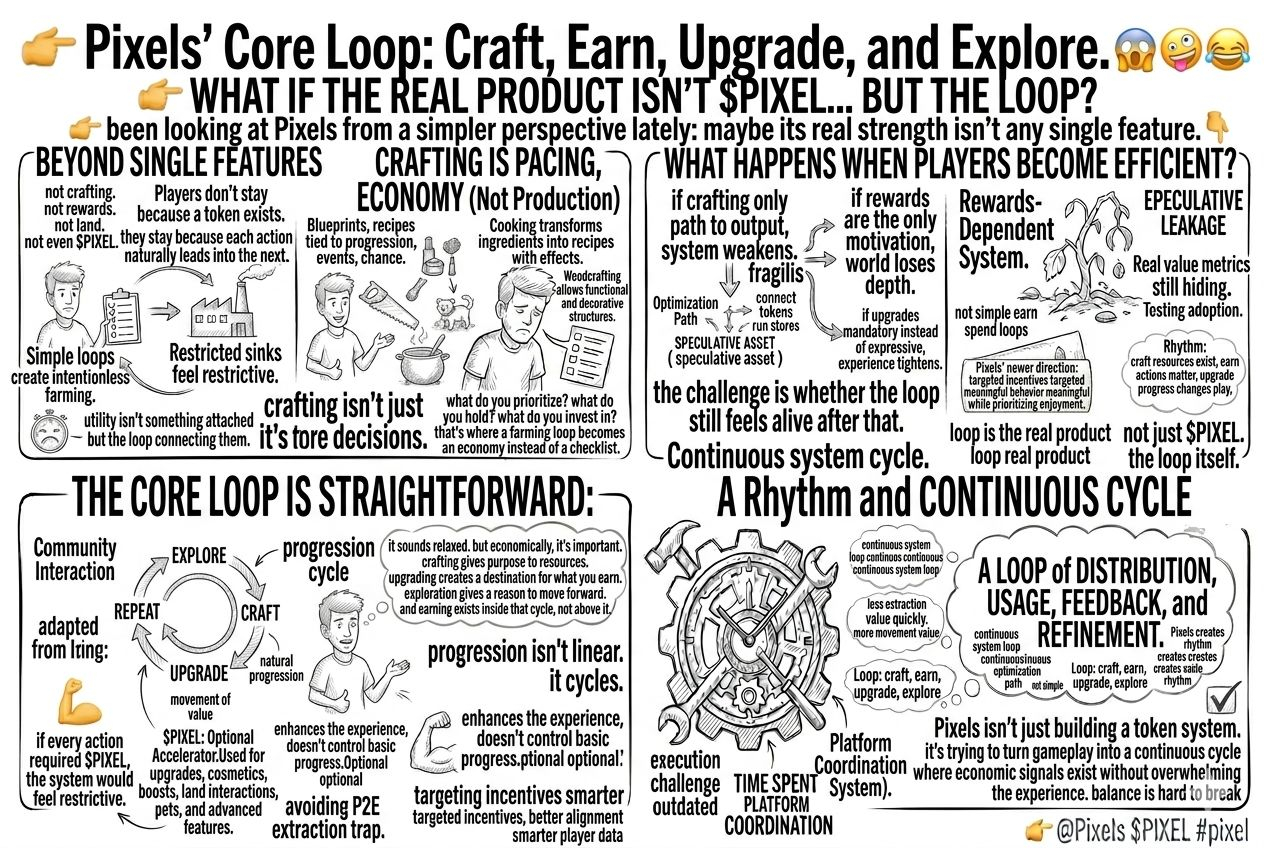
on the surface, the loop is straightforward: craft, earn, upgrade, explore. but underneath that simplicity is a deeper design choice. progression isn’t meant to feel linear. it’s meant to cycle. you gather resources, use them, improve your setup, unlock more possibilities, and move further into the world.
it sounds relaxed.
but economically, it’s important.
crafting gives purpose to resources beyond collecting them. upgrading creates a destination for what you earn. exploration gives a reason to move forward instead of repeating the same actions endlessly. and earning exists inside that cycle, not above it.
that shift changes everything.
crafting, in particular, does more than it appears. progression unlocks new materials, items, and systems over time. cooking transforms ingredients into recipes with effects, while woodcrafting allows players to build functional and decorative structures. blueprints and recipes become goals tied to progression, events, or chance.
so crafting isn’t just production.
it’s pacing.
it forces decisions. what do you prioritize? what do you hold? what do you invest in? that’s where a farming loop becomes an economy instead of a checklist.
then $PIXEL enters the system—but not as the center.
it acts more like a premium layer. used for upgrades, cosmetics, boosts, land interactions, pets, and advanced features, it enhances the experience rather than controlling basic progress. players don’t need it to move forward, but they can use it to move faster or express more.
that distinction matters.
if every action required $PIXEL, the system would feel restrictive. but when it mainly amplifies engaged players, it becomes an optional accelerator instead of a barrier.
that avoids a common trap.
older play-to-earn models rewarded activity and then struggled when players optimized purely for extraction. Pixels seems to recognize that pattern. its newer direction focuses on targeted incentives, better alignment, and rewarding meaningful behavior while still prioritizing enjoyment.
the real question is what happens when players become efficient.
early loops always feel engaging. gather, craft, upgrade, explore. simple and satisfying. but advanced players eventually break systems down into numbers. they optimize timing, resources, and outcomes.
that’s normal.
the challenge is whether the loop still feels alive after that.
if crafting becomes only a path to output, the system weakens.
if rewards become the only motivation, the world loses depth.
if upgrades feel mandatory instead of expressive, the experience tightens too much.
but if each layer continues to feed the next naturally, something stronger forms.
a rhythm.
craft because resources exist.
earn because actions matter.
upgrade because progress changes play.
explore because there’s always another layer.
that’s the part that gets overlooked.
Pixels isn’t just building a token system.
it’s trying to turn gameplay into a continuous cycle where economic signals exist without overwhelming the experience itself.
hard balance.
easy to break.
but if it works, the core loop becomes the real product.
not just $PIXEL.
the loop itself.
$PIXEL #BinanceLaunchesGoldvs.BTCTradingCompetition #StrategyBTCPurchase #EthereumFoundationUnstakes$48.9MillionWorthofETH #AaveAnnouncesDeFiUnitedReliefFund $SIREN