
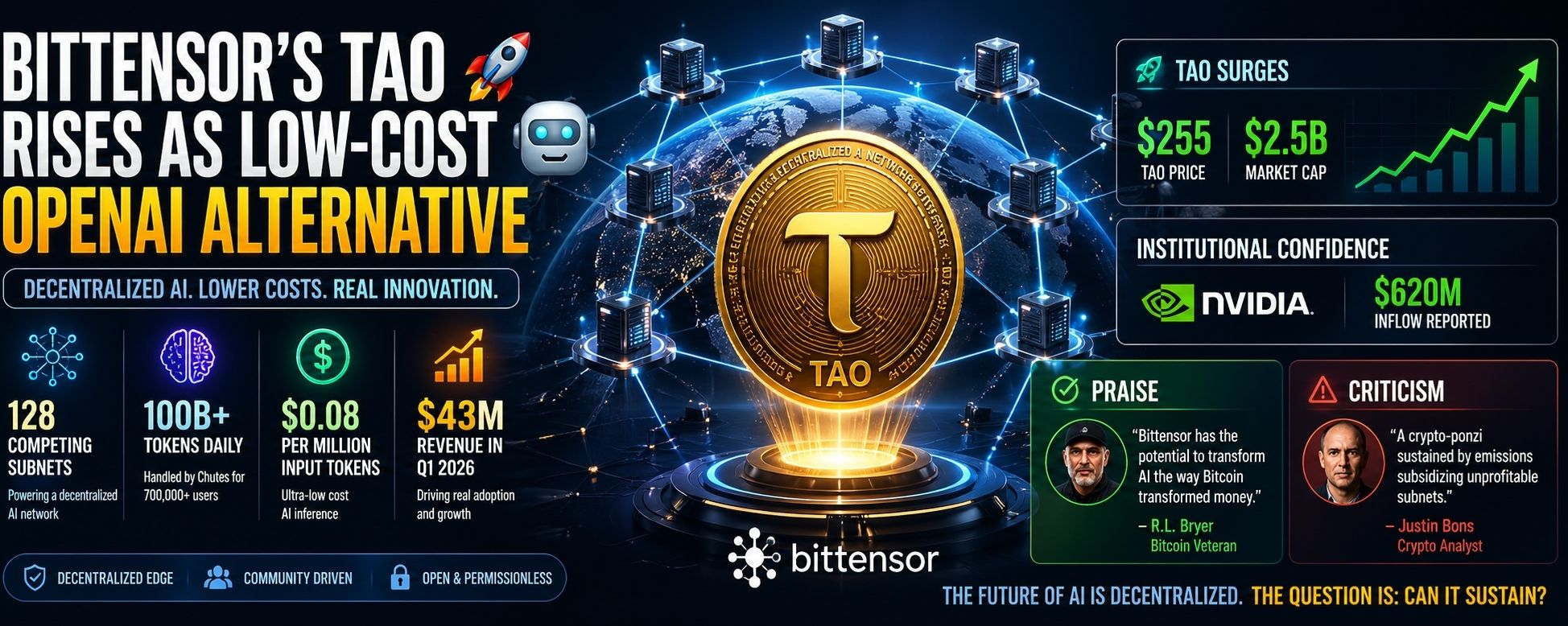
In a rapidly evolving artificial intelligence landscape, a new contender is challenging the dominance of centralized AI giants. Bittensor, a blockchain-based network, is gaining attention as a low-cost, decentralized alternative to traditional AI platforms like OpenAI. At the heart of this ecosystem lies its native token, TAO, which has recently surged in both value and relevance.
🌐 What is Bittensor?
Bittensor operates as a decentralized network composed of 128 subnets, each functioning as a competitive marketplace for AI models and inference services. Instead of relying on a single corporate entity, developers and miners collaborate and compete to produce useful machine learning outputs.
Miners on the network earn TAO tokens by contributing AI models or processing inference requests. This creates a self-sustaining economy where performance and utility directly influence rewards.
⚡ Ultra-Low Cost AI at Scale
One of Bittensor’s biggest advantages is its cost efficiency. Platforms like Chutes—built on the Bittensor network—are reportedly processing over 100 billion tokens daily for around 700,000 users, charging only $0.08 per million input tokens.
Compared to traditional AI APIs, this pricing model is significantly cheaper, making AI more accessible to developers and businesses worldwide.
📈 Explosive Growth and Market Momentum
The network’s financial performance reflects its growing adoption:
💵 $43 million revenue in Q1 2026
📊 TAO token price reached $255
🪙 Market cap climbed to $2.5 billion
This surge has attracted institutional attention, including reported inflows of $620 million from Nvidia, signaling confidence in decentralized AI infrastructure.
🧠 Industry Voices: Praise and Criticism
Not everyone agrees on Bittensor’s long-term viability.
On the bullish side, Bitcoin veteran R. L. Bryer compares Bittensor’s impact on AI to what Bitcoin did for money—decentralizing control and empowering participants globally.
However, critics like Justin Bons argue that the model may rely too heavily on token emissions to sustain unprofitable subnets. He has gone as far as labeling it a “crypto Ponzi,” raising concerns about long-term sustainability.
⚖️ The Big Question: Revolution or Risk?
Bittensor sits at the intersection of two powerful trends: blockchain and artificial intelligence. Its decentralized model challenges traditional AI economics by distributing both computation and rewards across a global network.
But the key question remains:
👉 Can it sustain real demand without relying on token incentives?
If Bittensor succeeds, it could reshape how AI is built, distributed, and monetized. If it fails, it may serve as a cautionary tale of hype outpacing fundamentals.
🔮 Final Thoughts
Bittensor’s TAO surge isn’t just about price—it represents a broader shift toward decentralized innovation in AI. Whether it becomes the “Bitcoin of AI” or fades under scrutiny will depend on its ability to deliver real, scalable value beyond incentives.
For now, the world is watching closely 👀
