
HOW IT WORKS 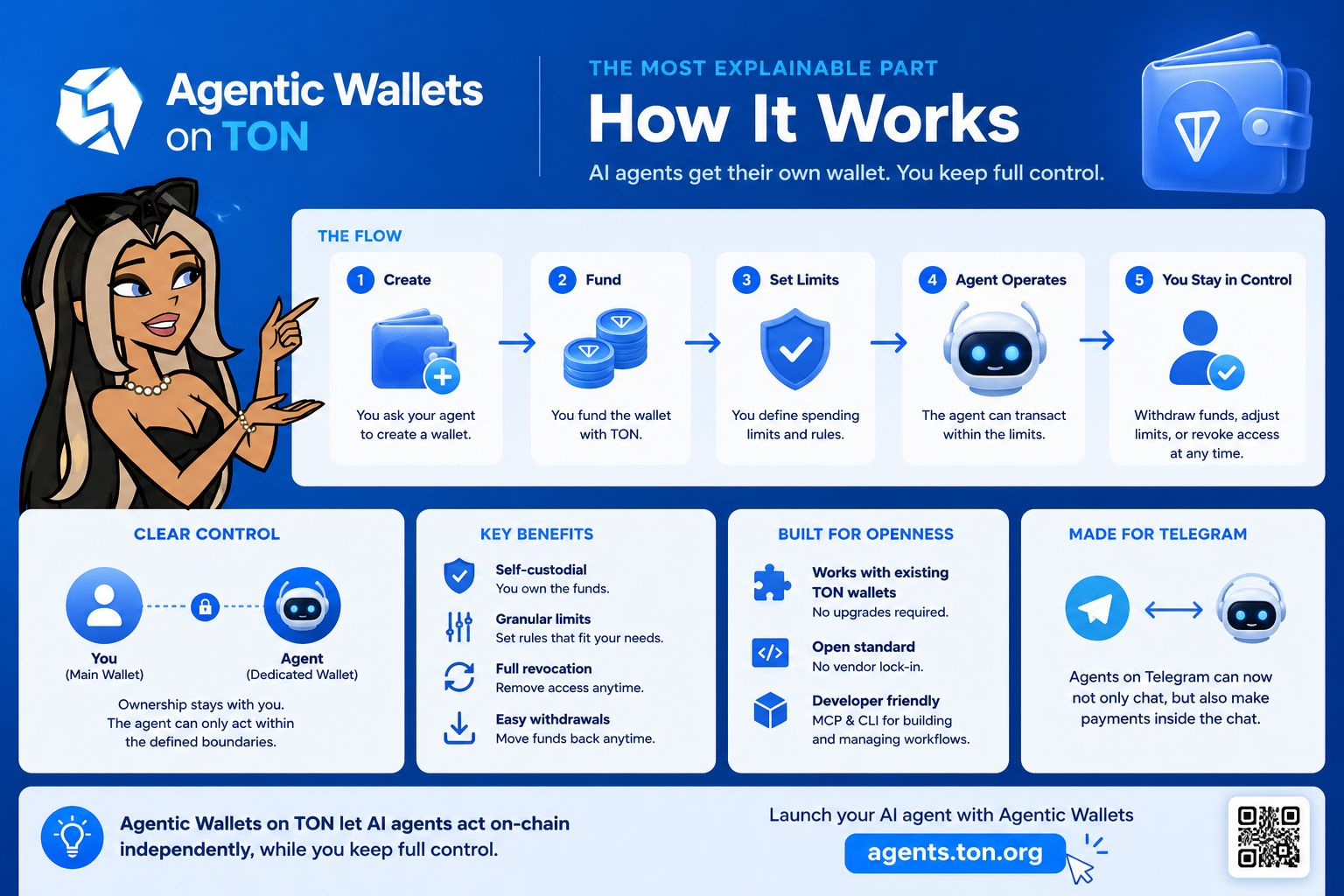
Agentic Wallets introduce a structure where an AI agent is given its own on chain wallet, separate from the user’s primary wallet. Instead of acting as a tool that constantly asks for permission, the agent operates within a defined boundary. The user funds the agent’s wallet and sets the limits, while still retaining full ownership and control. This separation matters because it creates a clear distinction between authority and execution. The user remains in charge, but the agent is allowed to act independently within agreed conditions.
The setup reflects a straightforward flow. A user requests wallet creation through an agent, funds it, and confirms the configuration. After that, the agent can begin transacting without interrupting the user for every step. At any point, funds can be withdrawn and access can be revoked. Control is not transferred away. It is structured in a way that allows delegation without losing custody.
What makes this approach practical is its compatibility with existing TON wallets. There is no requirement for upgrades or migration to a new system. Developers can integrate the standard into their own applications without being tied to a specific provider. This removes a common barrier where infrastructure decisions limit flexibility. The inclusion of MCP and CLI tools also means developers can build, test, and manage agent workflows in a controlled environment rather than relying on abstract concepts.
The integration with Telegram gives the concept immediate use. Telegram already supports bot interactions, and recent updates allow bots to communicate with each other. Agentic Wallets extend this by enabling financial actions within the same environment. An agent is no longer limited to responding to messages. It can complete transactions directly in the flow of conversation. This shifts the role of bots from passive responders to active participants in digital operations.
From a structural perspective, the design focuses on balance. Autonomy is introduced without removing oversight. The agent has enough independence to be useful, but not enough to override the user’s authority. This is essential for any system that combines financial control with automated decision making. Without that balance, either the system becomes too restrictive to be useful or too loose to be trusted.
Agentic Wallets represent a step toward making AI agents function as operational tools rather than simple interfaces. By giving them controlled access to funds, the system reduces friction while maintaining clear ownership boundaries. It is a practical approach to a problem that has limited the real use of automated agents in financial contexts.
If you want to explore how this works in practice, you can create and test your own agent here
agents.ton.org
𝐎𝐟𝐟𝐢𝐜𝐢𝐚𝐥 𝐑𝐞𝐬𝐨𝐮𝐫𝐜𝐞𝐬:
Official Site: ston.fi
Technical Documentation: docs.ston.fi
Analytics Dashboard: dune.com/stonfi
Follow for News: x.com/ston_fi
Community Chat: t.me/ston_fi