
Someone quietly pulled $4.85 million worth of $USDC STO off Binance and turned a $125 million token into a $1.7 billion headline overnight.
The token was StakeStone (STO) — the governance token of an omnichain liquidity protocol.
On February 6, $BNB STO was trading around $0.05.
By April 1, it had slowly climbed to nearly $0.11.
Then everything changed.
A brand-new wallet, created only days earlier with almost no transaction history, withdrew 25.5 million STO tokens from Binance in a single move.
That was nearly 11% of the entire circulating supply.
One transaction.
Millions of tokens gone from the exchange instantly.
When that much supply disappears from an exchange, sell-side liquidity dries up fast. There are fewer tokens available for traders to buy, so even moderate buying pressure can push the price aggressively higher.
STO exploded from $0.11 to $0.26 within hours.
But it didn’t stop there.
$0.50 → $0.80 → $1.20
Within 72 hours, $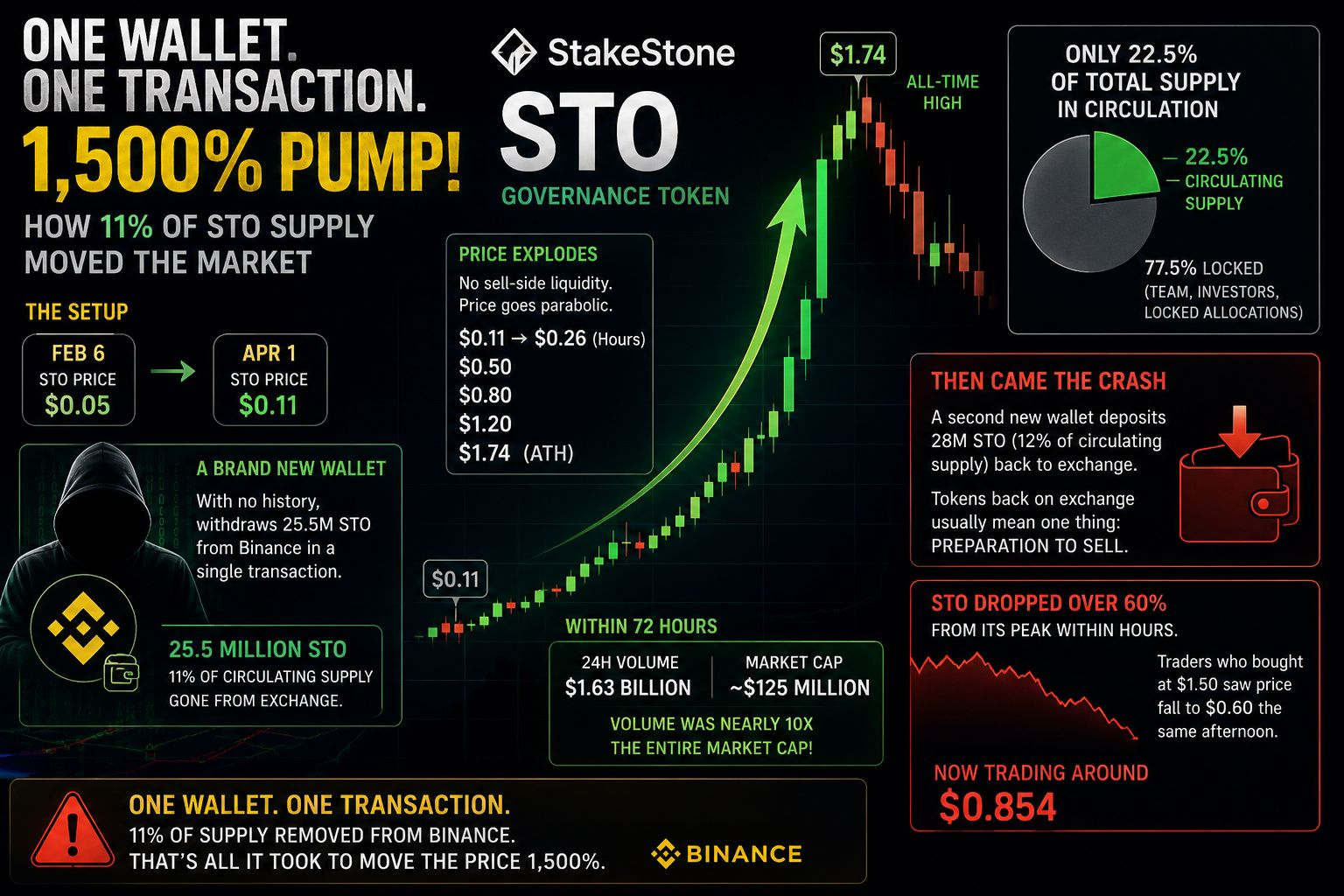 STO reached an all-time high near $1.74.
At the peak, 24-hour trading volume crossed $1.63 billion, despite the token’s market cap being only around $125 million before the move.
That means daily trading volume became almost 10x larger than the entire market cap — a sign of extreme speculation and rapid rotation.
Another important detail: only 22.5% of $XRP STO’s total 1 billion supply is currently circulating.
The remaining 77.5% is still locked with the team, investors, and future allocations.
Then came the reversal.
A second newly created wallet deposited around 28 million STO tokens back onto exchanges shortly after the peak — roughly 12% of circulating supply.
Large deposits back to exchanges usually signal one thing: preparation to sell.
The correction was brutal.
STO crashed more than 60% within hours.
Many traders who entered near $1.50 saw the price fall toward $0.60 the very same day.
The token is now trading around $0.85.
One wallet.
One massive withdrawal.
Just 11% of supply removed from Binance was enough to trigger a 1,500% price move and create one of crypto’s wildest short-term rallies.