
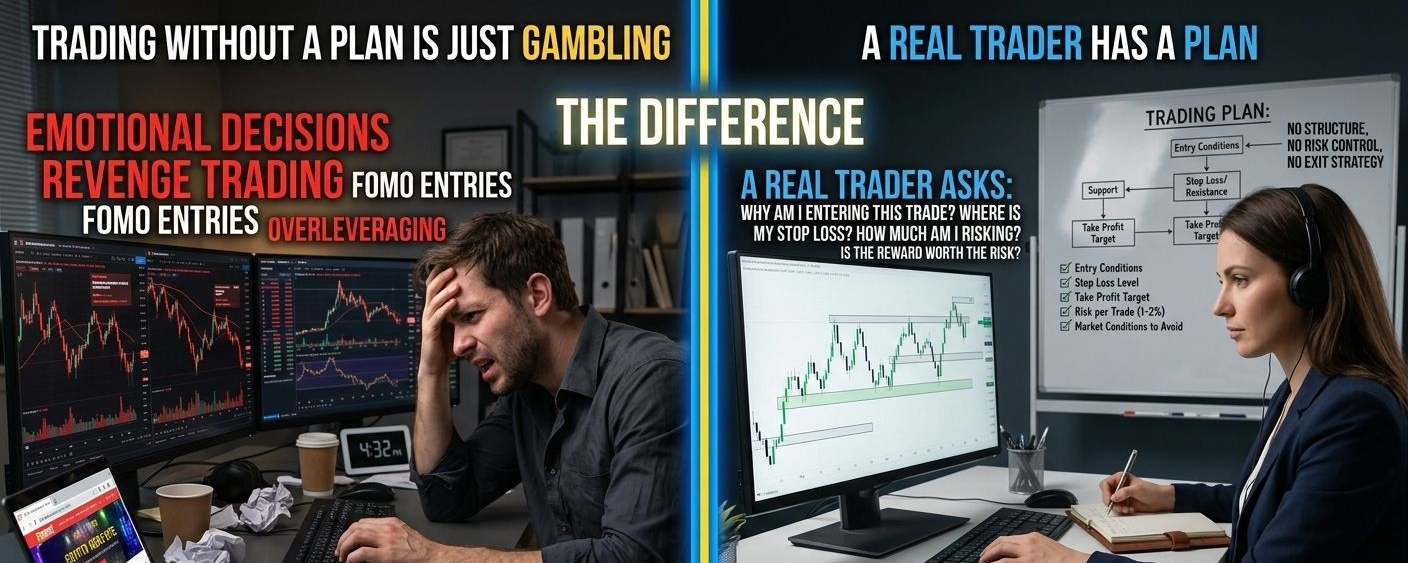
Most people enter trading believing success comes from finding the “perfect coin” or predicting the next explosive move.
It doesn’t.
The biggest difference between profitable traders and losing traders is not intelligence, luck, or secret indicators.
It’s structure.
The market rewards discipline and destroys emotional decision-making.
And that’s exactly why so many traders fail.
Not because the market is impossible.
But because they treat trading like a casino instead of a business.
The Dangerous Reality Most Traders Ignore
A huge percentage of traders enter positions without answering basic questions:
Why am I taking this trade?
Where will I exit if I’m wrong?
How much capital am I risking?
What confirms this setup?
Is the reward actually worth the risk?
Instead, many trades are driven by emotions:
“Maybe it keeps pumping.”
“I don’t want to miss this move.”
“I’ll recover my losses quickly.”
“It already went up, so it should continue.”
That mindset feels exciting in the moment.
But over time, it destroys accounts.
Because emotional trading always creates emotional results.
The Market Punishes Emotion
Every trader experiences emotions.
Fear.
Greed.
FOMO.
Frustration.
Overconfidence.
The problem starts when emotions begin controlling decisions.
This is where traders usually make their biggest mistakes:
Revenge Trading
After taking a loss, traders immediately jump into another position trying to recover quickly.
The goal stops being quality setups.
It becomes emotional recovery.
That’s when risk management disappears completely.
FOMO Entries
A coin pumps aggressively.
Everyone on social media is posting profits.
The trader enters late because they fear missing the opportunity.
Usually right before a correction starts.
Overleveraging
Instead of focusing on consistency, traders try turning small capital into massive gains overnight.
One bad move wipes out weeks or months of progress.
Holding Losers With Hope
This is one of the most dangerous habits in trading.
The setup fails.
The stop loss is ignored.
The trader keeps holding because they “believe” price will recover.
Hope becomes the strategy.
And hope is not risk management.
Why a Trading Plan Matters
A trading plan is not designed to guarantee profits.
No strategy in the world can do that.
A trading plan exists for something more important:
Protection.
It protects traders from emotional decisions.
It creates consistency.
It removes randomness.
Professional traders understand something beginners usually ignore:
Survival comes first.
If your account survives, opportunities always return.
If your account gets destroyed, the game ends.
That’s why experienced traders focus more on risk management than prediction.
Because nobody wins every trade.
But disciplined traders survive losing streaks.
What Every Trading Plan Should Include
A real trading plan does not need to be complicated.
In fact, simple plans are usually more effective.
Here are the core things every trader should define before entering a position:
1. Entry Conditions
Why are you entering?
Support bounce?
Breakout?
Trend continuation?
Liquidity sweep?
Momentum confirmation?
If you cannot clearly explain the reason, the trade probably should not exist.
2. Stop Loss
Every trade needs an invalidation point.
If price reaches that level, the setup failed.
Simple.
Without a stop loss, a small mistake can become catastrophic.
3. Take Profit Targets
Many traders know where to enter.
Very few know where to exit.
A trading plan should define profit targets before entering the trade, not during emotional volatility.
4. Risk Per Trade
Professional traders protect capital aggressively.
Many risk only 1% to 2% per trade.
Why?
Because consistency matters more than one lucky trade.
5. Market Conditions To Avoid
Not every market environment is tradable.
Sometimes the smartest decision is doing nothing.
Low volume.
Extreme uncertainty.
Choppy conditions.
News volatility.
Patience is also part of strategy.
6. Emotional Rules
This part gets ignored constantly.
A trader should know:
When to stop trading after losses.
When to reduce risk.
When emotions are affecting judgment.
When overconfidence becomes dangerous.
Psychology is not separate from trading.
Psychology is trading.
Discipline Beats Excitement
Many people enter trading searching for adrenaline.
Fast profits.
Big leverage.
Massive pumps.
But long-term profitability usually looks boring.
Disciplined entries.
Controlled risk.
Partial profit taking.
Patience.
Consistency.
The traders who survive for years are rarely the most emotional.
They are the most controlled.
Because trading is not about proving intelligence.
It’s about managing behavior under pressure.
Consistency Is the Real Goal
One profitable trade means nothing.
Anyone can get lucky temporarily.
Real success comes from repeating disciplined decisions over months and years.
That requires:
Patience during slow periods.
Confidence in your system.
Acceptance of losses.
Controlled risk.
Emotional stability.
The market will always offer opportunities.
But only disciplined traders stay around long enough to benefit from them.
Final Thoughts
Trading without a plan feels exciting at first.
But eventually, randomness catches up.
The market rewards preparation, discipline, and risk management far more than excitement or prediction.
A gambler asks:
“What if it pumps?”
A trader asks:
“What happens if I’m wrong?”
That single difference changes everything.
Because in trading, survival creates opportunity.
And consistency always beats excitement.