
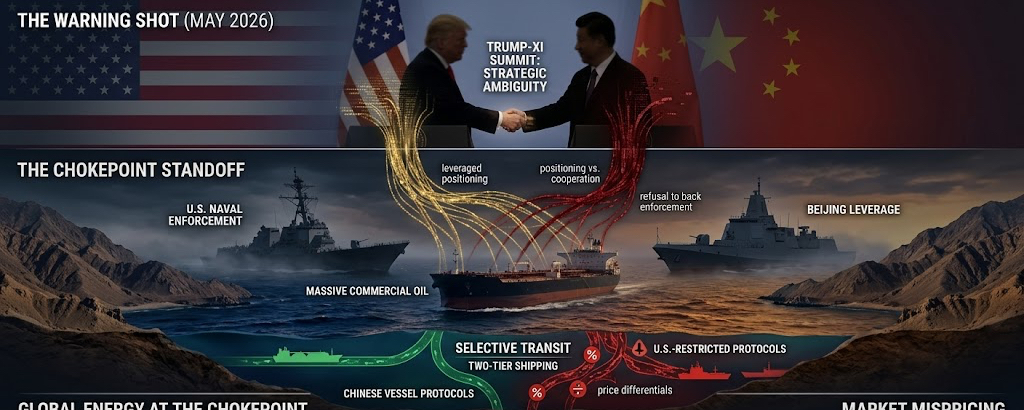
Contrary to standard diplomatic alignment, Beijing’s positioning in the current crisis is being viewed as an exercise in strategic ambiguity and leverage.
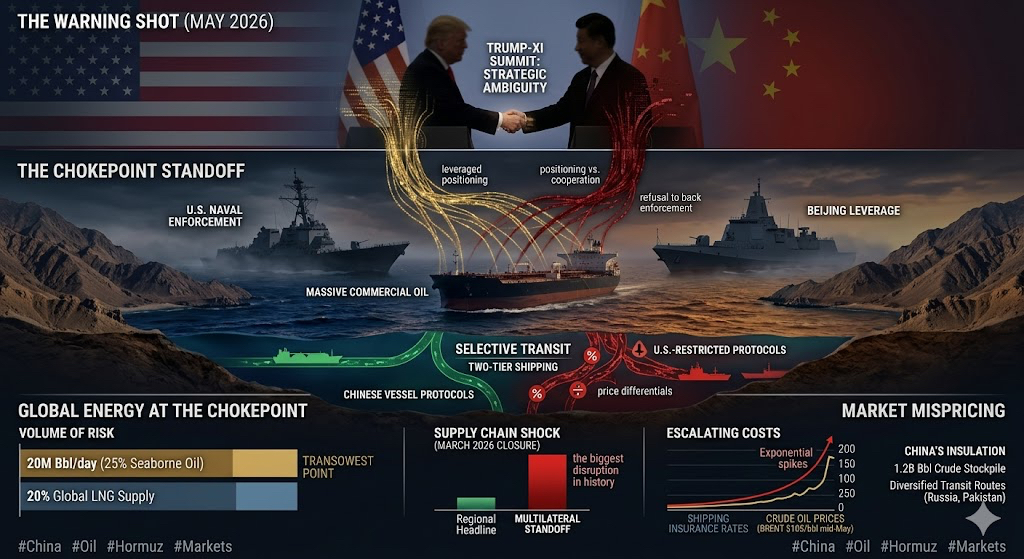
The Trump-Xi Summit (May 15, 2026): While President Trump announced an agreement with President Xi that the Strait "must remain open," Beijing has stopped short of providing a formal, binding mechanism for coordinated maritime enforcement.
Leverage vs. Cooperation: China continues to balance its "indirect" support for Tehran with its own energy needs. By refusing to publicly commit to a U.S.-led naval enforcement framework, Beijing maintains the ability to complicate Western maritime strategy during a heightening crisis.
Selective Transit: A "two-tier" shipping system is already emerging, where Chinese-linked vessels operate under different protocols than U.S.-restricted or Iranian-flagged ships, creating significant price differentials.
⚡ Global Energy at the Chokepoint
The global economy’s dependence on the Strait of Hormuz makes any multilateral standoff a "black swan" event for supply chains.
Volume of Risk: Approximately 20 million barrels per day (25% of the world’s seaborne oil) and 20% of global LNG supply transit this narrow waterway.
Supply Chain Shock: The March 2026 closure was the largest energy disruption in world history.Analysts warn that if the current "fragile stability" collapses, the world could face a supply shock far exceeding the 2020 pandemic disruptions.
Escalating Costs: By March 2026, shipping insurance rates had already spiked four to six times in a single week.
Market Mispricing: The Superpower Standoff
Oil markets are currently behaving as though the crisis is a manageable regional headline, but the structural risks are deep.
Price Levels: As of mid-May 2026, Brent crude is trading near $105 per barrel. However, traders appear to be pricing in a "stalemate" rather than a violent superpower confrontation.
The "Thucydides Trap": Structural rivalry between Washington and Beijing ranging from technology bans to Taiwan underlies the Hormuz talks, suggesting that any cooperation on energy routes is temporary and fragile.
China’s Insulation: Beijing is better prepared for a prolonged disruption than its rivals, having stockpiled approximately 1.2 billion barrels of crude and diversified into overland Russian pipelines and Pakistani transit routes.
If the current diplomatic "calm" breaks, the market repricing for oil, shipping, and global inflation is expected to be brutal and instantaneous. #BerkshireHeavilyIncreasesAlphabetStake #BTC走势分析