

Bitcoin Faces Fresh Selling Pressure
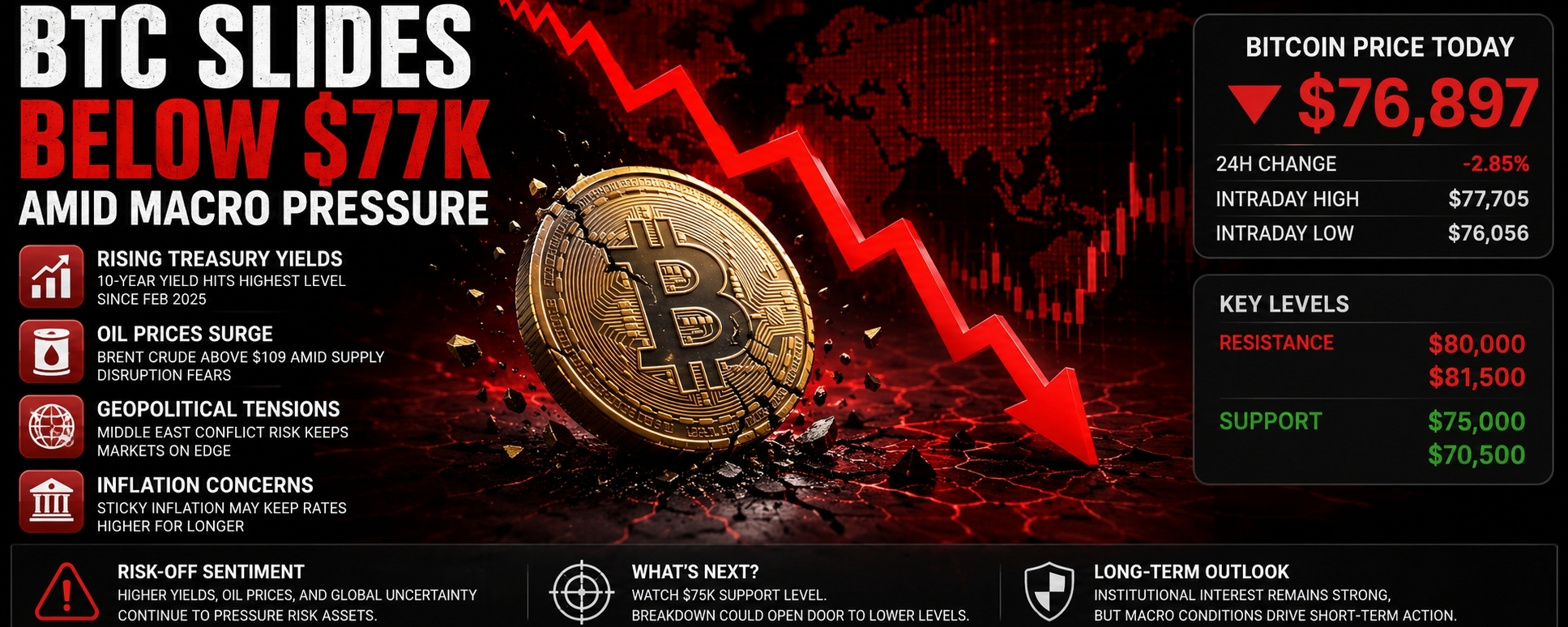
Bitcoin slipped below the $77,000 level as investors reacted to mounting pressure across global financial markets. The decline came during a broader risk-off move that pushed traders away from volatile assets, including cryptocurrencies and technology stocks.
After struggling to maintain momentum above the $80K region earlier this month, BTC once again lost strength as bearish sentiment returned across the market. The drop below a key psychological support level triggered additional caution among short-term traders, increasing selling pressure throughout the session.
Rising Treasury Yields Weigh on Crypto Markets
One of the biggest reasons behind Bitcoin’s latest decline is the sharp rise in U.S. Treasury yields. Investors are becoming increasingly concerned that inflation could remain elevated for longer than expected, forcing central banks to keep interest rates higher.
When bond yields rise, many investors shift capital into safer assets that offer more stable returns. This often reduces demand for high-risk investments like cryptocurrencies.
Bitcoin has become increasingly sensitive to macroeconomic conditions over the past few years. Instead of moving independently, the asset now reacts more closely to liquidity conditions, monetary policy expectations, and investor sentiment in traditional markets.
Inflation Concerns Return to the Spotlight
Inflation fears have also returned after energy prices moved higher in recent sessions. Concerns about global supply disruptions and geopolitical instability pushed oil markets upward, creating fresh worries about rising costs across the global economy.
Higher energy prices can make inflation more difficult to control. If inflation stays stubbornly high, central banks may delay interest rate cuts, which would keep financial conditions tight for longer.
That environment tends to hurt speculative markets, including crypto, because investors become more defensive and cautious with capital allocation.
Geopolitical Tensions Add More Uncertainty
Global uncertainty has further intensified pressure on financial markets. Ongoing geopolitical tensions have increased volatility across equities, commodities, and digital assets, encouraging traders to reduce exposure to risky positions.
Although Bitcoin is often described as “digital gold,” its recent behavior has looked much closer to a technology stock than a traditional safe-haven asset. During periods of uncertainty, traders still tend to exit crypto positions first as they move toward lower-risk investments.
This shift reflects how institutional participation has changed the crypto market. Large investment firms now trade Bitcoin alongside other macro-sensitive assets, making it more vulnerable to global economic developments.
Technical Structure Weakens Below Key Levels
From a technical standpoint, Bitcoin’s structure has weakened after losing support near the upper-$77K range.
Analysts are closely watching the $75,000 zone, which is now considered one of the most important short-term support levels. If BTC falls below that area, the market could see a deeper correction toward lower support zones.
On the upside, Bitcoin would likely need to reclaim the $80,000 level to restore bullish momentum and improve market confidence.
Trading activity has also increased during recent selloffs, showing that volatility remains elevated as traders react to rapidly changing macro conditions.
Altcoins Follow Bitcoin Lower
The broader crypto market also moved lower alongside Bitcoin. Major altcoins experienced sharper declines as risk appetite weakened across the sector.
Assets with higher volatility faced stronger selling pressure as traders reduced exposure to speculative positions. Market sentiment across digital assets remains fragile while macroeconomic uncertainty continues to dominate investor behavior.
Investors Focus on the Next Macro Catalyst
Market participants are now closely watching upcoming economic data, central bank commentary, and developments in global energy markets for signs of what could happen next.
If inflation begins to cool and bond yields stabilize, risk assets like Bitcoin could regain momentum. However, if economic uncertainty continues to increase, crypto markets may remain under pressure in the near term.
For now, Bitcoin’s move below $77,000 highlights how strongly the crypto market is still tied to global macro conditions. While long-term adoption remains intact, short-term price action continues to be driven by interest rates, liquidity, and investor sentiment.