

Institutions Are Returning to XRP — But Carefully
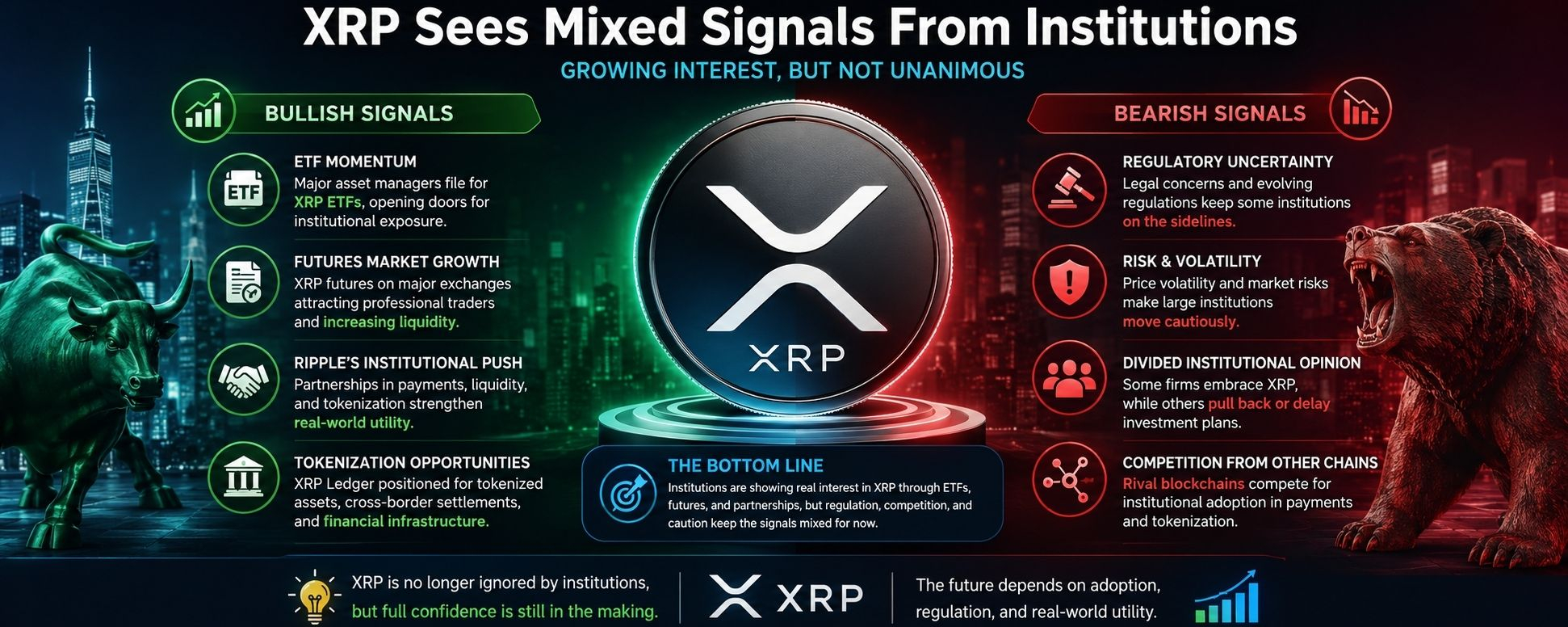
XRP is once again becoming part of the institutional crypto conversation. After years of uncertainty caused by legal battles and regulatory pressure, large financial firms are slowly finding ways to gain exposure to the asset. Some are launching investment products tied to XRP, while others are exploring how Ripple’s technology could fit into the future of digital finance.
At the same time, not every institution is fully convinced.
Some firms see XRP as a strong long-term opportunity connected to payments and tokenization. Others remain cautious because of regulation, volatility, and competition from other blockchain networks. That difference in opinion is why XRP is currently sending mixed signals across the institutional market.
ETF Activity Has Changed the Narrative
One of the biggest reasons institutional sentiment around XRP has improved is the growing interest in XRP exchange-traded funds.
For a long time, many traditional investors stayed away from XRP because there were limited regulated ways to access it. Now that investment firms are exploring XRP ETF products, the asset is starting to look more acceptable inside traditional financial markets.
This matters because institutions rarely jump directly into crypto markets without familiar investment structures. ETFs provide a safer and more comfortable entry point for wealth managers, hedge funds, and large investors who prefer regulated exposure instead of holding digital assets themselves.
The rise in ETF discussions has also helped improve XRP’s image. Instead of being viewed only as a controversial cryptocurrency tied to legal problems, XRP is increasingly being discussed alongside larger digital assets that are entering mainstream finance.
Still, ETF interest does not automatically mean institutions are fully bullish. Many firms are testing the waters rather than making aggressive moves.
Futures Markets Are Bringing More Professional Traders
Another sign of institutional involvement is the expansion of XRP futures trading.
Futures products allow professional investors to trade XRP in a more structured environment while managing risk more efficiently. These markets attract hedge funds, trading desks, liquidity providers, and institutions that usually avoid unregulated crypto platforms.
The growth of futures activity suggests that XRP is becoming more integrated into professional trading infrastructure.
But futures markets can create both positive and negative pressure.
Some investors use futures to bet on XRP’s price rising, while others use them to hedge or even short the market. Because of this, increased futures volume does not always translate into immediate bullish momentum.
It simply shows that larger financial players are becoming more active around XRP.
Ripple Continues Pushing Institutional Adoption
Ripple has spent years promoting XRP and the XRP Ledger as tools for global finance rather than purely speculative assets.
The company continues focusing on cross-border payments, liquidity systems, and tokenized financial products. Ripple’s broader vision is centered around making financial transactions faster, cheaper, and more efficient through blockchain technology.
This strategy is attracting attention from institutions exploring tokenization and digital settlement systems.
Many financial firms now believe blockchain technology could eventually transform how traditional assets move across markets. Tokenized funds, digital securities, and blockchain-based settlement systems are becoming serious discussion points inside the financial industry.
Ripple wants XRP Ledger to become part of that future.
That possibility has helped rebuild institutional interest in XRP, especially among firms looking beyond short-term trading opportunities.
Regulation Still Creates Hesitation
Despite the improving sentiment, regulation remains one of the biggest concerns surrounding XRP.
The legal fight between Ripple and regulators left a lasting impact on institutional confidence. Even though the situation has improved significantly compared to previous years, many institutions still prefer to move cautiously.
Large financial firms tend to avoid uncertainty whenever possible. Compared to Bitcoin, which already has broader institutional acceptance, XRP still carries more legal and regulatory sensitivity.
Because of that, some institutions prefer indirect exposure through ETFs or futures instead of buying large amounts of XRP directly.
Others are waiting for clearer long-term crypto regulations before increasing involvement.
This cautious approach explains why institutional interest in XRP continues to grow slowly rather than exploding overnight.
Not Every Institution Is Moving in the Same Direction
While some companies are increasing exposure to XRP, others are stepping back or delaying plans connected to the asset.
A few firms have reconsidered XRP-related products due to changing market conditions, competition, or uncertainty around long-term demand. This highlights an important reality about institutional adoption: it rarely happens all at once.
Different institutions have different goals.
Some are interested in XRP as a trading asset. Others care more about Ripple’s payment technology or tokenization infrastructure. And some simply believe other blockchain networks offer stronger long-term opportunities.
This split creates the “mixed signals” investors are currently seeing across the market.
Tokenization Could Become XRP’s Biggest Opportunity
One of the strongest long-term narratives surrounding XRP is tokenization.
Financial institutions are increasingly exploring ways to move traditional assets onto blockchain networks. This includes assets such as bonds, funds, and other financial products that can be traded digitally.
Ripple has positioned XRP Ledger as a blockchain designed to support fast settlement and liquidity movement for these types of systems.
If tokenization becomes a major part of global finance, XRP could benefit from increased utility and institutional relevance.
However, the competition is intense.
Several blockchain networks are fighting for dominance in the tokenization sector, and there is no guarantee XRP Ledger will become the preferred choice for financial institutions.
That uncertainty is another reason institutional sentiment remains divided.
Investor Confidence Remains Balanced Between Optimism and Caution
Right now, XRP sits in an unusual position within the crypto market.
There is clearly more institutional interest than there was during the peak of regulatory uncertainty. ETFs, futures markets, and tokenization projects all show that major financial players are paying attention again.
But there is also hesitation.
Institutions are entering carefully, testing products, and watching regulation closely before making larger commitments. Some investors believe XRP could become an important asset in the future of digital finance, while others remain unconvinced.
That balance between optimism and caution is shaping XRP’s current market identity.
Conclusion
XRP’s institutional story is becoming more complex and more important.
The asset is no longer being ignored by traditional finance. Growing ETF discussions, expanding futures markets, and Ripple’s push into tokenization have all helped revive institutional attention.
At the same time, concerns around regulation, competition, and long-term adoption continue to slow broader confidence.
For now, institutions are not giving XRP a full endorsement or a full rejection. Instead, they are approaching it carefully, exploring opportunities while managing risk.
That is exactly why XRP continues to show mixed signals from institutions — and why the market is watching every new development so closely.