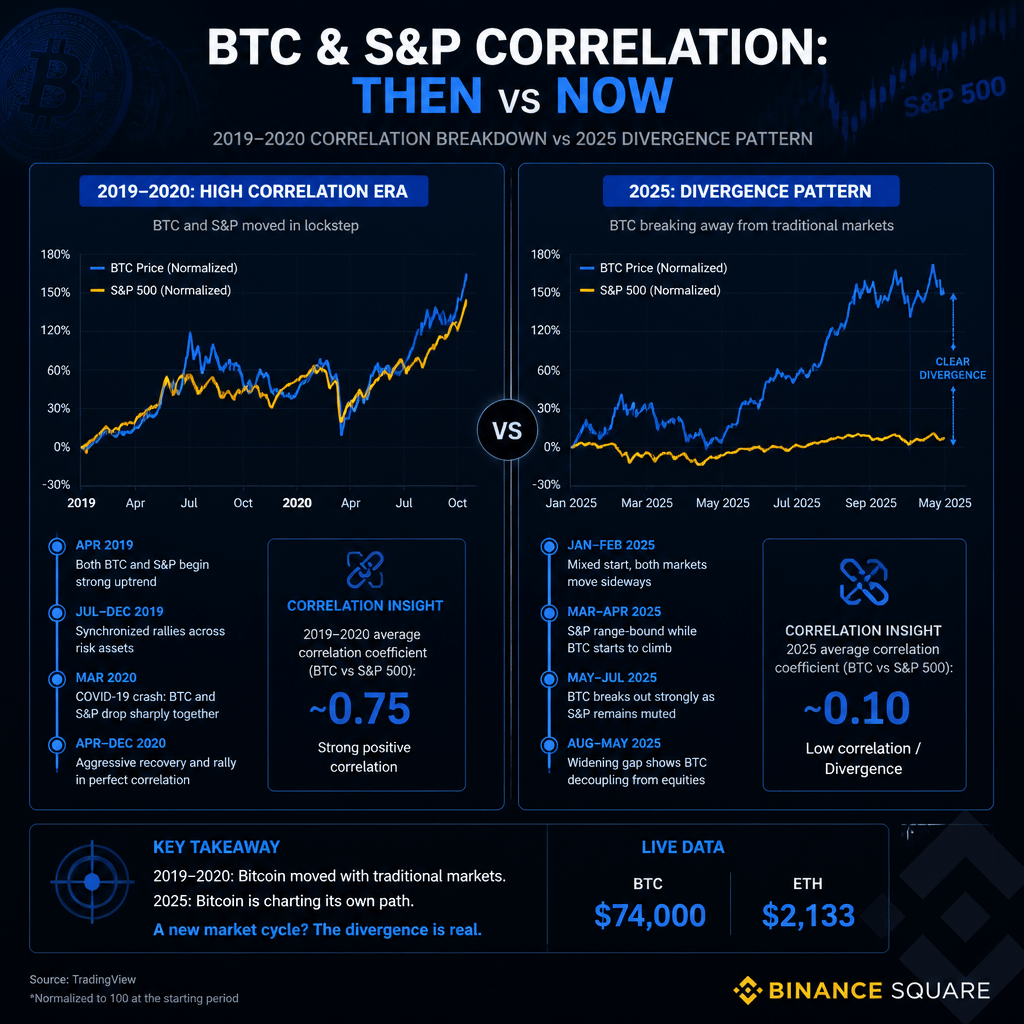


This is the most important macro signal in crypto right now and most traders are completely missing it.
The Decoupling Nobody Is Talking About
For the first time since 2020, Bitcoin has entered its longest decoupling from the S&P 500. The last time we saw a divergence this prolonged was August 2019 through January 2020. You know what happened after that. The bull run that changed a lot of lives.
Most people are watching CNBC, seeing red on their stock portfolios, and assuming BTC follows. That's the old playbook. The data says we're writing a new one.
BTC hit $74,000 on April 8, down nearly 30% from the January peak. Painful. But it bounced 24% off that low in weeks. We're sitting at $77,041 right now, consolidating above key support while equities continue to wobble. That divergence is not an accident.
The LTH Panic Was Based on Garbage Data
Here's where it gets interesting. Back when on-chain data was screaming that long-term holders were dumping, traders panicked. Headlines were brutal. The narrative was "smart money is leaving."
Except it wasn't real.
Coinbase moved approximately 800,000 BTC internally, and most of those transfers got miscategorized as long-term holder selling in on-chain dashboards. Once you strip out those internal transfers, actual LTH selling was likely far lower than anyone reported. The panic was built on distorted data.
Fam, this is exactly the kind of noise that shakes out retail right before a move. People sold based on a misread signal while actual long-term holders barely moved.
And it's not just private holders sitting tight. Digital asset treasury companies, Strategy being the biggest, collectively hold 1.1 million BTC right now. That's nearly 5% of the entire supply locked inside entities that do not sell on red days. That structural shift in who holds Bitcoin is changing the game in ways that price charts alone won't show you.
Sovereign Accumulation Is Accelerating
This part people are sleeping on the hardest.
On March 6, 2025, the United States established a Strategic Bitcoin Reserve via executive order. The government stopped auctioning off seized BTC and started holding it as a strategic asset. That's a complete 180 from standard practice.
Then in May 2025, New Hampshire became the first U.S. state to create its own Strategic Bitcoin Reserve, authorizing the state treasurer to allocate up to 5% of total state funds into BTC.
Read that again. A U.S. state is now legally authorized to buy Bitcoin with public funds.
This is not a meme. This is not a tweet. This is policy. And when policy moves this fast at the state and federal level, other states start watching. Other countries start watching. The sovereign accumulation wave isn't coming, traders. It's already here and it's accelerating.
What the Setup Actually Looks Like
So let's put this together. BTC at $77,041, consolidating after a sharp recovery off the yearly low. Decoupling from equities for the first time in five years, mirroring the exact setup that preceded the 2020 bull run. Long-term holder selling data was distorted and real conviction holders barely flinched. Institutions sitting on 1.1M BTC with no signs of distribution. And sovereign governments, at both the federal and state level in the U.S., actively accumulating as a strategic reserve.
ETH is at $2,133 and SOL at $85 for context, both still grinding through their own narratives. But the macro story right now is squarely on BTC.
The price isn't even the real story here. The real story is who is quietly accumulating while retail panics on bad data and macro fear. Because when that becomes common knowledge, and it always does eventually, the people who understood the setup early are already positioned.
This is not me telling you to buy anything. This is me reading the data out loud so you can make your own call.
The divergence from 2019 to 2020 lasted about five months before the market re-priced everything. We're early in this one.
Watch the holders. Watch the sovereign moves. Watch what happens when the S&P has another rough week and BTC doesn't follow.