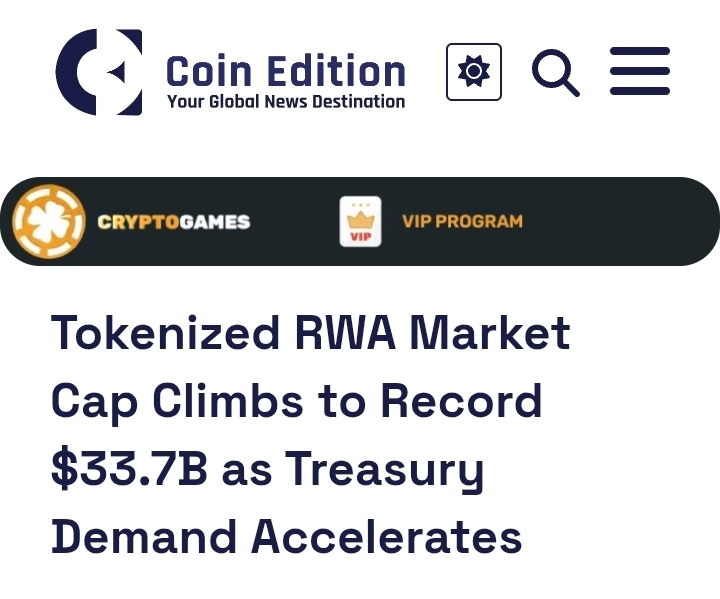
The tokenized RWA market just climbed to a record $33.7B.
And honestly, I think we’re slowly reaching a point where people realize something important:
putting assets on-chain is only the beginning.
Because once real-world assets like: funds, equities, treasuries, or credit instruments start moving across blockchain infrastructure,
the bigger question becomes:
how do those assets operate safely, compliantly, and transparently at scale?
That’s the first thing that came to my mind after seeing the recent RWA growth across networks like Canton, Ethereum, BNB Chain, and ZKsync.
And I know I’m not the only one thinking about it.
For years, most discussions around RWA focused on tokenization itself.
But the deeper challenge is what happens after assets become programmable.
How do you make sure: transfers follow jurisdiction rules? governance remains compliant? redemptions are verifiable? execution stays auditable? AI systems don’t operate outside defined boundaries?
And honestly, this is where Quack AI’s RWA architecture started making a lot more sense to me.
Not because it simply “puts RWAs on-chain.”
But because it introduces structure around how programmable assets can operate inside defined rules.
Through Quack AI’s RWA Integration Layer: assets can connect through verified modules, compliance conditions can be enforced through the Policy Engine, governance actions can integrate with Governance Intelligence, and settlements can execute through Q402 with verifiable receipts attached.
What stood out to me most is that the system is designed around bounded execution, not unrestricted automation.
Identity verification, KYC-gated participation, policy-aware execution, audit logs, Proof-of-Reserve validation, and real-time monitoring are all built into the architecture itself.
That feels very different from the usual: “tokenize first, figure out compliance later” approach.
And honestly, I think this may become one of the most important shifts in the next phase of Web3.
Because the future of RWA probably won’t be defined by tokenization alone.
It’ll be defined by the infrastructure governing how real-world assets move, settle, comply, and coordinate autonomously across on-chain systems.