

I’ve spent enough years building backend systems for live-service games to develop a permanent distrust of clean architecture diagrams. The prettier the diagram, the more likely somebody’s hiding a disaster behind it. Usually behind a load balancer with a vague name like “orchestrator-service-v2-final.”
So when I hear people describe OpenLedger as an “AI blockchain for monetizing data, models, and agents,” I already know the pitch is cleaner than the reality. It always is.
People imagine this massive decentralized machine where AI models run trustlessly on-chain, agents coordinate autonomously, and every transaction is cryptographically verified like some kind of elegant distributed organism. Sounds amazing in a whitepaper. Sounds even better in a VC deck.
Then you actually build one of these systems.
And suddenly you remember GPUs don’t care about ideology. Networks don’t care either. Physics definitely doesn’t.
The first thing most people get wrong is assuming the blockchain is doing the heavy lifting. It’s not. It can’t. Modern AI workloads are absurdly expensive compared to what blockchains are designed for. A single inference request might involve huge model weights sitting in VRAM, vector lookups, retrieval pipelines, memory context assembly, ranking systems, and a bunch of asynchronous coordination happening across services that all have their own failure modes. And all of that has to happen fast enough that the user doesn’t think your app is broken.
Nobody wants to wait fifteen seconds for “decentralized intelligence.” They’ll just close the app.
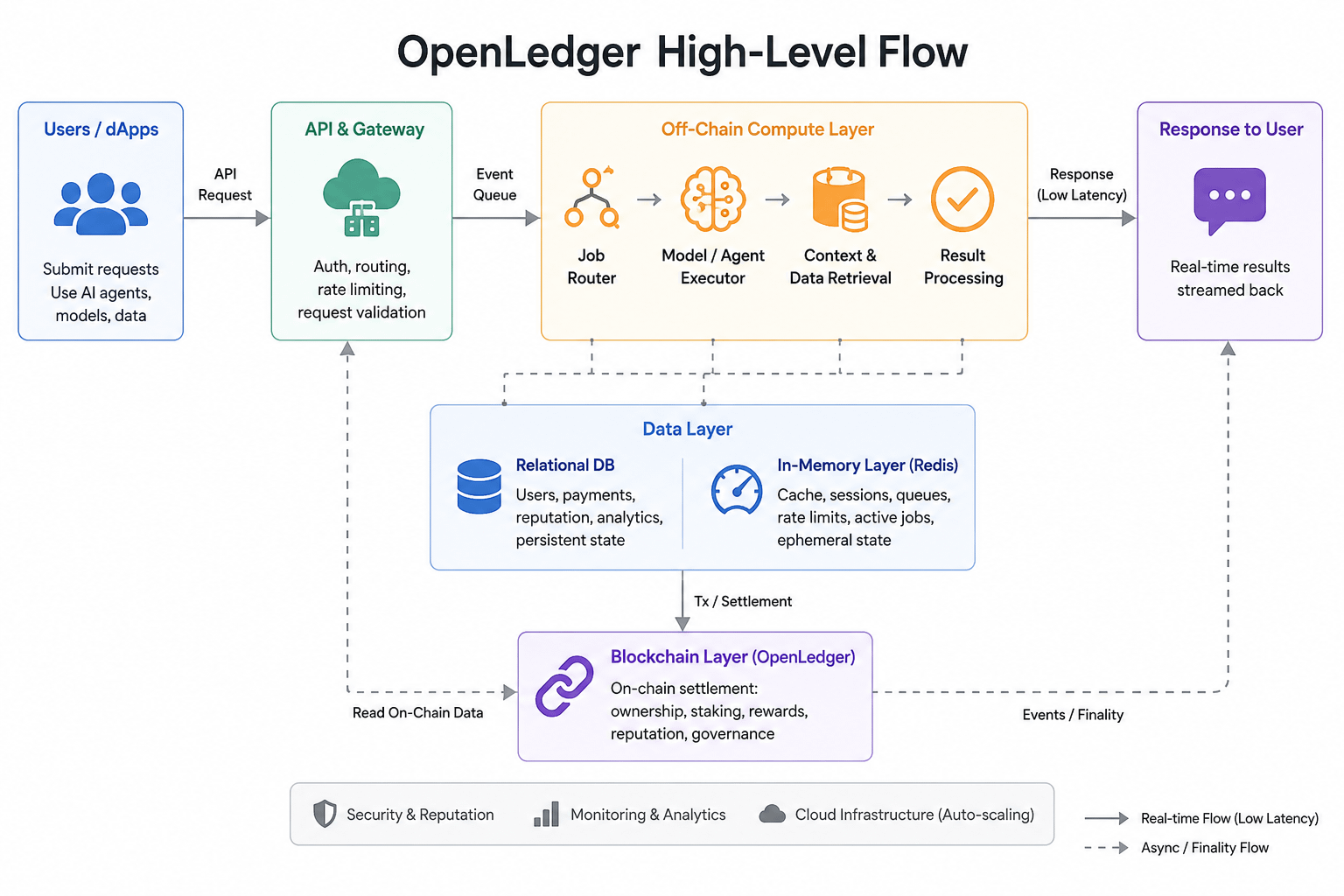
Let’s be honest here. Most so-called AI blockchains are really cloud systems wearing a blockchain jacket. The chain handles the money stuff. Ownership. Rewards. Staking. Reputation maybe. The actual compute almost certainly happens off-chain because if you tried to run transformer inference directly through decentralized consensus, you’d melt the system into uselessness before lunch.
I’ve seen teams try to force blockchain architecture into places it absolutely does not belong. Usually because somebody in product got emotionally attached to the word “trustless.” Three months later the engineers are duct-taping Redis caches onto everything just to keep latency below catastrophic levels.
And Redis ends up everywhere. Every single time. Redis becomes the quiet hero holding the entire thing together while the marketing team keeps talking about decentralization. Session state, hot caches, queue coordination, rate limits, temporary memory, active jobs. Because disk-bound database calls are death when you’re trying to orchestrate AI agents in real time.
Meanwhile your relational database is sitting there doing the boring adult work nobody wants to talk about. Transactions. Accounting. Reconciliation. The stuff that actually matters once money enters the system. SQL survives every hype cycle because eventually somebody has to answer a simple question: “Where did the funds go?” And at 3 AM during an outage, nobody wants probabilistic accounting.
That’s another thing people underestimate. These systems are less like blockchains and more like massively distributed live-service infrastructure. Honestly, OpenLedger probably has more architectural overlap with large multiplayer game backends than most crypto projects would like to admit.
You end up building around events because synchronous systems collapse under load. Always. User sends request. Event enters queue. Another service consumes it. Another service routes inference. Another handles attribution. Another updates rewards. Another writes settlement data somewhere else. Then something fails halfway through because one node times out in Singapore while another service retries aggressively and accidentally DDOSes your own infrastructure.
That’s a real thing, by the way. Retry storms are horrifying when you first experience them. Tiny failure upstream, absolute chaos downstream.
And AI systems make this worse because they’re naturally bursty. One viral use case and suddenly your queue depth looks like a heart attack monitor. GPU pools saturate. Autoscaling kicks in too slowly. Latency spikes. Timeouts trigger retries. Retries increase load. Somebody on the infra team starts muting alerts because Slack is basically screaming nonstop.
This is the reality underneath all the “autonomous AI economy” language.
The funny part is decentralization often makes the operational side harder without necessarily improving the user experience. That’s the uncomfortable truth nobody likes admitting publicly. Distributed compute nodes sound great until half the network has inconsistent hardware, bad routing, unstable uptime, or operators trying to game reward systems. Then you start adding reputation scoring, validation layers, redundancy checks, challenge systems. More coordination. More overhead. More complexity.
You slowly reinvent centralized reliability mechanisms while insisting the system is decentralized.
I’m not even saying that cynically. It’s just what happens when systems meet production traffic.
Latency becomes this constant invisible war. Users expect instant responses because OpenAI, game servers, TikTok, Netflix — everything trained people to expect responsiveness immediately. But blockchain consensus is slow by design. Slow is literally part of the trust model. So these systems split themselves into two realities.
The first reality is the user-facing illusion. Fast responses. Optimistic execution. Cached state. Probably some speculative routing. The second reality is the economic settlement layer slowly reconciling everything underneath. Rewards finalize later. Attribution updates later. Consensus happens later.
That architecture works, mostly. Financial exchanges have operated similarly for years. But it creates weird edge cases when things break. And things always break eventually.
Maybe the AI layer keeps functioning while the chain gets congested. Maybe rewards stop settling while inference requests continue flowing. Maybe balances drift temporarily. Maybe duplicate jobs start appearing because an idempotency check failed somewhere deep in the pipeline that nobody touched in eight months because the engineer who built it left the company.
Tech debt in distributed systems is vicious because it compounds silently. Nobody notices until load hits a threshold and suddenly an ancient architectural shortcut becomes everybody’s problem.
I think people also underestimate how hard verification becomes once AI execution moves off-chain. And it has to move off-chain. There’s really no serious alternative right now. But once that happens, trust creeps back in through the side door.
How do you prove a node actually performed inference correctly? How do you stop fake execution claims? How do you validate outputs without duplicating expensive compute everywhere? Cryptographic proofs help in theory, but they add overhead. Redundant execution improves trust, but now your costs explode. Consensus scoring introduces more coordination latency.
You never really escape the trade-offs. You just move them around.
That’s why I get skeptical whenever somebody describes these architectures as revolutionary in a clean, deterministic way. They’re not clean. They’re compromise machines. Carefully balanced compromise machines.
And honestly, the projects that survive long term are usually the ones willing to admit that.
I suspect OpenLedger’s future — and probably this entire category’s future — depends less on achieving pure decentralization and more on figuring out where decentralization is actually worth the pain. Not every operation deserves consensus-level guarantees. Most users don’t care if an inference request was decentralized. They care if it was fast, cheap, and reliable.
That changes how you design everything.
Over time, these systems will probably become more hybrid, not less. More off-chain compute. More specialized infrastructure. More geographic optimization. More abstraction layers hiding ugly operational details from users because users should never see the operational details. If they do, you’ve already lost.
And maybe that’s the real irony here. AI blockchains aren’t really competing with other blockchains most of the time. They’re competing with hyperscale cloud infrastructure companies that have spent twenty years solving distributed systems problems at terrifying scale.
That’s a brutal competition to walk into.
Still, I think there’s something interesting happening here. Not because the architecture is elegant. It isn’t. Most real systems aren’t. But because projects like OpenLedger are starting to expose a deeper truth about modern infrastructure: decentralization is easy to market, but reliability is what actually survives production traffic.
Those are very different things... @OpenLedger #OpenLedger $OPEN
