
I filed this one away without a second look. The space is full of projects that put artificial intelligence in their description as a narrative layer without anything specific underneath it. I had seen enough of those to develop a fast filter.
What made me stop with OpenLedger was a whitepaper published in June 2025 that described something I had not seen any other project attempt with this level of engineering detail.
What I keep coming back to is this. Most AI tokens sit on top of the AI trend without a structural connection between how the token moves and how the AI actually gets used. @OpenLedger built that connection at the protocol level and whether it holds at production scale is the question I genuinely cannot answer yet.
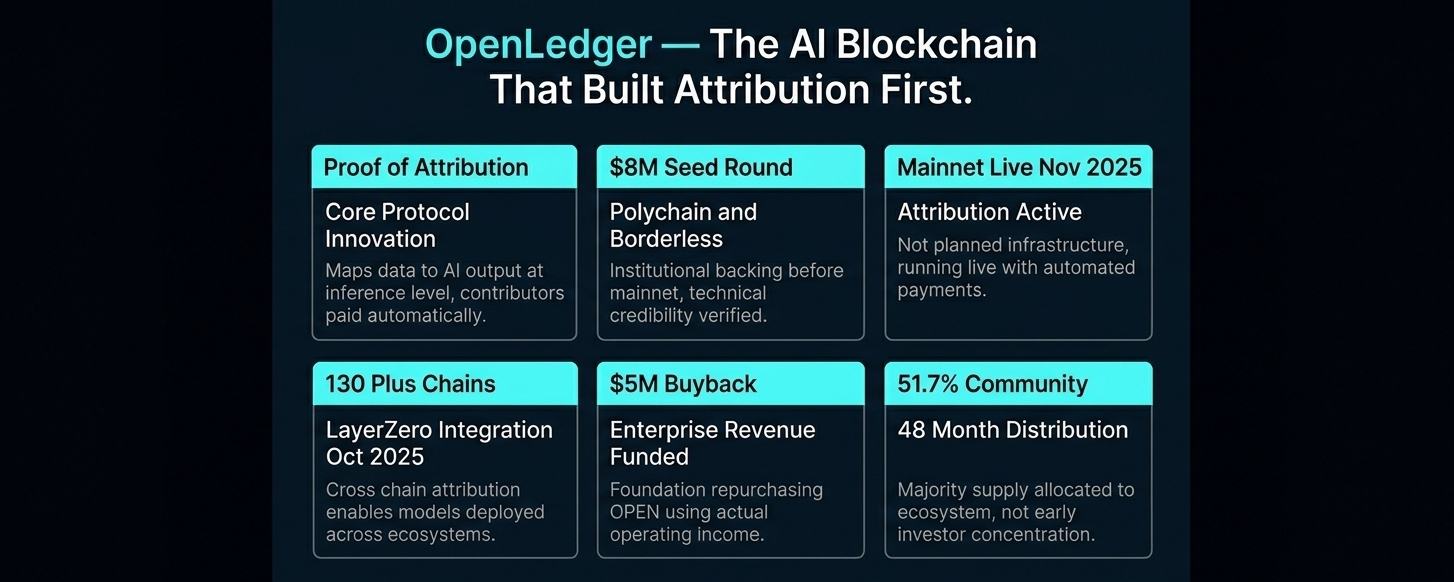
The mechanism is called Proof of Attribution. The problem it is solving is more fundamental than it first appears. When a large language model produces an output today, nobody in the traditional AI industry can tell you which specific training data influenced that specific response.
That sounds like an academic concern until you realize it is the core reason data contributors have never been properly compensated, AI models operate in opacity, and no one has been able to build a functioning economic loop between AI usage and the people who made it possible. The June 2025 whitepaper describes two technical approaches to solving this. Influence function approximations for smaller models.
Suffix array based token attribution for large language models that checks output tokens against compressed training corpora to detect memorized spans.
That influence score becomes the basis for inference level payouts. Every time a model runs on #OpenLedger , attribution fires. Every attribution event routes $OPEN automatically to the contributor whose data shaped the output.
This is not a planned feature. The mainnet launched in November 2025 with attribution enabled and automated payments live. I keep coming back to that detail because in a space full of infrastructure promises, something that is actually running is worth treating differently from something still on a roadmap.
The backing matters here too and not just as a credibility signal. OpenLedger raised 8 million dollars in seed funding from Polychain Capital and Borderless Capital, with participation from HashKey Capital and angels including Sreeram Kannan of EigenLabs, ex-Coinbase CTO Balaji Srinivasan, and Polygon co-founder Sandeep Nailwal. These are not narrative investors. These are people who evaluate technical whitepapers before committing capital. Their involvement before mainnet suggests the attribution mechanism was credible enough on paper to justify conviction ahead of proof.
The token design follows from the mechanism rather than sitting beside it. OPEN is the gas token for every transaction on the network. It is also the payment currency for model training, inference access, and dataset purchases. Maximum supply is 1 billion tokens.
Community allocation is 51.7 percent distributed over 48 months, which means the majority of supply is aligned with ecosystem growth rather than concentrated in early investor positions.
A 5 million dollar buyback program funded entirely by enterprise revenue was announced, meaning the foundation was using actual operating income to purchase tokens from the open market.
That last detail is the kind of thing I find myself returning to because it tells you whether commercial activity is real or being simulated.
The LayerZero integration completed in October 2025 connected the network to over 130 blockchains simultaneously. Cross chain attribution is not optional for a system that wants to capture value from AI models being trained on one chain and queried from another. The infrastructure for that exists now.
The question is whether model developers and data contributors build on it.
That adoption question is what I cannot resolve and I want to be honest about why it matters so much. The technical architecture is more carefully designed than most projects in this category. The mainnet is live. The attribution mechanism runs. But enterprise AI teams do not retool their infrastructure for a blockchain native system unless the economics justify the operational cost. The friction is real even on an Ethereum compatible Layer 2. The 5 million dollar Cambridge University grants program for blockchain AI research launched in November 2025 is one signal the team is investing in making the case. Whether research agreements turn into production deployments is what the next several quarters will actually show.
I have to argue against my own reading here because the case I just made has real weaknesses.
The first problem is scale. Inference level attribution has never been proven at production load. The whitepaper describes the mechanism. The mainnet runs it. But test deployments are not the same as hundreds of models processing millions of inferences daily with attribution firing correctly on each one. The January 2026 attribution engine update addressed keeping data output links intact as models are fine tuned, which tells me the system is still being refined. A core mechanism that needs updates this early in its deployment is not yet stable infrastructure.
The second problem is fragmentation.
The Story Protocol partnership for legal AI training announced in January 2026 is interesting but it also signals that competing attribution standards are being built in parallel by different teams for different use cases. If the attribution landscape fragments, OPEN's structural demand thesis weakens considerably because the token becomes payment rail for one corner of the market rather than the unified layer the design envisions.
The signals I am watching are specific. Whether active model deployments on the network grow quarter over quarter after the mainnet stabilization period. Whether the enterprise partnerships produce production workloads on chain rather than staying at the research agreement level. Whether the attribution engine handles model fine tuning updates without patches, because stability of the core mechanism is the prerequisite for everything downstream.
And whether the buyback program stays funded by enterprise revenue as the project scales, because that single data point tells you more about the commercial reality than any announcement ever could.