

When I first started reading about OpenLedger, I assumed it was just another “AI + blockchain” mashup trying to ride two narratives at once. And maybe part of it still is. Hard to separate genuine infrastructure experiments from pure narrative timing right now, especially when anything connected to AI suddenly gets treated like a future monopoly.
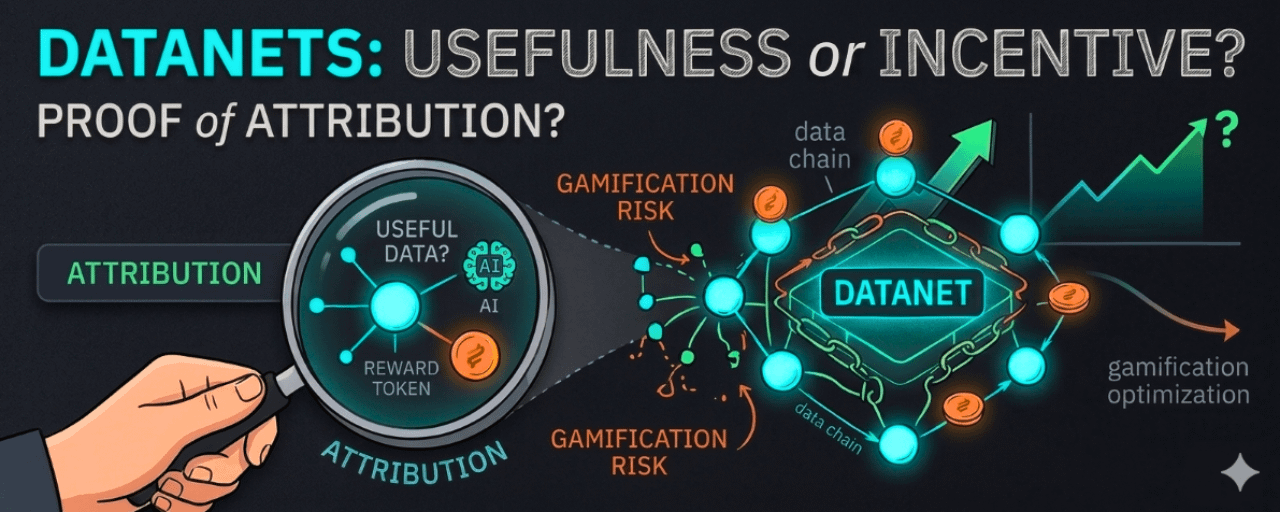
But the thing that kept pulling me back wasn’t the token itself. It was this idea of “Datanets.”
At first I thought Datanets were basically just decentralized datasets with better branding. Actually… maybe that framing is too simplistic. The more I read, the less it felt like a simple data marketplace and the more it started looking like an attempt to build an attribution economy around AI. Underneath that, OpenLedger seems to be trying to solve a weird coordination problem most AI systems quietly ignore: where does useful training data actually come from, and who gets rewarded when models use it?
That’s where their “Proof of Attribution” mechanism gets interesting. Or at least… conceptually interesting.
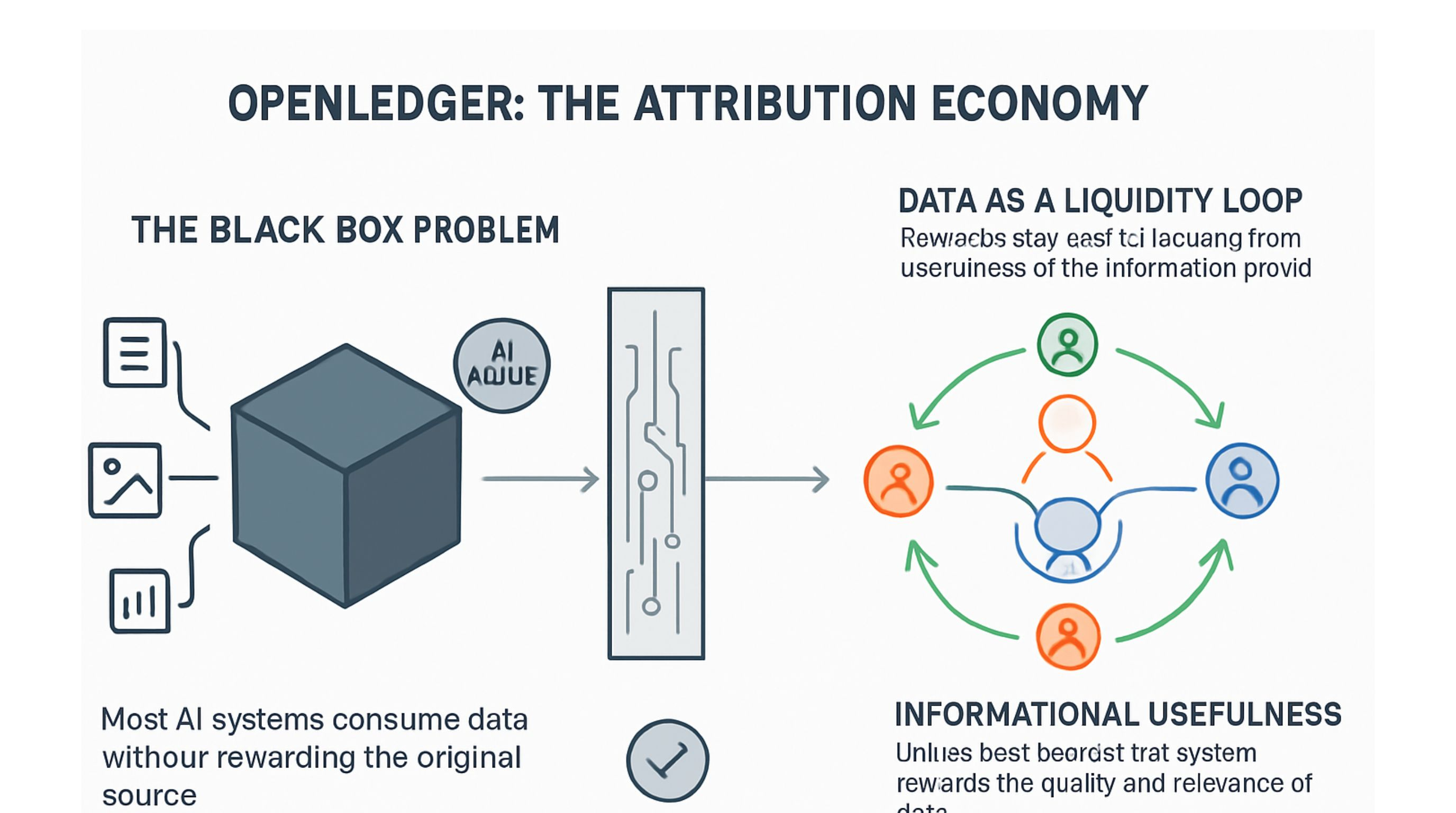
Most AI systems today operate like giant black boxes. Data goes in, models come out, and the people contributing useful information usually disappear from the economic layer entirely. OpenLedger seems to be experimenting with the opposite structure: trace the value back to the source and reward contributors proportionally when AI outputs generate activity or revenue.
If that attribution layer actually holds together, the incentive structure changes pretty dramatically.
Instead of users just dumping data into platforms for free, The system tries to create a feedback loop where attribution stays attached as models generate activity, allowing contributors to remain economically tied to the long-term usefulness of their data. Kind of reminds me of early DeFi liquidity mining logic, except instead of rewarding idle capital, the system tries to reward informational usefulness. The whole model basically depends on whether attribution can function as a durable economic primitive instead of just metadata attached to AI outputs.
Not totally sure the mechanics scale cleanly though.
Because the moment attribution becomes financially valuable, the system stops rewarding contribution alone and starts attracting optimization behavior around the reward layer itself. We already saw versions of this during GameFi cycles where incentive design got optimized faster than the ecosystems themselves could mature. Even some social-fi systems collapsed under their own incentive structures because users learned how to farm the mechanism faster than the protocol could adapt.
And AI data is even messier because “quality” itself is subjective. A dataset can look useless in one context and suddenly become valuable six months later depending on what models need.
And honestly, that uncertainty might be one of the most important parts of the whole model.
I also can’t ignore the timing. AI-related crypto infrastructure is gaining attention during a period where liquidity keeps rotating away from older narratives. DeFi still matters, obviously, but the market increasingly seems to believe the next major AI value layer won’t just come from models themselves. It’s moving toward the infrastructure coordinating computation, inference, data supply chains, and attribution around them. You can see it in on-chain flows too — more speculative capital moving toward infrastructure plays instead of consumer-facing apps.
Not saying that automatically validates OpenLedger. Crypto markets confuse narrative alignment with product-market fit all the time. But it does create conditions where systems like this get space to experiment.
And honestly, there’s something lowkey uncomfortable about tokenizing data contribution at scale.
Part of me thinks it’s inevitable. If AI models become foundational infrastructure, then data providers eventually demand economic participation. That feels structurally logical. But another part of me keeps wondering whether turning every informational interaction into an attributable financial event creates incentives that become too artificial over time.
I remember seeing smaller decentralized data marketplaces a few years ago — maybe around the 2023 AI mini-cycle — and most of them struggled because contributors arrived faster than actual demand. Tons of supply, very little real consumption. OpenLedger seems aware of that trap, which is probably why the attribution layer matters so much to them.
And honestly, that might be the real experiment here — not whether decentralized AI can exist, but whether crypto incentive systems can reward informational quality without eventually overwhelming it.
And crypto… historically… doesn’t always do that particularly well.
The entire model really depends on attribution staying harder to game than it is to measure — otherwise the reward layer becomes the product.
Maybe systems like this become a foundational coordination layer for decentralized AI economies. Or maybe this is another case where crypto discovers a genuinely important coordination problem, then realizes too late that financial incentives can distort the very behavior they were supposed to improve.
#OpenLedger $OPEN @OpenLedger
