
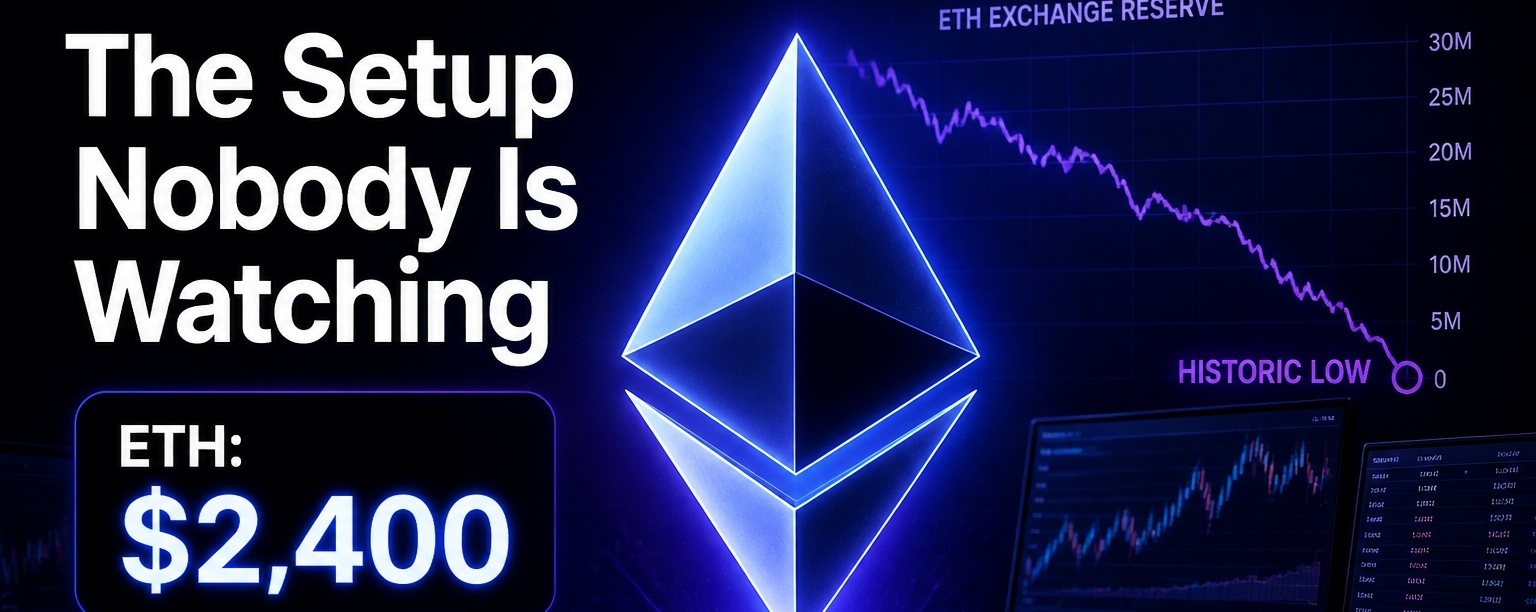


The divergence between shrinking supply and a price stuck below resistance is one of the cleanest setups I've seen this cycle. Let me break it down.
The Supply Picture Nobody Is Discussing
Exchange reserves just hit a multi-year low of 14.5M ETH in late April. We're now sitting at 14.9M ETH, barely off that floor. That 400K ETH that trickled back onto exchanges? It came in almost exactly as price approached the $2,400 resistance zone and continued through the pullback to current levels at $2,103.
Think about what that means. When buyers finally step in with real conviction, they're going to face the thinnest order book this cycle has ever seen. There's simply less liquid sell-side supply available to cap a recovery than at any prior point. That doesn't mean the breakout happens tomorrow. Demand still needs to show up. But when it does, there's a lot less ETH standing in the way.
The Math on Where We Are
ETH is down roughly 57% from its August 2025 ATH near $4,954. Right now it's trading at $2,103, below key support, with the $2,400 zone having rejected price multiple times without a single sustained close above it. The 200-day moving average sits around $2,600, which is the next real ceiling if $2,400 finally breaks.
That's the technical reality. Not pretty on the surface.
But then look at what's happening underneath....
30% of all ETH is now staked across 1.1 million active validators. That supply is locked. It's not showing up on an exchange to hit bids. Spot ETFs have pulled in $11.6 billion in cumulative net inflows, and BlackRock launched its staking-enabled ETHB product back in March 2026. Institutions aren't waiting for ETH to break out before they accumulate. They're already in.
And on May 17 alone, three separate catalysts hit the tape. SBI and Rakuten announced plans for regulated ETH investment trusts in Japan. Ronin gaming blockchain completed its migration to Ethereum L2. CME and Nasdaq announced new crypto index futures products that include ETH.
Three bullish catalysts in a single day.
Price dipped.
That's either distribution or it's the market being completely asleep at the wheel. Based on the reserve data, I lean toward the latter.
What I'm Actually Watching
The setup is simple. $2,400 is the wall. Every rejection there has come on relatively thin volume, which tracks with the reserve data. The sellers aren't a massive wave of supply, they're a stubborn horizontal level that hasn't been tested with real buy-side pressure yet.
If ETH reclaims $2,400 and holds it on a daily close, the path to the 200-day around $2,600 opens up fast. And with reserves this low, a sustained push through $2,600 could move quicker than most traders expect because the sell-side depth just isn't there to absorb it the way it would have been earlier this cycle.
The risk is straightforward too. If broad macro turns south or BTC loses its footing, ETH doesn't get to run its own race. The correlation is still there. And $2,103 needs to hold as support, because losing that level brings lower targets back into play.
But here's the honest take. The on-chain structure on ETH right now is the kind of setup that quietly builds for weeks, then resolves in a single violent week that everyone calls obvious in hindsight. Staked supply locked up. Exchange reserves near historic lows. Institutional accumulation via ETFs running in the background. Regulatory tailwinds picking up in Japan. A gaming L2 migration completing. And a price that's more than 50% off its highs giving late buyers a window that may not stay open.
Fam, the people who get rewarded are usually the ones paying attention before it's loud.
I'm not saying ape in recklessly. Size it right, know your invalidation level, and respect the fact that $2,400 has been a wall. But the supply squeeze is real, the data is clear, and the next technical catalyst could be the one that actually sticks.