
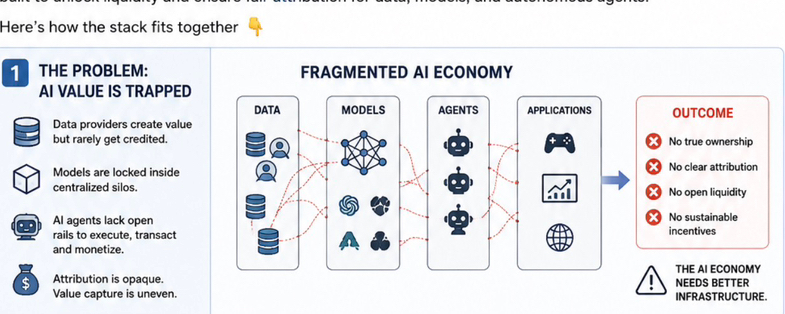

What’s less obvious? The value layer still feels broken.
Data gets collected. Models get trained. Agents execute tasks. But when you zoom out, most of the economic upside still gets trapped in centralized systems with limited attribution and weak incentive alignment.
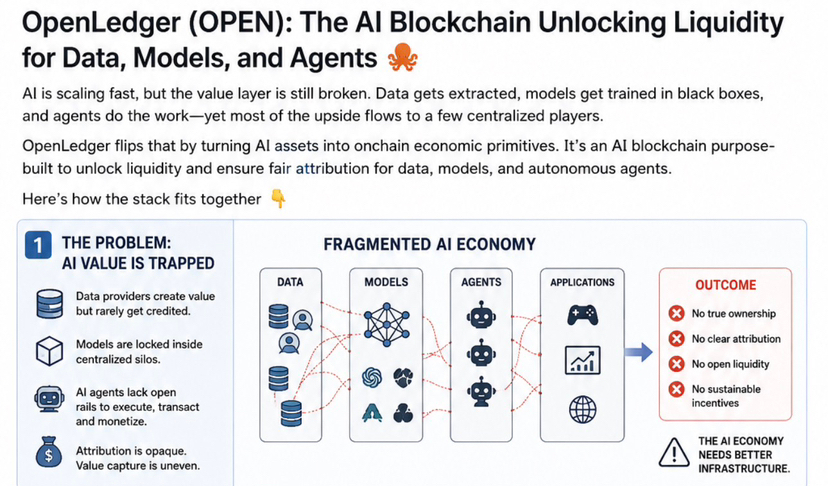 That’s the part of the AI conversation I think people underweight.
OpenLedger isn’t trying to be “just another AI token.” The more interesting thesis is infrastructure: building an AI-native blockchain where data, models, and autonomous agents can actually function as economic participants instead of disconnected components.
Think about the current friction.
A dataset might help train a useful model, that model powers an agent, the agent creates value... but tracing contribution across that stack? Messy. Monetizing it fairly? Even messier.
That’s where OpenLedger’s architecture starts making sense.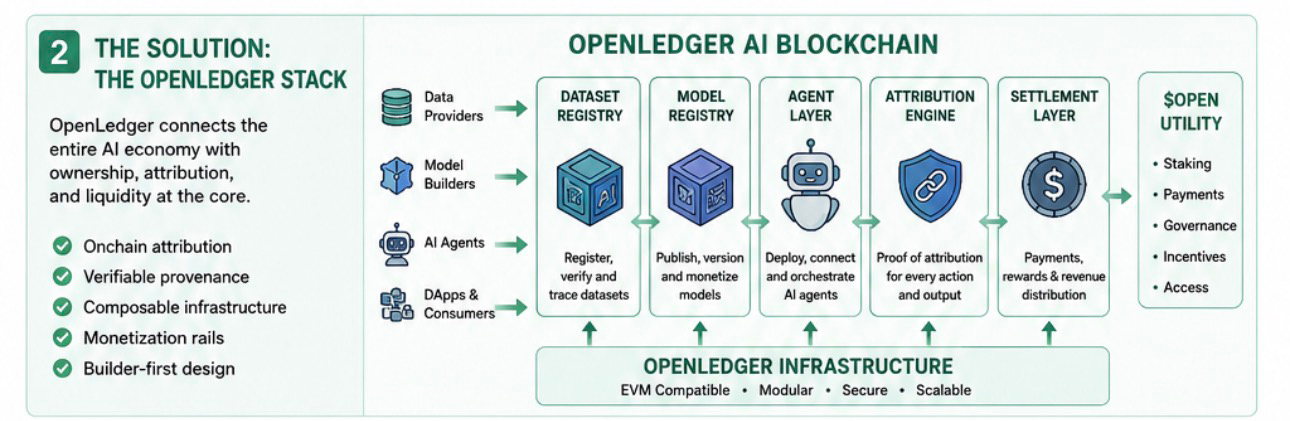
The attribution layer matters more than hype.
If every contribution across the AI pipeline can be tracked, verified, and economically recognized, you move from speculative AI narratives toward actual infrastructure.
That changes incentives.
Data providers are no longer invisible.
Model builders aren’t dependent on closed ecosystems.
Agents become more than experimental bots sitting in isolated environments.
They become economic actors.
And this is where OpenLedger’s ecosystem gets more interesting than generic “AI + blockchain” branding.
Octoclaw lowers deployment friction for agent execution.
Trading agents push toward practical automation use cases instead of theoretical demos.
ERC-4626 integration opens stronger DeFi composability pathways.
The EVM bridge matters because isolated ecosystems rarely scale efficiently.
Vibecoding and cloud tooling matter because infrastructure only wins if builders actually use it.
So the bigger question isn’t whether AI grows.
That seems inevitable.
The better question is:
where does value settle when AI systems become increasingly autonomous?
If attribution stays opaque, value concentrates.
If attribution becomes native infrastructure, the economic model changes.
That’s the bet OpenLedger seems to be making.
Still early, obviously.
But I find infrastructure narratives way more compelling than hype cycles pretending every AI project is revolutionary by default.
If the agent economy actually scales, monetization rails may matter more than the intelligence layer itself.
That’s what I’m watching.