


You upload data.
You give feedback.
You help train models just by existing online.
And somehow… the value ends up concentrated in a few closed platforms running black-box systems.
That’s the uncomfortable reality of the current AI economy.
AI keeps advancing fast but the people creating the raw intelligence behind it rarely own anything.
No attribution.
No revenue share.
No visibility.
Just contribution without compensation.
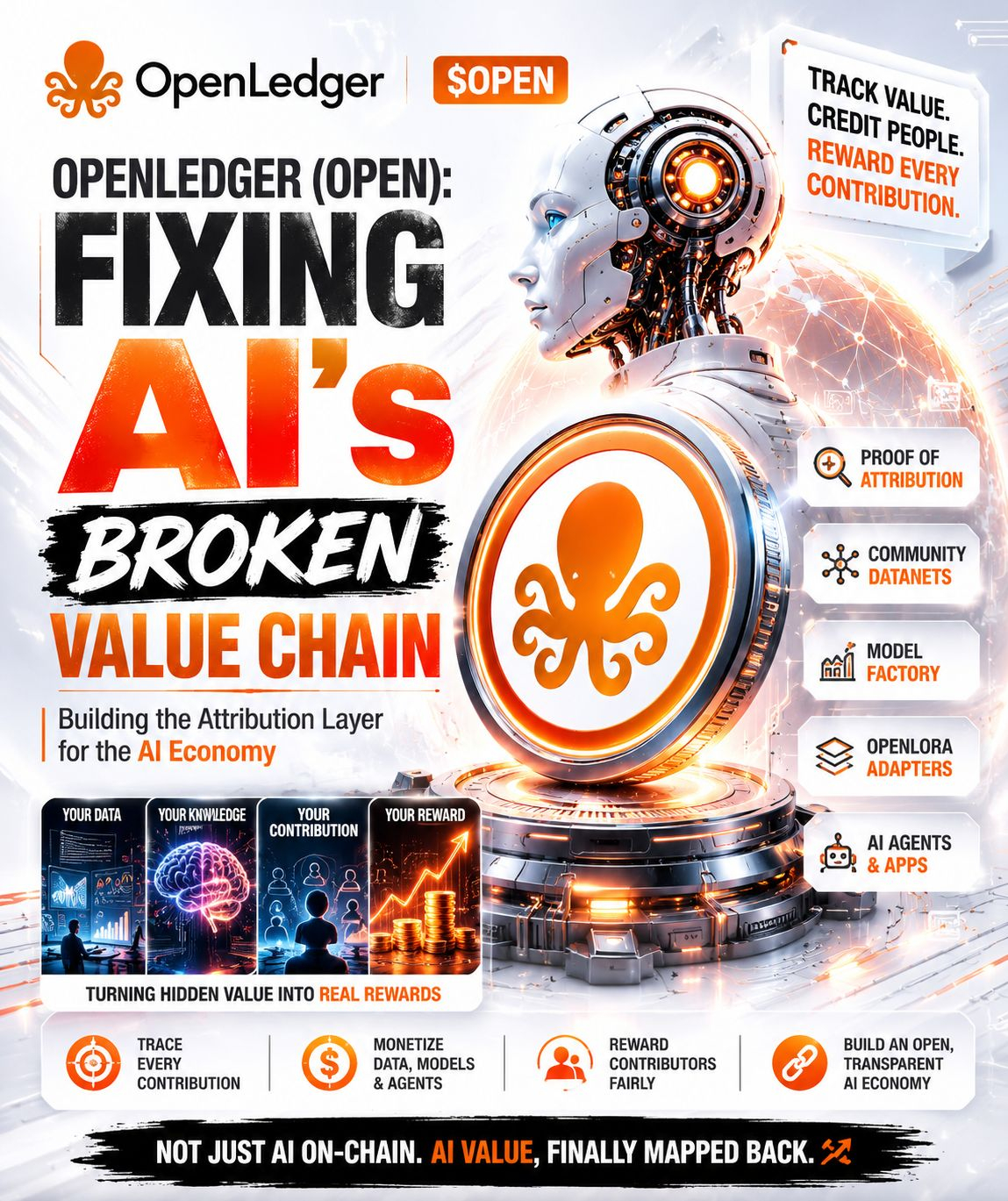
That’s the gap @OpenLedger (OPEN) is trying to fix.
The idea is actually simple:
👉 If data creates value, contributors should be able to track it and earn from it.
Today’s AI works like a sealed factory:
data goes in → model comes out → profits stay inside.
OpenLedger wants to open that factory and make the value chain transparent, verifiable, and on-chain.
Their core thesis isn’t “more AI models” or another hype narrative.
It’s an attribution layer for AI.
Because if you can’t measure contribution, you can’t reward it.
And if contributors never earn, the AI economy stays fundamentally broken.
This is where Proof of Attribution comes in.
Instead of treating AI outputs like magic, OpenLedger tries to map who actually added value:
• Which dataset helped train it
• Which model or adapter improved results
• Which agent executed the task
• Who deserves a share of the outcome
If this works, data stops being disposable input and becomes a real economic asset.
And honestly — that changes everything.
Rather than chasing one giant “do-everything” model, OpenLedger leans into specialized AI.
The future probably isn’t one god-model running the world.
It’s thousands of focused systems built for real industries:
finance, cybersecurity, legal research, healthcare, gaming, Web3 analytics, enterprise workflows.
Each vertical needs high-quality structured data — not random internet noise.
That’s where Datanets enter.
Think of Datanets as community-owned data economies.
A cybersecurity Datanet organizes threat intelligence.
A finance Datanet structures market signals.
A legal Datanet compiles jurisdiction-specific records.
The key difference?
Contributors don’t disappear after submitting data.
If their data powers a model that generates usage, rewards can flow back to them.
That creates a real flywheel:
Better data → better models
Better models → more apps & agents
More usage → more fees
More fees → contributor rewards
Rewards → stronger contributors
Actual economics not just token emissions pretending to be adoption.
OpenLedger also introduces tools like Model Factory and OpenLoRA to lower the barrier for building specialized AI.
Because let’s be real: most teams don’t have OpenAI-level infrastructure.
Instead of training massive models from scratch, developers can fine-tune existing ones cheaply and quickly for specific tasks.
A trading model should master markets.
A security model should understand attack vectors.
A legal model should understand law.
Specialization beats scale when utility matters.
Where things get even more interesting is the agent layer.
AI agents are evolving from passive tools into economic actors.
They can call models, execute workflows, interact with smart contracts, and pay for services autonomously.
But agents need rails:
identity, payments, access, trust, and usage tracking.
OPEN is designed to sit inside that flow.
The token powers gas, inference payments, staking, contributor rewards, and governance — meaning value moves through the network as AI services are actually used.
That’s the bullish case.
The realistic case?
None of this matters without real adoption.
Crypto AI projects often look incredible on paper great diagrams, strong narratives but fail when usage never arrives.
Attribution itself is also extremely hard technically. Measuring which data influenced an AI output across layered models and adapters isn’t trivial.
Execution will decide everything.
OpenLedger needs:
developers building models,
active Datanets,
real agents,
real apps,
and contributors earning enough to stay involved.
Without usage, the flywheel never spins.
Still, the problem they’re tackling is very real.
AI may become the largest value-creation engine of this decade yet today’s system heavily favors centralized platforms capturing most of the upside.
OpenLedger is betting the next phase of AI requires new infrastructure:
ownership rails,
payment rails,
and most importantly attribution rails.
Track the data.
Monetize the models.
Reward contributors.
Let agents transact on-chain.
If they succeed, AI shifts from hidden value extraction to open, contributor-owned economics.
Not just AI on blockchain.
But AI value finally flowing back to the people who helped create it.
Definitely one to watch but like all DeAI plays, execution > narrative. 👀