

I’ve been around crypto long enough to notice when a narrative feels manufactured versus when it feels inevitable. Manufactured narratives usually explode fast, dominate timelines for a few weeks, then slowly disappear once liquidity rotates somewhere else. But inevitable narratives behave differently. They keep resurfacing even after hype cools down because the underlying problem never actually goes away.
That’s the feeling I got when I started looking into .
At first I wasn’t even planning to research it deeply. I’ve seen too many AI-related crypto projects recently, and honestly, a lot of them blur together after a while. Same futuristic branding. Same promises about decentralized intelligence. Same vague language about revolutionizing industries. After the third or fourth project, your brain naturally becomes skeptical.
But something about OpenLedger kept showing up in conversations differently. Not louder. Just differently.
People weren’t only talking about AI models or infrastructure performance. They were talking about ownership. Attribution. Contribution. Incentives. That immediately made me pay closer attention because I think the AI market is quietly approaching a tension point most people still underestimate.
Right now AI is creating enormous value, but the ownership structure still looks incredibly concentrated.
That matters more than people think.
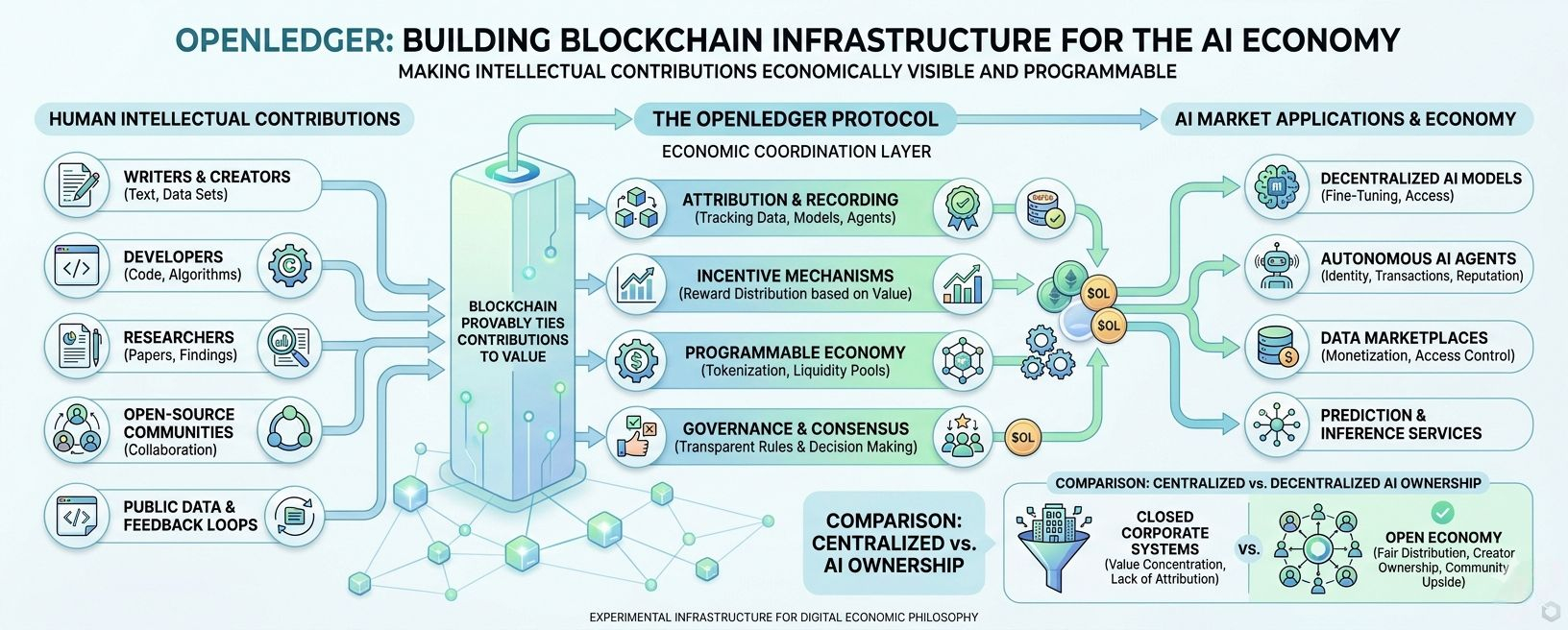
Every major AI system today is built on layers of human contribution. Writers, developers, researchers, artists, online communities, public data, feedback loops, open-source ecosystems. Intelligence systems don’t emerge magically from nowhere. They absorb human knowledge at massive scale. Yet the economic rewards mostly flow toward centralized companies controlling the platforms.
I’ve noticed this becoming a bigger conversation lately, especially among creators and developers. People are starting to ask uncomfortable questions. If AI systems are trained on collective human input, should only a few corporations own the upside forever? Or does the internet eventually move toward something more open?
That’s where OpenLedger suddenly became much more interesting to me.
From what I’m seeing, the project isn’t trying to become another flashy AI application. It’s trying to build infrastructure for AI economies themselves. And honestly, I think that distinction matters a lot.
The easiest way I can explain it is this: OpenLedger seems focused on making AI contributions economically visible and programmable through blockchain infrastructure. Data, models, agents, inference activity, participation. Instead of existing invisibly inside centralized systems, those contributions can theoretically become attributable and rewardable onchain.
At first that sounded abstract in my head, but then I started connecting it to something crypto already understands well: liquidity.
A few years ago DeFi transformed idle crypto assets into productive economic layers. Tokens sitting passively suddenly became collateral, liquidity, yield-generating assets, governance mechanisms. Entire ecosystems formed around making capital more programmable.
OpenLedger feels like a similar idea applied to intelligence itself.
Not just tokenizing AI narratives for speculation, but creating systems where intelligence contributions become economically active.
That’s a much bigger concept than most people realize at first glance.
What also caught my attention is the timing. The broader crypto market feels like it’s slowly moving away from pure attention cycles and back toward infrastructure again. Liquidity isn’t as careless as it was during peak euphoric phases. Retail participants are more selective. Even institutions entering crypto now seem more interested in foundational systems than short-lived hype.
AI infrastructure sits directly inside that shift.
And I think OpenLedger understands something important about where AI is heading. Most people currently focus on the visible layer of AI, meaning the apps and outputs. Chatbots, image generation, assistants, automation tools. But underneath that sits another layer entirely. The economic coordination layer. Who contributes value. Who owns data. Who controls access. Who captures monetization.
That layer still feels unresolved.
The more I looked into OpenLedger, the more I realized the project is essentially betting that future AI ecosystems will eventually require transparent economic coordination systems. If millions of people and autonomous agents contribute to intelligence networks over time, there needs to be infrastructure capable of tracking and distributing value fairly.
And honestly, blockchains are probably one of the few technologies naturally designed for that kind of coordination problem.
I didn’t expect this observation to stick with me, but OpenLedger almost feels less like a traditional crypto project and more like an experiment in digital economic philosophy. It’s asking whether intelligence itself can become part of an open economy instead of remaining trapped inside closed corporate systems.
That’s a very different conversation from most AI narratives in crypto right now.
The rise of AI agents also makes this more interesting. I’ll admit, when the “agent economy” narrative first exploded, I mostly dismissed it as market excitement running ahead of reality. Every project suddenly wanted to build autonomous AI ecosystems. It felt forced.
But lately I’ve started changing my perspective a little.
Not because I think fully autonomous digital civilizations are suddenly around the corner, but because even relatively simple AI systems already require economic coordination layers. If AI agents eventually transact, negotiate, process services, or interact autonomously online, they need infrastructure capable of handling identity, incentives, ownership, payments, and reputation.
Traditional internet systems weren’t built for that.
Blockchains were.
That’s why OpenLedger focusing on AI economies instead of just AI applications feels strategically smart to me. It’s operating one layer below the visible hype cycle.
And historically, infrastructure layers tend to become more important over time than most people initially expect.
I also think there’s an underrated cultural shift happening underneath all this. Younger internet users increasingly care about ownership dynamics. Creators want monetization control. Developers prefer open ecosystems. Communities are becoming less comfortable generating enormous value for platforms they don’t own.
AI intensifies those tensions dramatically because now the value being extracted isn’t just attention anymore. It’s intelligence itself.
That changes the emotional psychology around participation.
If future AI systems depend heavily on collective contributions, I think users eventually demand more transparent value-sharing models. Maybe not immediately, but eventually.
That’s the larger trend OpenLedger seems aligned with.
Of course, none of this guarantees success. Actually, the risks here are huge.
Execution risk alone is massive. Building blockchain infrastructure is already difficult. Building infrastructure tied to AI economies while both sectors evolve rapidly at the same time is even harder. OpenLedger doesn’t just need a strong technical foundation. It needs developers, contributors, applications, governance participation, and sustained ecosystem activity.
That’s incredibly difficult to coordinate.
Competition is another major issue. already holds strong mindshare in decentralized machine intelligence. dominates large parts of the compute narrative. Larger ecosystems like are aggressively pushing AI integrations too.
And AI narratives move fast. Sometimes too fast.
Projects can attract huge attention quickly, then struggle maintaining momentum once markets demand real adoption metrics instead of conceptual potential. I’ve seen this pattern repeatedly in crypto. Narrative strength creates visibility, but sustainable ecosystems require actual economic activity underneath them.
Token economics matter too, maybe more than people realize right now. Every AI-related blockchain eventually faces the same challenge: does the token genuinely connect to network utility, or does it mainly function as a speculative asset riding market excitement?
That distinction becomes brutally important during weaker market conditions.
I’m also paying attention to regulatory uncertainty here. AI governance discussions are accelerating globally, and decentralized systems dealing with data attribution or AI ownership could eventually face legal complexities nobody fully understands yet. The intersection between AI and crypto is probably one of the least-defined regulatory spaces in technology right now.
Still, despite all those risks, I keep coming back to one personal observation that feels difficult to ignore.
The internet spent the last twenty years monetizing human attention.
The next phase of the internet might monetize human intelligence itself.
And if that’s true, then the infrastructure deciding who owns, distributes, and benefits from that intelligence becomes incredibly important.
That’s why OpenLedger stayed in my head longer than I expected after researching it. Not because it guarantees success. It doesn’t. The space is still experimental, volatile, and highly competitive. But because it’s focused on a problem that feels real and increasingly unavoidable.
Most AI projects talk about making machines smarter.
OpenLedger feels more interested in figuring out whether humans participating in AI economies should finally have ownership within them too.
And honestly, I think that question becomes much bigger over the next few years than the market currently realizes.
Because if AI truly becomes the next foundational economic layer of the internet, then we probably won’t just debate how intelligent these systems become.
We’ll debate who the intelligence actually belongs to.
