
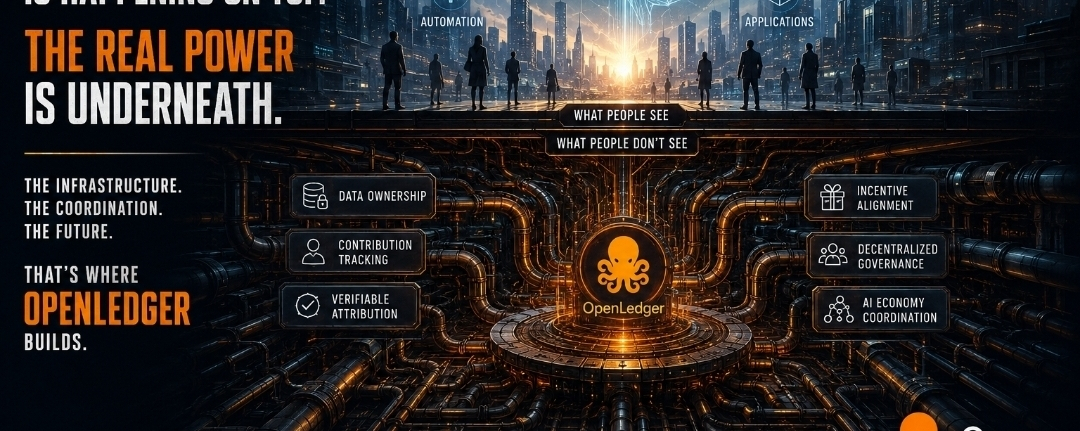

@OpenLedger Everyone wants to talk about the AI revolution… but almost nobody wants to talk about the pipes running underneath it.
And honestly, that’s usually where the real power ends up.
The more I sit with OpenLedger, the less it feels like a project trying to compete in the AI race directly… and the more it feels like something trying to position itself underneath the race itself.
That’s a very different thing.
Because right now, most of the attention around AI is happening at the surface level. New models, AI agents, automation tools, viral products — everything people can immediately see and interact with gets all the excitement.
But underneath all of that, there’s another problem quietly growing in parallel.
Who owns the data feeding these systems?
Who gets rewarded when models improve?
Who tracks contribution?
Who coordinates value once thousands of AI systems start interacting with each other?
And the strange part is… most of AI still doesn’t have a clean answer for any of this.
Everything feels fragmented.
Data moves everywhere, but ownership stays blurry. People contribute value constantly without realizing it. Models get smarter, but the systems around attribution and incentives still feel messy and disconnected.
It almost feels like AI grew faster than the infrastructure needed to support it.
And maybe that’s why OpenLedger starts making more sense the longer you think about it.
Because it’s not really trying to become “the AI.”
It’s trying to become the layer that organizes the chaos forming around AI.
At first, that sounds less exciting. Infrastructure usually does. People don’t get emotionally attached to backend systems. They notice the applications, not the coordination layers underneath them.
But historically… those hidden layers end up mattering the most.
Not because they’re visible.
Because eventually, everything starts depending on them.
That’s the feeling I keep getting with OpenLedger.
It’s less focused on building one isolated product and more focused on structuring how data, models, agents, and contributors interact with each other. Almost like it’s preparing for a future where AI systems don’t operate alone anymore… but as connected economies.
And once you start looking at AI that way, the problems become much bigger than intelligence.
Now it’s about coordination.
Take data for example.
Right now, data flows into AI systems almost invisibly. People create information constantly — through usage, behavior, content, interactions — and most of that value disappears into centralized systems without clear attribution.
You help train the machine… but rarely participate in the value the machine creates afterward.
That imbalance is starting to feel more noticeable as AI grows.
OpenLedger seems to be trying to tighten that gap.
The idea isn’t just that data exists — it’s that contribution itself can become trackable, attributable, and eventually monetizable. So instead of value disappearing into black-box systems, contributors become visible parts of the network.
And honestly… that changes the feeling of the system entirely.
Because once contribution can be verified, value distribution stops feeling arbitrary.
It becomes programmable.
But that’s also where things start getting complicated.
The moment you build incentives around AI infrastructure, you’re no longer just building technology. You’re building an economy. And economies don’t run purely on efficiency — they run on trust, governance, and human behavior.
That’s the part people underestimate.
Infrastructure sounds neutral until you realize infrastructure quietly shapes everything built on top of it.
The systems coordinating value eventually influence who benefits from value.
And if OpenLedger becomes a layer where AI ecosystems coordinate data, ownership, and rewards… then it’s not just supporting activity anymore.
It’s influencing the rules underneath the activity itself.
That’s real power.
Not loud power.
Structural power.
The kind people barely notice while it’s forming.
And maybe that’s why the blockchain side of this matters more than it first appears.
A lot of AI today still operates in closed environments. Models become more powerful, but attribution becomes harder to trace. Contributions disappear into systems users can’t fully see into. Value moves… but visibility doesn’t always move with it.
OpenLedger seems to approach blockchain less like branding and more like infrastructure for coordination — a way to make contribution, ownership, and incentives more transparent as AI systems become increasingly interconnected.
That doesn’t magically remove problems, though.
In fact, it creates new ones.
Because once infrastructure starts coordinating intelligence itself, questions around control become unavoidable. Who defines participation? Who sets the rules around attribution? Which contributors matter more than others?
Even decentralized systems still depend on someone designing the framework underneath them.
And frameworks shape behavior more than people realize.
That’s why the deeper you look at the AI gold rush, the less it feels like the biggest opportunity is sitting at the surface.
It might actually be underneath everything.
In the systems quietly positioning themselves as the coordination layer behind the next generation of AI economies.
And honestly… that’s a little unsettling once it clicks.
Because if AI becomes powerful through intelligence… but infrastructure becomes powerful through dependency…
then who really ends up controlling the future —
the systems creating intelligence…
or the systems quietly deciding how that intelligence is allowed to move, scale, and create value in the first place?
