
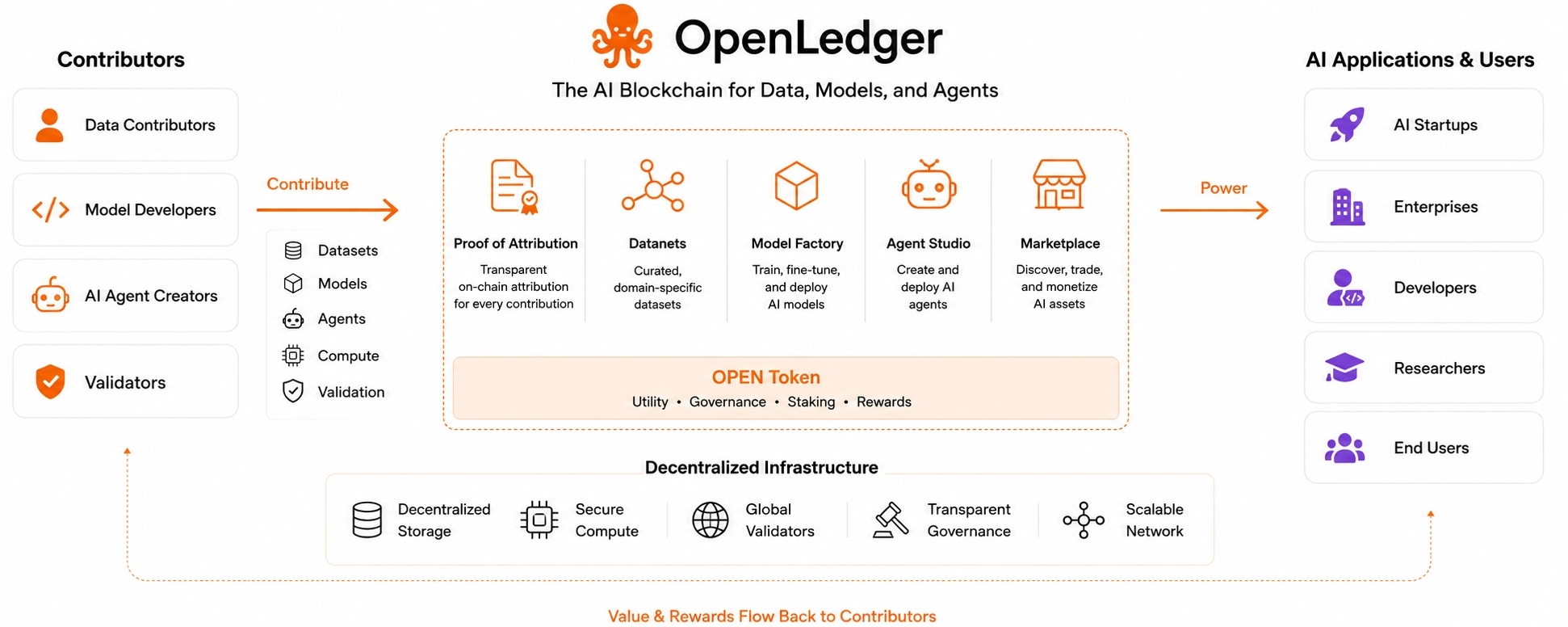

I keep coming back to OpenLedger because it feels like one of those projects trying to stand in front of a shift before anyone fully understands where the shift is going. Not in the loud way crypto usually does things, where every new narrative gets treated like the final form of the internet. This feels quieter than that. More uncertain. Almost like the project itself is still testing whether the assumptions underneath it can survive reality.
The idea sounds simple when you first hear it. AI models, datasets, contributors, validators, all connected through a blockchain economy where value is supposed to flow back to the people actually contributing intelligence into the system. Data becomes an asset. Models become productive infrastructure. Attribution becomes measurable. At least that’s the theory.
But I’ve watched crypto long enough to know that theories behave very differently once incentives start pulling on them.
That’s the part I find myself thinking about whenever I look at OpenLedger. Not the branding. Not the token charts. Just the pressure points underneath the architecture. Because crypto projects rarely fail from lack of vision. They usually fail when human behavior enters the equation.
And human behavior changes the second money appears.
People always talk about decentralization as if it naturally creates fairness, but most decentralized systems eventually become mirrors of whatever incentives dominate them. The moment contributors are rewarded for data, people begin optimizing for rewards instead of usefulness. The moment attribution becomes valuable, participants start looking for ways to manufacture attribution. Every metric eventually turns into something people learn to game.
That doesn’t mean the idea is broken. It just means systems become more honest under pressure.
OpenLedger interests me because it seems aware of that problem, at least indirectly. The project keeps circling around ideas like proof of attribution, transparent contribution tracking, specialized data networks, validation layers. Underneath all the technical language, what it’s really trying to solve is trust. Not trust in the blockchain itself, but trust in whether intelligence can be measured fairly once it becomes financialized.
And I’m not sure anyone actually knows the answer to that yet.
The AI industry right now feels strangely detached from the people feeding it. Massive models absorb information from everywhere — forums, conversations, articles, images, behavioral patterns — but the economic value rarely flows back outward. It concentrates upward into a handful of companies with enough compute and infrastructure to dominate the field. OpenLedger seems to be reacting to that imbalance by asking whether intelligence itself can become part of an open economic system instead of a closed corporate asset.
That question matters more than most people realize.
But crypto has a habit of taking real problems and assuming tokenization alone solves them. I’ve seen this happen too many times. A genuine structural issue gets identified, then the market rushes to financialize the solution before understanding the long-term consequences of the incentive model being built around it.
Sometimes I wonder if the crypto industry confuses coordination with alignment. A blockchain can coordinate participants. That doesn’t mean participants remain aligned once scarcity, speculation, and profit enter the system.
That’s where projects become interesting to me — not at launch, but later, when the incentives start bending behavior in directions nobody originally planned for.
Because OpenLedger isn’t just building infrastructure for AI. It’s trying to build an economy around contribution itself. And contribution is a much messier thing than crypto likes to admit.
What counts as valuable data? Who determines quality? Can decentralized validators actually distinguish expertise from noise at scale? What happens when low-quality synthetic content starts flooding systems designed to reward participation? The more AI-generated material exists online, the harder attribution itself becomes. Eventually machines start training on machine-produced outputs, and suddenly the entire ecosystem begins feeding back into itself.
That possibility feels more real to me than most of the optimistic projections surrounding decentralized AI.
Still, I can understand why projects like this keep emerging. There’s a growing discomfort around how centralized AI development has become. A small number of companies control the compute, the models, the interfaces, the distribution, and increasingly the data pipelines too. Crypto naturally reacts against concentration. It always has. OpenLedger feels like part of that reaction — an attempt to build economic rails underneath AI before the industry hardens into permanent monopolies.
Whether that works is another question entirely.
Decentralized systems sound attractive philosophically, but in practice they move slower, coordinate less efficiently, and often struggle once speculative behavior overtakes genuine participation. Crypto markets are incredibly good at pricing narratives long before real adoption arrives. AI makes that even more dangerous because the narrative already carries enormous emotional weight outside crypto.
Everyone is afraid of missing the next infrastructure layer now.
That fear changes how projects are perceived. It creates an environment where ambition alone starts sounding like inevitability. And I’ve learned to be careful whenever the market begins speaking about the future as if it has already arrived.
OpenLedger may eventually build something meaningful. Or it may discover the same thing many crypto systems eventually discover: that aligning human incentives around long-term quality is far harder than designing the architecture itself.
Personally, that uncertainty is what keeps my attention on it.
Not because uncertainty is bullish, but because it’s honest.
Most systems look coherent before they experience stress. Governance sounds elegant before power concentrates. Incentive structures sound fair before exploitation begins. Communities sound ideological before market cycles test loyalty. The real identity of a crypto project usually appears later, after enough pressure exposes what participants actually value once speculation fades.
And that’s what I keep quietly watching with OpenLedger.
Not whether the token pumps. Not whether AI remains the dominant narrative this cycle. Just whether a system built around monetizing intelligence can avoid collapsing into the same patterns crypto always seems to reproduce — extraction, centralization, short-termism, and incentives drifting away from the original mission.
Because underneath all the language about decentralized AI, that’s the real question sitting in the background.
Whether intelligence can become an open economic layer without eventually being captured by the same forces these systems were supposedly designed to escape.