
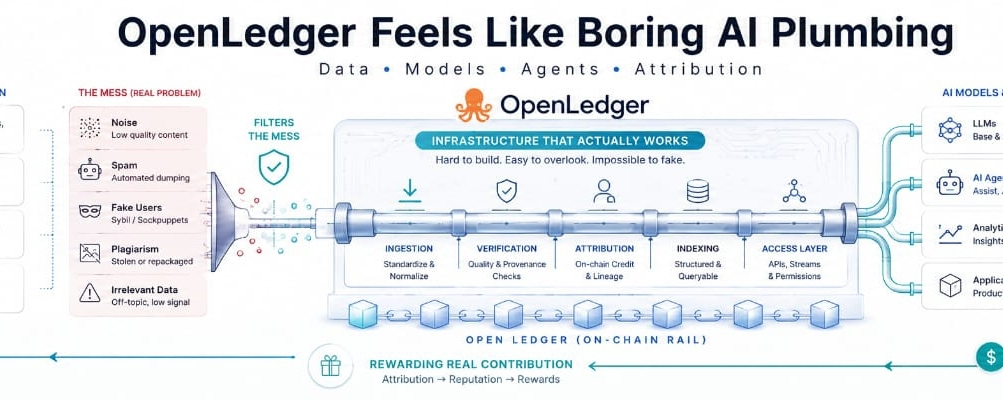
OpenLedger (OPEN) feels like one of those projects I don’t want to hype too quickly, because crypto has already burned that instinct out of me. Look, we have all seen this before. A new narrative shows up, everyone starts using the same words, and suddenly every project is “AI infrastructure” with a token attached. After a few cycles, you stop clapping immediately. You start asking where the actual use is.
Honestly, the thing OpenLedger is trying to deal with is real.
AI runs on data. Models need data. Agents need data. And most of that data comes from people who never really get paid for it. Writers, researchers, developers, communities, users, people cleaning things up behind the scenes. Their work gets absorbed into some model, some product, some system, and then the value moves somewhere else.
That is the mess.
And crypto has its own version of this mess too. Bad airdrops. Fake users. Point farming. People pretending to contribute just to get rewards. Projects rewarding noise because they cannot properly measure value. We have all watched it happen. The loudest wallets get noticed. The real contributors get ignored. Then everyone acts shocked when the system fills with junk.
So when OpenLedger talks about data, models, agents, and attribution, I understand why it exists.
Not because it sounds fancy.
Because this part of the market is broken.
The idea is basically to build plumbing for AI value. Not the exciting stuff people put in viral threads. More like the stuff under the hood. Who contributed what? Which data matters? Which model is being used? Who should get rewarded if something creates value?
It is not flashy.
It is just necessary.
But that does not mean it is easy.
The thing is, measuring contribution in AI is brutally difficult. A model does not always tell you clearly which piece of data helped it produce something useful. Data gets mixed together. Patterns get buried. Outputs are not clean. So if OpenLedger wants to reward contributors properly, it has to solve a problem that is messy from the start.
And once rewards are involved, crypto behavior shows up.
People will farm it. People will upload low-quality data. People will try to game whatever scoring system exists. Some will pretend to be useful. Some will copy others. Some will spam the network until something pays.
That is not negativity.
That is experience.
Every open incentive system in crypto eventually meets the same crowd: builders, users, farmers, and parasites. OpenLedger will need to handle all of them. If it cannot separate real value from noise, the whole thing becomes another reward machine with better branding.
Still, I can see why this project matters.
AI is becoming too centralized. Data ownership is unclear. Model value is hard to trace. Smaller builders do not have the same access as the giants. And contributors are still treated like invisible fuel. OpenLedger is trying to put some structure around that. Some accountability. Some way to make data and model work less invisible.
That part is worth paying attention to.
But I do not want to oversell it.
Blockchain does not magically fix bad data. It does not magically make AI honest. It does not stop people from lying. It records things, yes. It can make actions visible. But visibility is not the same as truth. If someone uploads garbage, the chain can record garbage forever.
Beautiful.
Still garbage.
So the real test is not whether OpenLedger has a strong idea. It does. The real test is whether the infrastructure actually works when people start using it for selfish reasons. Because that is when crypto systems get tested. Not when the docs look clean. Not when the community is excited. When incentives go live and everyone starts pushing the edges.
OPEN as a token also has to earn its place.
Maybe it is needed for payments, rewards, access, governance, or network activity. Fine. But crypto has seen too many “utility tokens” that looked useful on paper and ended up being mostly trading chips. A token can be part of the system, but it should not become the only reason people care.
That is always the danger.
If people only show up for rewards, they leave when rewards shrink.
If people only talk about listings, the product becomes background noise.
If the token moves faster than adoption, the story gets fragile.
OpenLedger has to avoid becoming just another AI coin people rotate through during a narrative run. That is the hard part. It needs real data contributors. Real builders. Real model usage. Real demand. Not just wallets farming tasks and waiting for something to pump.
Honestly, the boring side is probably the most important side here.
The filters.
The reward logic.
The data quality.
The attribution system.
The developer experience.
The parts nobody wants to tweet about.
That is where OpenLedger either becomes useful or becomes another nice idea that got swallowed by crypto habits.
Maybe it works. Maybe it takes years. Maybe the market loses interest before the infrastructure matures. That happens all the time. Crypto is impatient. Infrastructure is slow. AI is messy. Put them together and you get a project that has a real problem to solve, but also a lot of ways to fail.
Still, I prefer this kind of idea over another empty AI mascot coin.
At least OpenLedger is pointing at something painful. The unpaid data layer. The invisible contributors. The broken reward systems. The fake activity problem. The question of who actually owns and earns from AI work.
That does not make it perfect.
It just makes it relevant.
For now, I see OpenLedger as plumbing for a part of AI crypto that desperately needs better plumbing. Not glamorous. Not clean. Not guaranteed.
But maybe necessary.
And in crypto, honestly, necessary is already more interesting than most of the noise.