
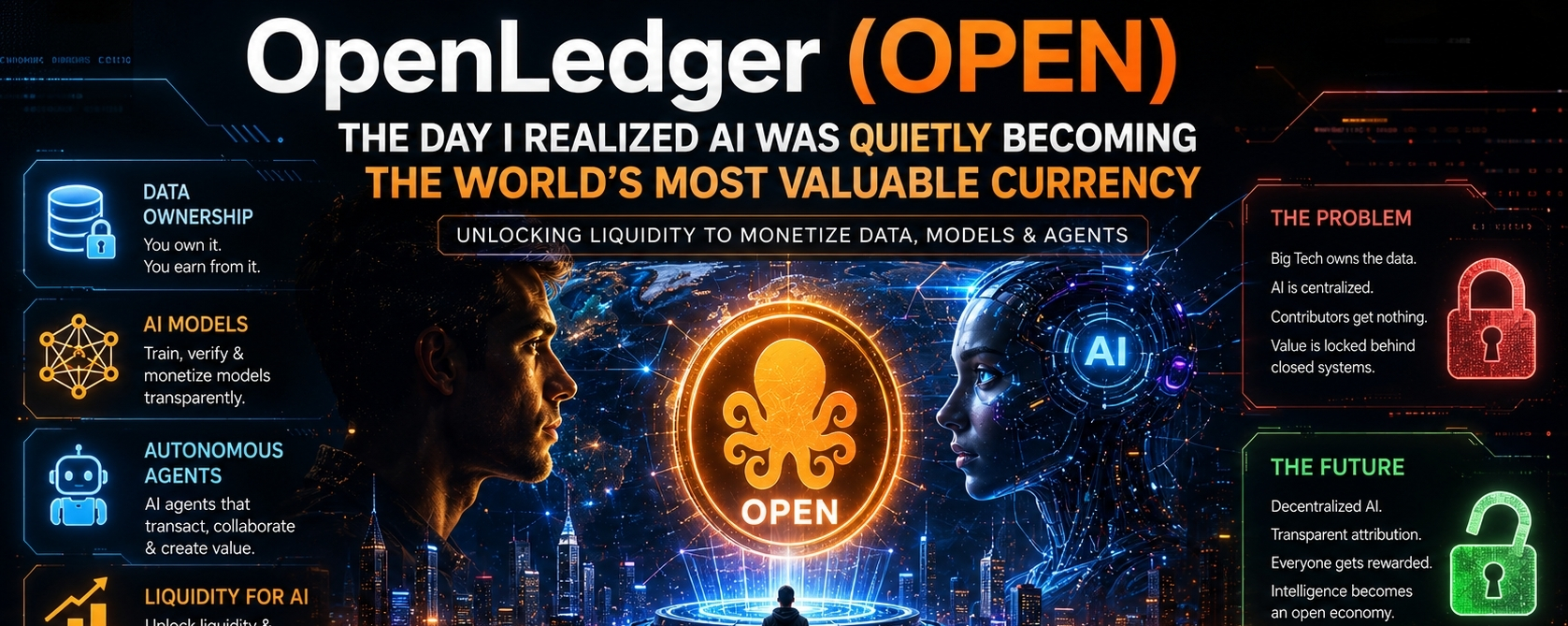
When i first started looking into OpenLedger, i honestly expected another recycled AI token trying to survive on hype, buzzwords, and temporary market excitement. The crypto industry has become crowded with projects promising “revolutionary AI infrastructure,” but most of them feel empty once you look beyond the marketing.
But this one felt different the deeper i went.
I remember when i start reading through their vision, i noticed they were not only talking about faster transactions or decentralized apps. They were talking about something much bigger ownership of intelligence itself. That sentence stayed in my mind for hours because most people still do not understand what AI is quietly turning into.
AI is no longer just software.
It is becoming an economic engine.
And whoever controls the data behind that engine controls the future.
That realization completely changed the way i looked at OpenLedger.
The strange thing about modern AI is that billions of people unknowingly help build it every single day. Every search, every image upload, every conversation, every trend, every online interaction slowly trains future systems. Humanity is feeding intelligence into machines nonstop, yet almost nobody gets rewarded for it. Big tech companies collect the value, lock the models behind closed systems, and monetize outputs at a scale ordinary users cannot even imagine.
When i start noticing this pattern, OpenLedger suddenly stopped looking like a normal blockchain project to me.
It started looking like a response to a broken internet economy.
Most blockchains focus on moving money. OpenLedger seems focused on moving value created by intelligence. That difference is massive. The project is trying to create liquidity around data, AI models, and autonomous agents in a way that feels more like building an economy than building an app.
And honestly, i think most people still underestimate how early this entire narrative is.
What caught my attention most was the idea of attribution. The more i researched, the more i noticed OpenLedger repeatedly emphasizing traceability and contribution. At first glance, that sounds technical. But underneath it sits one of the biggest unanswered questions in artificial intelligence:
Who deserves payment when AI creates value?
That question becomes extremely uncomfortable once you think deeply about it.
If an AI model generates billion..dollar outputs using data collected from millions of people, who should benefit financially? The company? The engineers? The users whose information trained the system? Society itself?
Right now, nobody truly has an answer.
And i think that uncertainty is exactly where OpenLedger sees its opportunity.
When i start connecting all the pieces together, i noticed the project is not trying to compete directly with AI giants like OpenAI or Google. Instead, it appears to be building the economic rails underneath decentralized AI systems. Almost like a financial layer for machine intelligence.
That idea feels far more important than another chatbot.
Because eventually AI models may become cheap and everywhere. But trusted data, verified attribution, transparent provenance, and monetizable contribution systems could become the real scarce assets of the AI era.
That is where things become fascinating.
I when looking deeper into broader AI research communities, i noticed more academics and developers quietly discussing decentralized intelligence ecosystems. Not because decentralization sounds trendy, but because centralized AI creates dangerous concentrations of power. Whoever owns the intelligence layer could eventually influence finance, media, education, healthcare, and even political systems.
That is not science fiction anymore.
It is already happening.
And OpenLedger appears to be positioning itself directly inside that future conflict.
What surprised me most is how psychological this entire market has become. Most people still trade AI tokens based on momentum without understanding the infrastructure war happening underneath. Everyone sees flashy demos and viral AI videos, but very few are paying attention to the invisible layer powering ownership, incentives, and data legitimacy.
When i noticing discussions around OpenLedger communities, i saw something unusual compared to typical meme-driven hype cycles. People were not only talking about price action. They were discussing data economies, decentralized contribution systems, AI governance, and tokenized intelligence markets.
That tells me this narrative is evolving beyond speculation.
And maybe that is why the project keeps attracting attention despite operating in such a competitive space.
The deeper i went, the more i realized OpenLedger’s real bet is not just about crypto adoption. It is betting that the next internet economy will revolve around intelligence ownership instead of information ownership.
The old internet monetized attention.
The next internet may monetize intelligence itself.
That transition changes everything.
Because once intelligence becomes programmable, traceable, and financially connected, entirely new markets begin to emerge. Datasets become assets. AI models become revenue-generating entities. Autonomous agents become economic participants. Human knowledge itself becomes part of a global liquidity network.
That sounds futuristic until you realize the foundation is already being built right now.
But i also think people romanticize decentralized AI too easily. There are serious risks hiding beneath this vision. Malicious data can poison systems. Attribution mechanisms can potentially be manipulated. Autonomous agents could create legal and ethical chaos nobody is prepared for. Governance inside decentralized intelligence networks may become one of the hardest technological problems humanity has ever faced.
And honestly, that complexity is exactly why OpenLedger interests me.
Easy ideas rarely reshape industries.
The projects attempting impossible coordination problems are usually the ones worth watching closely.
When i look back at previous technology cycles, i notice the same pattern repeating constantly. The biggest innovations often appear confusing in the beginning because people judge them using old frameworks. Ethereum was once dismissed as useless internet money. Early AI research was treated like fantasy. Even social media originally looked insignificant before it transformed global culture.
OpenLedger feels like one of those ideas people may only fully understand years later.
Right now many see an AI blockchain token.
But underneath, i think the project is really experimenting with something much larger a system where intelligence itself becomes an open financial economy instead of a closed corporate asset.
And if that idea succeeds, even partially, it could completely redefine how humans interact with AI forever. @OpenLedger