
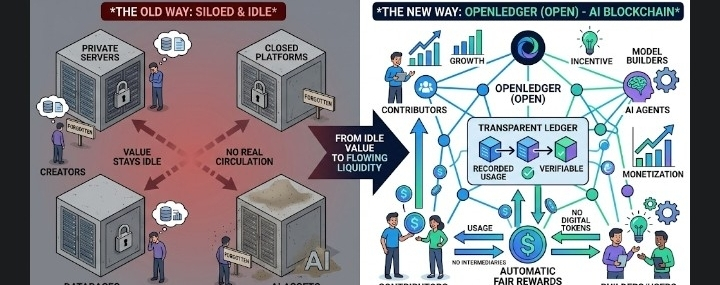
*Most data, models, and AI agents today are built, uploaded, and then forgotten. They sit in private servers or closed platforms, useful to their creators but invisible to everyone else. The result is a lot of potential with no real circulation. Ideas get locked away not because they’re bad, but because the system for sharing them fairly never existed.
*OpenLedger (OPEN) approaches this as a liquidity problem. It’s an AI Blockchain where contributors can register data, models, and agents directly on-chain. Once registered, every interaction with those assets is recorded transparently. When someone uses a dataset, calls a model, or deploys an agent, the system routes liquidity back to the original contributor.
*There are no intermediaries deciding who gets paid and who doesn’t. The record is public, verifiable, and tied to actual usage, not speculation. That means the value created by a contributor doesn’t disappear into a platform’s revenue stream. It stays connected to the person who made it.
*The shift here is subtle but important. Trust stops being a claim made by a platform and becomes something the protocol enforces. If contribution is verifiable, then rewards can be automatic and proportional.
*That changes the incentive structure in a quiet way. People are more willing to share if they know the accounting is handled fairly and openly. It removes the fear that your work will be used without credit or compensation. Over time, that changes what gets built, because creators can afford to contribute openly instead of hoarding resources behind paywalls.
*For builders, it lowers the barrier to accessing diverse, real-world data and models without negotiating with a dozen gatekeepers. Instead of starting from scratch or relying on a single vendor, you can pull from a network of assets that are already proven and paid for.
*For contributors, it creates a path to monetize work that would otherwise sit unused. A dataset collected for one project can support ten others. A model trained for a niche task can become infrastructure for someone else.
*For the ecosystem, it means AI development becomes less dependent on centralized data hoards and more dependent on open participation. The network grows stronger as more people add to it, and the benefits circulate back to everyone who contributes.
*OpenLedger isn’t promising to solve every problem in AI. It’s testing a simpler idea: value should follow contribution, not just capital. If that holds, maybe the next phase of AI gets built differently. Not in silos guarded by a few companies, but in a shared space where what you build actually stays yours, and gets used.