

I Will Be Honest...
I’ve been thinking About something lately, and the more I think about it, the harder it becomes to ignore.
Yeah... We spend so Much time talking about what artificial intelligence can do that we rarely stop and ask a much simpler question.
Who actually owns The intelligence we are building?
It sounds obvious at first. Most people would probably say the companies training the models own it. Some Would say the developers writing the code own it. Others might argue that no one really owns intelligence once it exists.
But the more I look at how AI is evolving, the more this question Feels unfinished.
Right now, intelligence is being built on data gathered from millions of people, systems, interactions, and Behaviors. It learns from communities, from shared information, from digital patterns created by all of us. Yet the rewards and control usually end up concentrated in very few hands.
That has always felt strange to me.
If intelligence is Shaped by collective contribution, why is ownership so centralized?
This is not only an AI problem. It is also a crypto problem.
For years, crypto has promised decentralization. We built systems to remove middlemen, to distribute trust, And to give users more control over value creation. But when it comes to AI, we often fall back into old patterns. Massive datasets are locked away. Training happens behind closed doors. Models become black boxes. The people who indirectly help Create them rarely know where their contributions went, let alone benefit from them.
And honestly, I think this is one of the biggest gaps in digital infrastructure today.
The problem is not Just fairness. It is trust.
If an AI system produces decisions that shape markets, products, information, or even human behavior, we should be able to understand where that intelligence Came from. We should know what data shaped it, who contributed to it, and how value flows back through that chain.
Without that transparency, we are simply replacing one form of Centralization with another.
This is where OpenLedger started to catch my attention.
Not because it claims to “revolutionize” anything. I have seen Enough of those promises to know that hype usually fades faster than technology matures.
What interested me was the direction of its thinking.
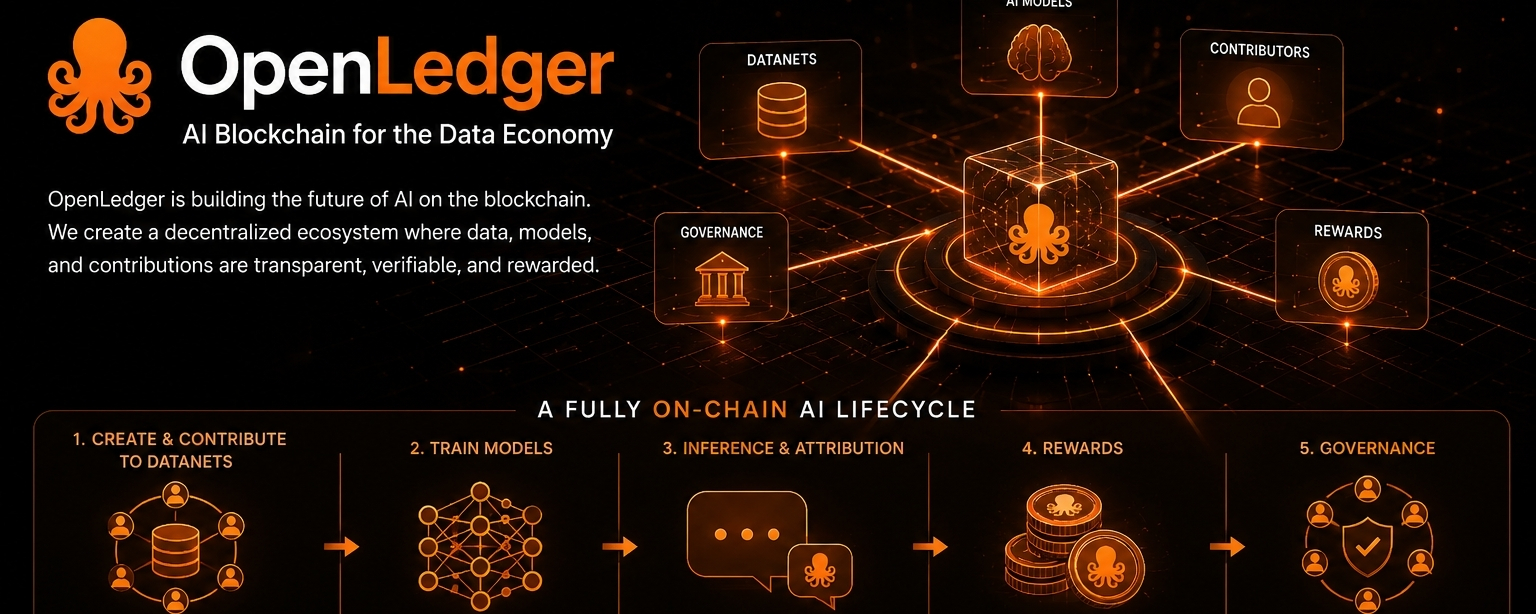
OpenLedger seems to approach AI infrastructure from a very different angle. Instead of treating data as something Extracted and hidden inside private systems, it treats data as a shared asset that can be organized, verified, and rewarded directly on-chain.
The idea of Datanets is what made me pause.
At a basic level, these are community-owned datasets that People can create, contribute to, and help improve over time. Contributions are recorded transparently, which means attribution is not lost somewhere in the background.
That matters more than people realize.
In most AI systems today, once data enters the pipeline, its origin Becomes blurry. Eventually, no one really knows which contribution mattered, who shaped outcomes, or who deserves value when the model succeeds.
OpenLedger tries to Make that visible.
Training also feels different here. Instead of intelligence being built inside isolated walls, models can be trained using these open datasets with every Contribution tracked across the process.
And then comes the part I find most interesting: inference attribution.
This is a concept the Industry has not fully appreciated yet.
If an AI model generates value through usage, then that value should be traceable back to the people and Datasets that made the output possible.
It sounds simple when you say it like that, but it changes everything.
It turns AI from a closed product into a living economic system.
Every interaction becomes connected to its source. Every Useful output becomes part of a reward loop that can compensate contributors fairly.
If this works at scale, it Could fundamentally change behavior.
People might contribute better data because quality becomes economically visible. Builders might collaborate More openly because attribution is preserved. AI Development could become less extractive and more cooperative.
Of course, this is where realism matters.
Ideas like this are powerful in theory, but execution is always the Hardest part.
Decentralized Coordination is messy. Governance can become slow. Incentive systems often look elegant on paper And become chaotic in practice.
OpenLedger still has to prove that transparent attribution can remain efficient at scale without becoming too Complex for normal users.
That uncertainty is real, and I think it is important to admit it.
But uncertainty Does not make the idea less important.
If anything, it makes experimentation necessary.
Because when I look ahead, I keep wondering what kind of AI Economy we are actually building.
Are we creating systems where intelligence becomes another Closed monopoly, owned by whoever controls the largest compute clusters?
Or are we building something more open, where intelligence behaves like public infrastructure and contributors are Recognized as participants instead of invisible inputs?
This is why OpenLedger feels worth watching.
Not because all the answers are solved.
But because it is Asking questions the industry has avoided for too long.
And maybe that is Where meaningful progress starts.
So I keep thinking about this.
What are we really Building when we combine AI and blockchain?
Are we creating better Tools, or redesigning digital ownership itself?
And if intelligence becomes one of the most valuable assets of this Century, who should truly benefit from creating it?
For me, that is the real conversation.
My view is Simple
The strongest projects are rarely the loudest ones. They are usually the Ones quietly trying to solve the problems most People have not fully noticed yet. OpenLedger Feels like one of those ideas.
And whether it succeeds or not, I think the questions it raises Are exactly the ones this industry needs to confront.