
Look, I understand why OpenLedger is getting attention right now. Artificial intelligence is sucking up capital across Silicon Valley at a speed that feels vaguely familiar to anyone who lived through the dot-com era, the crypto boom, or the cloud-computing gold rush. Investors are desperate for the next infrastructure story. Crypto desperately needs legitimacy after years of exchange collapses, vaporware projects, and token economies that looked revolutionary until the liquidity dried up.
So now we get the latest pitch. AI plus blockchain.
I’ve seen this movie before.
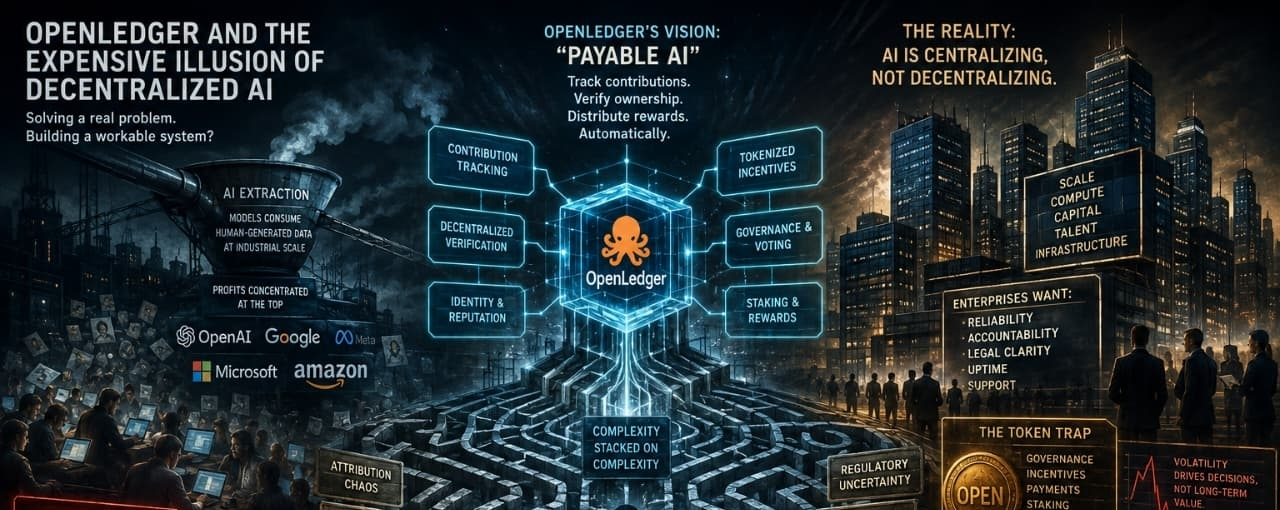
OpenLedger presents itself as infrastructure for what it calls “Payable AI,” which sounds polished enough to survive a venture capital meeting. The idea is simple on the surface. AI models consume enormous amounts of human-generated data, but the people contributing that data rarely see any economic upside. Writers, developers, artists, researchers, and users feed giant machine-learning systems while a handful of companies absorb the profits.
That part is true.
Modern AI systems are basically extraction machines. They gather information at industrial scale, train models on it, and monetize the outputs through APIs, enterprise subscriptions, and cloud infrastructure. Most contributors disappear from the economic equation once their data enters the pipeline.
OpenLedger claims blockchain infrastructure can fix this problem by tracking contributions, verifying ownership, and distributing rewards automatically through decentralized systems.
It sounds tidy. On paper, at least.
But once you move beyond the marketing layer, the whole thing starts looking less like a revolution and more like another extremely complicated coordination problem wrapped in token economics.
The first issue is attribution itself.
AI models do not operate like spreadsheets where you can point to a single row and say, “This created that output.” Modern machine-learning systems are probabilistic monsters trained on oceans of overlapping information. A single response generated by an AI system may indirectly reflect fragments of millions of separate inputs gathered across years of training cycles.
Now imagine trying to build an automated compensation system around that chaos.
Who decides which dataset mattered most? Which contributor deserves what percentage of value? What happens when two contributors dispute ownership claims? What happens when copyrighted material enters the system accidentally? What happens when bad actors flood the network with low-quality data designed purely to farm token rewards?
This is where the clean narrative starts collapsing under operational weight.
OpenLedger’s answer involves decentralized verification, contribution scoring, identity systems, governance structures, staking mechanisms, and tokenized incentives. In other words, layer after layer of economic machinery designed to coordinate participants who may not trust one another.
That is not simplification. That is complexity stacked on complexity.
And let’s be honest here. Crypto has spent the last decade pretending token incentives naturally create healthy ecosystems. Sometimes they work temporarily. Usually they attract people optimizing for extraction rather than sustainability.
I’ve watched this cycle repeat endlessly.
Liquidity mining was supposed to build decentralized finance communities. Instead, it created armies of mercenary capital chasing rewards. Play-to-earn gaming promised player-owned economies until most systems collapsed under inflation and speculation. Governance tokens were marketed as decentralized democracy until whales quietly accumulated enough influence to dominate decision-making.
Human behavior does not magically improve because you attach a blockchain to it.
OpenLedger assumes contributors will behave cooperatively because the incentives are theoretically aligned. History suggests people behave opportunistically the moment meaningful money appears.
And then there is the deeper contradiction underneath the entire project.
The AI industry is moving toward concentration, not decentralization.
The companies dominating artificial intelligence right now are not small distributed networks. They are giant corporations with massive compute clusters, global cloud infrastructure, engineering armies, and balance sheets large enough to absorb billions in capital expenditure. Training advanced models requires enormous scale. Scale creates operational efficiency. Operational efficiency attracts enterprise adoption.
Centralization is not an accident in AI. It is the business model.
OpenLedger is effectively betting that decentralized coordination can compete with some of the largest technology firms on earth. That is an ambitious assumption. Maybe an unrealistic one.
Because enterprises generally do not care about ideological decentralization. They care about reliability.
If a hospital deploys AI diagnostics, it wants accountability. If a bank integrates machine-learning systems into fraud detection, it wants legal clarity. If a logistics company automates operations using AI, it wants predictable uptime and support contracts.
Nobody wants to hear that a decentralized validator network is debating governance proposals while critical systems fail.
And this is where crypto infrastructure projects quietly run into reality. The more important the application becomes, the more centralized oversight tends to return. Somebody has to resolve disputes. Somebody handles compliance. Somebody negotiates regulatory pressure. Somebody controls upgrades and emergency responses.
The decentralization narrative survives right up until operational responsibility matters.
Then power concentrates fast.
The OPEN token introduces another layer of fragility. Like many crypto infrastructure assets, it appears designed to do everything simultaneously. Governance. Incentives. Payments. Staking. Settlement. Participation. This sounds elegant in whitepapers because it creates the impression of a self-contained economic ecosystem.
In practice, these systems often become unstable because speculation overwhelms utility.
Infrastructure decisions become tied to token price volatility. Governance drifts toward large holders. Contributors optimize around liquidity events rather than long-term infrastructure development. Early investors and venture funds usually secure discounted allocations before retail participation arrives downstream.
Crypto calls this community ownership.
Traditional finance calls it asymmetric positioning.
And here is the catch the marketing teams rarely discuss openly. OpenLedger may not actually need mass adoption to generate financial returns for insiders. The crypto industry has repeatedly demonstrated that narrative momentum alone can sustain valuations for long periods, especially when attached to fashionable sectors like AI.
The infrastructure does not necessarily need to dominate enterprise markets immediately. It merely needs to remain plausible enough for capital to keep flowing.
That is a very different business model from the one most retail participants imagine.
There is also the regulatory problem sitting quietly in the background.
OpenLedger exists at the intersection of two industries governments increasingly distrust: crypto and artificial intelligence. Regulators are already struggling with copyright disputes, AI liability questions, token classification issues, and cross-border data governance. OpenLedger inherits all of those problems simultaneously.
Who becomes legally responsible if decentralized AI systems generate harmful outputs? How are copyrighted datasets verified inside open contribution networks? Does the token function as infrastructure utility or an investment contract? What happens when contributors from multiple jurisdictions challenge ownership claims?
These questions are not minor technicalities. They determine whether institutions ever feel comfortable building on systems like this at meaningful scale.
And institutions tend to avoid unresolved legal ambiguity whenever possible.
None of this means OpenLedger is fraudulent or technically unserious. The underlying problem it targets is real. AI ownership and attribution are becoming increasingly important issues. The current AI economy concentrates enormous value among a relatively small number of firms while consuming vast amounts of publicly generated information.
That tension will not disappear quietly.
But solving a real problem is not the same thing as building a workable economic system around it. Markets often choose systems that are simpler, uglier, and more centralized than technologists initially imagine.
Because eventually the conversation stops being theoretical.
Then the questions become much colder.
Can the infrastructure survive manipulation? Can enterprises trust it? Can governance remain stable once money and power accumulate? Can decentralized coordination outperform centralized systems built by trillion-dollar companies?
That is usually the moment when the glossy future starts looking a lot more expensive than the pitch deck suggested.
