
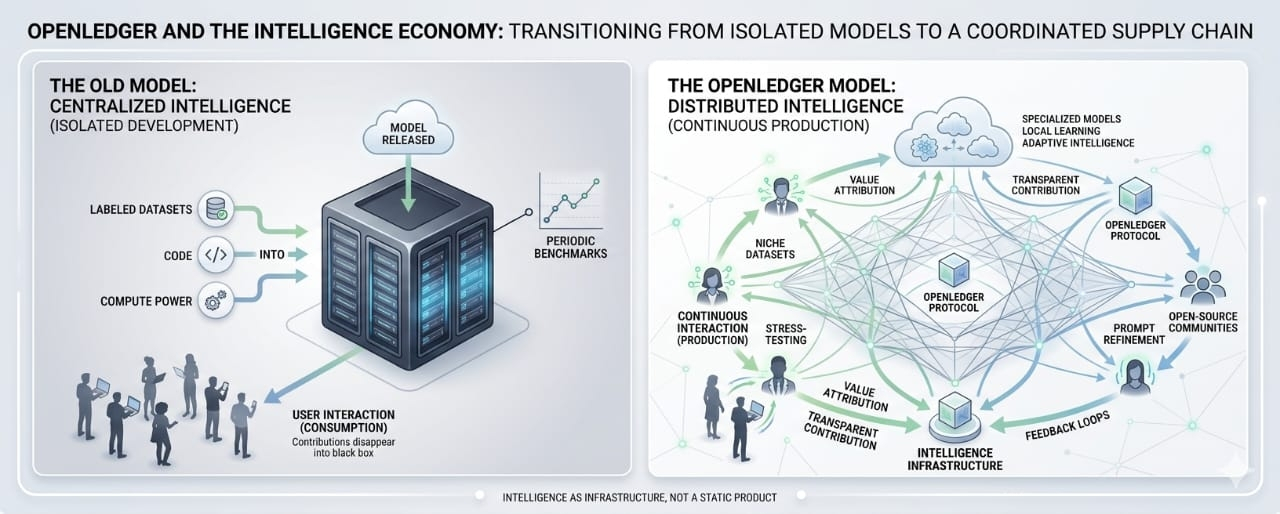
Most AI conversations still feel strangely repetitive. Every week there is another model release, another benchmark, another promise that everything is about to change forever. The language around it has become polished to the point of feeling detached from reality. Bigger context windows. Faster inference. Smarter agents. More automation. The entire industry often talks about intelligence like it appears fully formed out of giant data centers, as if models simply emerge from compute alone.
But the deeper shift happening underneath AI feels far less clean than the marketing layer built around it.
What keeps standing out to me is that AI systems are no longer learning in isolated environments. They are learning continuously through interaction itself. People correct outputs without calling it labor. Users refine prompts until systems produce better behavior. Developers feed niche datasets into training loops that may eventually shape future products without ever clearly preserving where that contribution came from. Entire communities spend time stress-testing models, identifying weaknesses, improving workflows, and indirectly training systems simply by using them long enough.
At some point that stops looking like usage.
It starts looking like production.
And that distinction matters more than most people realize because once interaction becomes production, the economics around AI change completely.
That is the space where OpenLedger becomes interesting to me, although even describing it as “another AI project” feels misleading. The project is really circling around a more uncomfortable question underneath the surface: what happens when intelligence itself becomes a distributed economic process instead of a centralized product?
Most technology platforms already rely on invisible contribution layers. Search engines improved through user behavior long before people thought carefully about what they were giving away. Social platforms monetized participation while presenting themselves as communication tools. Recommendation systems quietly converted engagement patterns into predictive infrastructure. AI just tightens that loop even further because now the interaction itself can improve the underlying intelligence directly.
That changes the relationship between users and systems in a way that still feels underexplored.
The current AI ecosystem mostly absorbs contribution invisibly. People upload information, generate corrections, provide feedback, rank outputs, refine prompts, and shape model behavior, but almost none of that contribution has a meaningful ownership framework attached to it. The value gets centralized later by whoever controls the model, the infrastructure, or the distribution layer.
OpenLedger seems to be trying to expose that hidden layer instead of leaving it abstract.
The project talks heavily about attribution, datasets, specialized models, decentralized contribution systems, and traceable intelligence infrastructure. Underneath the technical language, the idea appears relatively simple: if AI systems are continuously shaped by distributed contributors, then those contributors should not disappear economically once the model improves.
That sounds reasonable until you start thinking through what it actually implies.
Because the moment intelligence production becomes monetized, behavior changes immediately.
People optimize for incentives. Data becomes financialized. Contribution stops being purely informational and starts becoming strategic. Synthetic content floods systems because generating artificial material is cheaper and infinitely scalable. Feedback loops emerge where models begin reinforcing outputs produced by other models. What initially looks like growth can slowly become recursive noise accumulation if verification systems fail to keep pace.
And verification is where everything becomes difficult.
It is easy to say decentralized intelligence should reward contributors. It is much harder to determine which contributions are genuinely useful, which ones improve system quality, and which ones are simply gaming the incentive structure. Anyone can upload datasets. Anyone can generate synthetic information. Anyone can claim participation in model improvement. The hard problem is proving informational value at scale.
That problem does not disappear just because a system is decentralized.
In fact, it often becomes more complicated.
The more participation expands, the more systems need mechanisms for verification, validation, reputation, and coordination. Eventually new centers of authority start forming around those processes whether projects intend it or not. Validators emerge. Governance layers appear. Attribution standards become gatekeepers. Reputation systems accumulate influence. Compute providers gain leverage because infrastructure still matters more than ideology once systems move into real-world usage.
That tension feels unavoidable to me.
A lot of decentralized AI narratives still carry this assumption that removing central ownership automatically creates balanced power structures. Historically that almost never happens. Coordination simply reorganizes itself in new forms. The internet itself was supposed to decentralize information entirely, yet massive concentration still emerged around platforms, hosting layers, algorithms, cloud providers, and distribution systems.
AI may follow a similar path.
Not fully centralized. Not fully decentralized. More like a layered intelligence economy where contribution is distributed but coordination still accumulates around infrastructure, standards, and compute access.
And compute remains the reality most idealistic discussions eventually collide with.
Training and deploying advanced AI systems still depends on extremely expensive hardware, energy consumption, networking infrastructure, storage systems, and low-latency environments. Open systems do not magically remove those constraints. Latency matters. Bandwidth matters. Semiconductor access matters. Power costs matter. Physical infrastructure still shapes digital systems far more than people like admitting.
That is partly why OpenLedger feels more interesting as a signal than as some final solution.
The project seems less important because it “solves” intelligence ownership and more important because it forces the industry to confront how unclear ownership already was. AI systems today already depend on massive distributed contribution networks. The difference is that most of those systems hide the process behind centralized products and polished interfaces.
Once attribution becomes visible, uncomfortable questions appear quickly.
Who owns improvements created through millions of interactions? Who owns behavioral optimization generated collectively by users? Who owns datasets refined over time by communities? Who owns synthetic intelligence built partially from prior synthetic intelligence? Who captures the economic value of continuous learning systems?
There are no clean answers because intelligence itself no longer behaves like a static product.
It behaves more like infrastructure.
That may ultimately be the deeper shift happening underneath everything else. For a long time people treated intelligence as something individual. A person had intelligence. A company built intelligence. A model contained intelligence. But modern AI systems increasingly reveal intelligence as a coordination process spread across data pipelines, contributors, inference systems, reinforcement loops, infrastructure providers, and continuous interaction patterns.
In that world, intelligence starts resembling a supply chain more than a standalone invention.
And supply chains always raise questions about labor, ownership, extraction, incentives, and value distribution.
Maybe that is why projects like OpenLedger keep pulling attention even from people skeptical of crypto narratives. The real idea underneath them is not speculation. It is attribution. It is the recognition that AI systems are being shaped collectively while the economic structures around them still behave as though intelligence emerges from isolated entities.
That contradiction probably does not disappear.
If anything, it gets larger as AI becomes more economically important.
Because once intelligence becomes something continuously produced instead of simply deployed, the learning layer itself turns into infrastructure worth monetizing. And the moment that happens, every unresolved question around ownership, coordination, verification, incentives, and control stops being theoretical.
It becomes economic reality.
Maybe that is the point that keeps staying with me after everything else falls away:
AI did not suddenly create distributed intelligence.
It just made the invisible production layer impossible to ignore anymore.
