
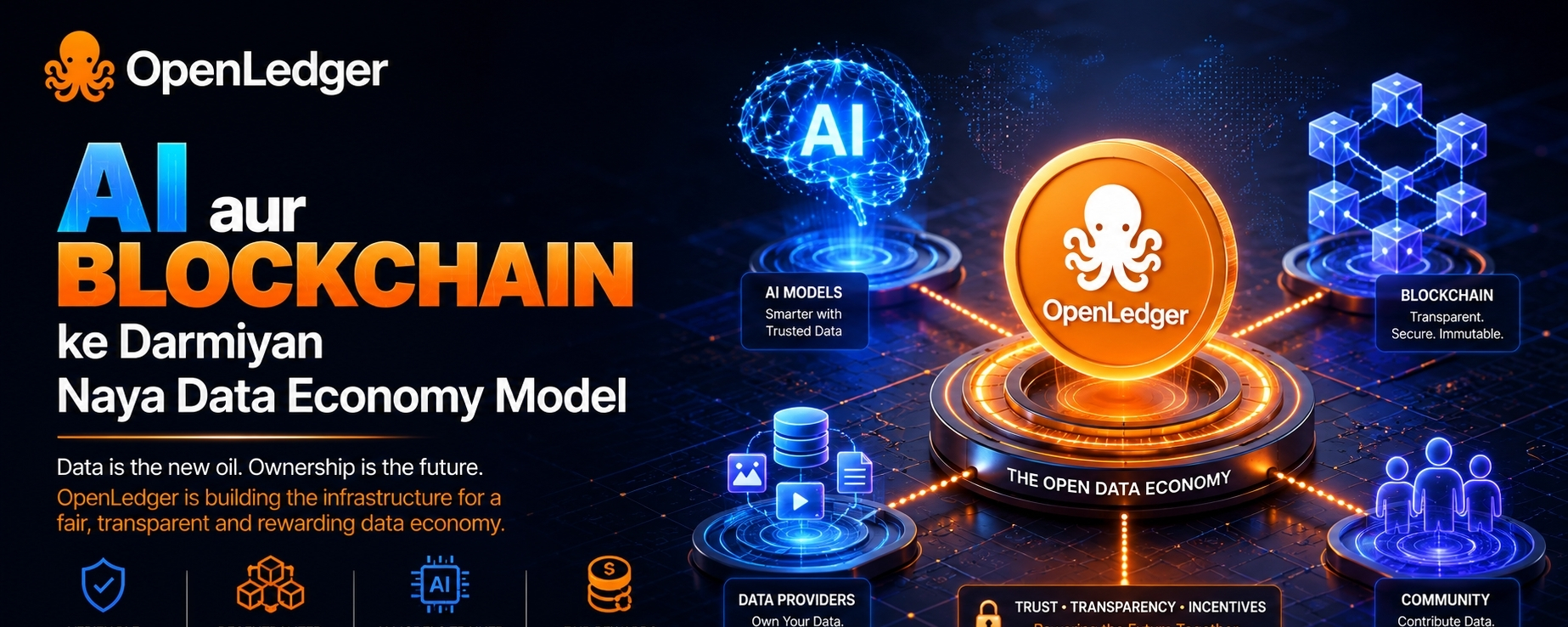
I see OpenLedger as sitting in that increasingly crowded but still genuinely important intersection of AI infrastructure and blockchain-based data ownership. In my view, the core idea is deceptively simple: if data, models, and autonomous agents are what power the next generation of AI, then whoever controls, prices, and governs those assets effectively controls the value chain. OpenLedger is essentially trying to turn that into a transparent, monetizable system where data providers, model builders, and agent deployers can all participate in a shared economic layer instead of being locked inside closed platforms.
I find something emotionally compelling about that direction, especially when I think about how the current AI economy has evolved. A few large platforms quietly absorb most of the value, while the people generating raw data, fine tuning domain models, or building niche agents often get very limited upside beyond indirect exposure. So my initial enthusiasm around OpenLedger comes from a sense of fairness and rebalancing. It feels like an attempt to say: if your medical dataset improves a diagnostic model, or your enterprise logs improve a fraud detection agent, you should not just “contribute,” you should be able to directly benefit from that contribution in a measurable, programmable way.
But I also find the skepticism just as natural and honestly necessary. The moment I hear “AI blockchain unlocking liquidity for data,” I instinctively ask whether the system is solving a real coordination problem or just wrapping existing infrastructure in token incentives. Data is not like financial assets. It is messy, context-dependent, and often legally constrained. Liquidity sounds attractive in theory, but in practice, most valuable datasets are not freely tradable commodities. They are bound by consent, regulation, and trust relationships. So the emotional tension I feel around OpenLedger is this push and pull between a genuinely attractive vision of fair value distribution and the very real friction of implementing that vision in regulated, high-stakes environments.
When I try to ground it in real-world workflows, the healthcare example stands out first. I imagine a hospital network training an AI model to detect early stage sepsis from patient vitals. The data is extremely sensitive, governed by strict privacy laws, and cannot simply be exported into a public dataset. Yet I also know that across hospitals, there is immense value in shared learning. Today, that sharing typically happens through centralized partnerships or federated learning setups, where trust is negotiated institution by institution.
In an OpenLedger-like architecture, I could imagine hospitals contributing encrypted or permissioned data streams into a shared model ecosystem. Instead of handing over raw data, they might expose selective signals or computed embeddings, and those contributions would be tracked, attributed, and monetized if they improve a downstream diagnostic model. A rural clinic that provides rare edge-case patient data could, in theory, earn ongoing value if that data meaningfully improves global detection accuracy. That version of the idea feels emotionally powerful to me: turning previously invisible contributions into recognized economic participation.
I also think the financial fraud detection use case is equally illustrative. Banks and fintech companies sit on highly valuable transaction data but are reluctant to share it due to competitive concerns and compliance risks. Yet fraud patterns are global and adaptive, and I know that a model trained in isolation is always slightly behind. In an OpenLedger-like system, institutions might contribute anonymized pattern signatures or model updates, while smart contracts track which contributions improve detection accuracy. That creates an interesting dynamic in my mind: cooperation without full disclosure, competition without full isolation.
Stepping back, I see OpenLedger’s promise resting on three pillars: provenance of data and models, incentive alignment, and decentralized governance. Provenance means being able to trace which data contributed to which model improvement. Incentive alignment means ensuring contributors are rewarded proportionally to their impact. Governance means deciding how models evolve, who can deploy agents, and how disputes over attribution are resolved.
From my perspective, the hardest of these is provenance. In modern machine learning systems, especially large-scale deep learning, attribution is not straightforward. Influence is distributed across millions or billions of parameters. I know there are techniques like data attribution scores, gradient influence estimation, and Shapley-value approximations, but they are computationally expensive and often unstable. So while the concept is elegant, I see operationalizing it at scale as an open research challenge rather than a solved engineering problem.
When I think about who would actually use OpenLedger, I don’t see it as a consumer-facing system. I see it as infrastructure for three groups: data providers like enterprises and hospitals, AI developers who want higher-quality or niche datasets with clear usage rights, and decentralized application builders deploying autonomous agents that interact with verified data sources.
What attracts me operationally is the idea of composability. In theory, I could assemble a fraud detection agent by combining banking transaction signals, identity verification models, and behavioral anomaly detectors, each sourced from different contributors who are continuously rewarded as the agent is used. That is the “liquidity” narrative at its strongest: not just trading data, but continuously flowing value from usage.
But I also can’t ignore the limitations. First, regulatory friction is very real. In 2026, data sovereignty laws are tightening globally, especially in healthcare and AI governance. Even if a blockchain system claims to anonymize or tokenize data, regulators still focus on consent, traceability, and re identification risks. That means I think systems like OpenLedger would inevitably operate in a hybrid mode rather than a purely decentralized one.
Second, I see economic complexity as a major challenge. If every model output depends on thousands of upstream contributors, I question how fair value distribution can happen without introducing overhead, latency, or cognitive overload for developers. Micropayment systems for AI inference sound appealing, but I suspect they can become messy very quickly at scale.
Third, I think trust in the model layer is often misunderstood. Blockchain can guarantee immutability of records, but it does not guarantee correctness of AI behavior. If a model is biased, hallucinating, or manipulated, recording its lineage does not fix the underlying problem it only makes the system more transparent about its flaws.
Zooming out to the broader industry trend in 2026, I see convergence rather than pure decentralization. Enterprises are increasingly adopting AI governance layers that combine secure data enclaves, federated learning, and auditability frameworks. Projects like OpenLedger are trying to plug into this shift by adding economic coordination on top of technical infrastructure. But in my observation, most real-world adoption remains cautious. Organizations want auditability and incentive alignment, but they are not willing to fully expose their data pipelines unless legal and security guarantees are extremely strong.
Healthcare still feels like the most promising but also most constrained domain. AI-assisted diagnostics, drug discovery, and personalized medicine all depend on sensitive data that cannot be freely pooled. If OpenLedger can genuinely solve selective disclosure where contribution can be proven without exposing raw data I think it could become a foundational layer for cross-institutional AI collaboration. But if it cannot move beyond theoretical cryptographic promises into reliable, low-friction deployment, I suspect it will remain experimental.
Emotionally, I feel two conflicting responses at once. On one hand, I’m excited about finally giving structure to something the AI world has largely ignored: attribution. On the other hand, I feel fatigue from seeing similar “decentralized AI economy” narratives repeat across cycles, often overpromising and underdelivering due to complexity, regulation, or lack of adoption.
If I strip away the hype, my most realistic expectation is that OpenLedger will not become a global AI marketplace for data liquidity. Instead, I see it more as interoperable infrastructure used in specific domains where data sharing is both valuable and tightly controlled like healthcare consortiums, financial fraud networks, or industrial IoT ecosystems. In those environments, even partial success in attribution and incentive distribution could still be meaningful.
