
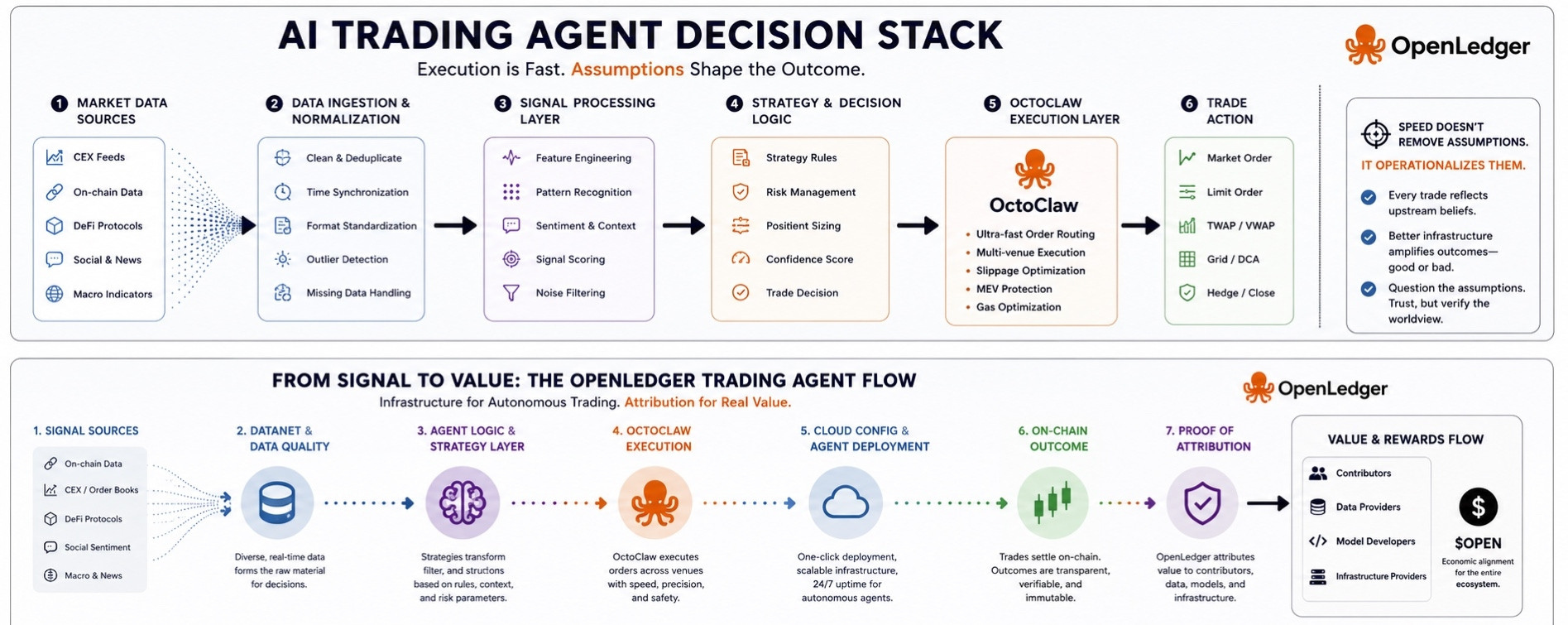
OpenLedger’s Trading Agents Look Efficient. That’s Exactly Why I’m More Interested in Their Assumptions Than Their Speed
Most people hear “AI trading agent” and immediately imagine the same fantasy.
No hesitation.
No panic-selling.
No revenge trades after getting wicked out.
No human staring at a red candle pretending discipline still exists.
Just cleaner execution.
Fair.
That story sounds great until you stop looking at the execution layer and start asking what the agent was actually taught to believe before the first trade ever happens.
That’s where @OpenLedger gets more interesting for me.
Because I don’t think the compelling part is “AI can trade.”
That sentence alone means almost nothing now.
Everyone is building some version of automation.
Signal bots.
Execution bots.
Copy systems pretending to be intelligence.
The more interesting question is what happens when infrastructure makes autonomous execution genuinely easier.
That’s where OpenLedger’s trading agent narrative changes tone.
Because once execution becomes real, assumptions stop being abstract.
They become expensive.
OpenLedger’s pitch around trading agents is naturally attractive to crypto users.
Fast interpretation.
Strategy automation.
Execution logic.
Reduced friction between signal and action.
And with Octoclaw sitting in the execution conversation, plus cloud configuration reducing deployment friction, the whole stack starts looking much more usable than the usual AI demo theatre.
That matters.
Because most AI crypto products still live in presentation mode.
They explain things.
Generate responses.
Simulate intelligence.
That’s cute.
Execution is different.
The moment an agent can actually act, intelligence becomes much less interesting than decision quality.
And decision quality is never just about speed.
That’s where I think people oversimplify this category.
Say someone builds a DeFi-focused trading agent.
The architecture looks clean.
Market signals flowing in.
Volatility thresholds.
Pattern recognition layers.
Execution triggers.
Risk controls.
Automated reactions.
Professional enough to inspire confidence.
Maybe even backtested enough to impress people who should know better.
Lovely.
Now the ugly question.
Where did those assumptions come from?
Because markets don’t behave like clean educational datasets.
A liquidation event can look identical to panic until context changes the interpretation.
An oracle issue can look like momentum.
A governance scare can look like solvency risk.
A technically accurate signal can still be strategically stupid.
That’s the problem.
Humans call this judgment.
Infrastructure calls it input logic.
Same bruise.
Different naming.
This is why OpenLedger’s execution story is more interesting than generic AI trading hype.
Not because automation removes emotional mistakes.
Because automation can scale hidden mistakes faster.
That distinction matters.
A human trader making a flawed judgment might lose once.
An automated system inheriting flawed assumptions can repeat the same mistake structurally.
That’s worse.
Not random wrong.
Systematically wrong.
And once deployment friction drops, the scale changes.
That’s where Octoclaw and cloud configuration become bigger than product features.
Because easier deployment doesn’t only accelerate strong systems.
It accelerates weak assumptions too.
Infrastructure is neutral like that.
The rails don’t care whether the logic is brilliant or deeply flawed.
They just make execution easier.
Which is useful.
And slightly terrifying.
That’s also why I think people underestimate what OpenLedger is actually building here.
The surface narrative says trading agents.
The deeper narrative is autonomous decision infrastructure.
Different conversation.
Because the second you allow execution, attribution becomes more interesting too.
If an agent generates value, what exactly created that value?
The execution layer?
The strategy logic?
The signal architecture?
The deployment infrastructure?
That’s where OpenLedger becomes more than “AI trading automation.”
It starts touching the broader question of how autonomous systems create and distribute economic value.
And honestly, that’s a much more serious conversation than “AI bot bullish.”
I keep coming back to this:
Speed is easy to admire.
Judgment is harder to inspect.
A fast bad assumption is still a bad assumption.
Just with better uptime.
So while most people get impressed by the execution story, I’m more interested in the invisible part.
Not whether the trading agent reacts faster than me.
Whether the thing inherited a worldview I’d actually trust with capital.
Because if OpenLedger succeeds, that’s probably the real question.
Not whether autonomous systems can trade.
Whether they can inherit judgment without inheriting human mistakes at machine scale.