
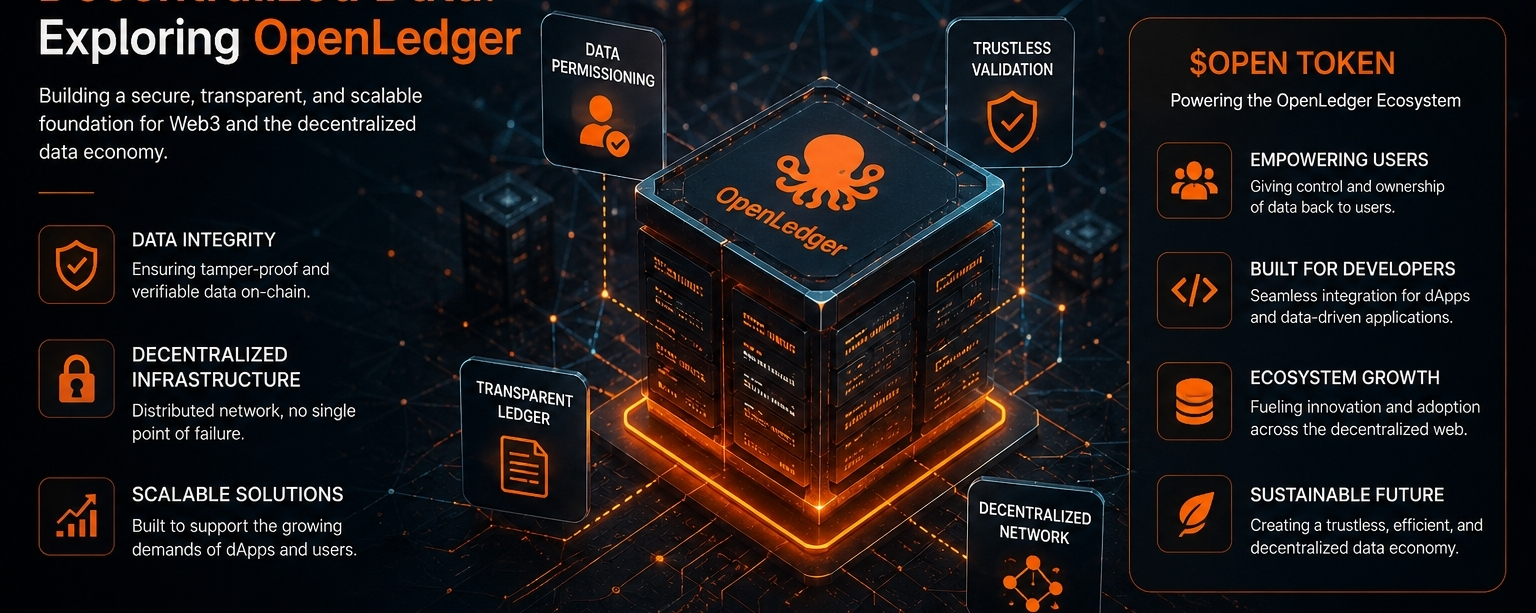
The Future of Decentralized Data: Exploring OpenLedger
In the rapidly evolving world of Web3 and blockchain technology, data integrity and decentralized infrastructure have become more crucial than ever. This is where projects like @OpenLedger are paving the way for a more secure and transparent digital ecosystem. By focusing on robust ledger solutions, they are addressing the core challenges of data permissioning and scalability.
As decentralized applications (dApps) continue to grow, the need for efficient data layers becomes evident. The ecosystem surrounding the $OPEN token highlights a strong commitment to empowering users and developers alike, ensuring that data validation is both seamless and trustless. Keeping an eye on these foundational technologies is essential for anyone looking to understand where the future of decentralized finance and data management is heading.
What are your thoughts on the growth of decentralized data infrastructures? Let's discuss below!
Decentralized Data Revolution: Why OpenLedger is Shaping the Future of Web3
The blockchain and cryptocurrency industry has undergone massive transformations over the past decade. We have transitioned from simple peer-to-peer electronic cash systems to complex decentralized finance (DeFi) protocols, non-fungible tokens (NFTs), and decentralized autonomous organizations (DAOs). However, as the ecosystem expands, a fundamental challenge remains largely unaddressed: the decentralized management, validation, and security of data. In the age of artificial intelligence and high-throughput smart contracts, the world needs a robust, transparent, and scalable data infrastructure. This is precisely where projects like @OpenLedger come into play, offering innovative solutions to modern data dilemmas.
The Core Problem of Modern Data Infrastructure :
In the traditional tech landscape, data is heavily centralized. Tech giants control massive server farms, meaning users have little to no control over their own information. Even within the current Web3 space, many applications still rely on centralized data providers to bridge the gap between on-chain smart contracts and off-chain real-world data. This reliance creates single points of failure, exposing networks to data manipulation, breaches, and censorship.
To build a truly trustless digital future, the underlying data layers must match the decentralization of the blockchains they support. This requires a paradigm shift toward permissionless ledger systems that ensure data integrity without compromising speed or security.
How OpenLedger Bridges the Gap :
The ecosystem being developed by @OpenLedger focuses on creating a high-performance environment for data permissioning and decentralized ledger technology. By establishing a framework where data can be securely tracked, validated, and utilized, it empowers both developers and everyday users.
One of the stand-out features of this architecture is its ability to handle complex data verification processes seamlessly. Whether it is powering advanced AI data pipelines or securing cross-chain financial records, a reliable data ledger ensures that every piece of information is verifiable and tamper-proof. This structure is essential for scaling decentralized applications (dApps) to a global audience.
The Role of the $OPEN Token
At the heart of this growing ecosystem is the native utility token, $OPEN. Tokenomics play a vital role in maintaining the security and efficiency of any decentralized network. For a data-focused ledger, the token typically serves multiple critical functions:
•. Network Incentivization: Rewarding node operators and validators who dedicate computational power to secure the ledger.
•. Governance: Allowing token holders to propose and vote on key protocol upgrades, ensuring democratic development.
•. Transaction Fees: Facilitating smooth operations and data queries across the network architecture.
By aligning the economic incentives of users and validators, the $OPEN token ensures that the entire network remains secure, active, and economically viable in the long run.
