I didn't expect this... but a no-code tool being this structured was genuinely outside what I had imagined.😅 Usually "no-code" carries a certain reputation. Limited. Toy-grade. Something you use when you have no other choice. I walked into the Model Factory with that exact bias sitting in the back of my head... and walked out with a slightly different picture.
There is a version of this story I have seen before. A project shows up, wraps itself in AI narrative, calls everything a "factory" or a "protocol" or an "engine"... and by the time you actually try to use it, the product is either half-built or completely behind a paywall that makes the whole concept irrelevant. I went into this with that mental checklist already running. 🙄
What stopped me from walking away immediately was something simple. The tool actually let me do something. Not just read about doing something. Actually build a working structure around a model without writing a single line of code... and ngl that is not a small thing when you think about who is trying to build in Web3 right now.
Most people entering this space are not engineers. They have ideas, they have context about markets or communities or specific problems... but they get filtered out at the technical layer. That filtering has always felt like an artificial ceiling rather than a natural one. A no-code model builder, if done seriously, could lower that ceiling significantly. The question is always whether it is done seriously. 👀
Here is where I want to slow down and be honest about the tension I felt. The "no-code" framing is genuinely powerful as a concept... but it also creates a specific expectation problem. When something is labeled no-code, it quietly promises that the complexity is handled on the other side..... That is a real engineering promise, not a marketing one. If the complexity is just hidden rather than actually solved, the cracks appear fast. The models behave unexpectedly. The outputs drift. The user has no way to understand why... because they were never given access to the underlying logic.
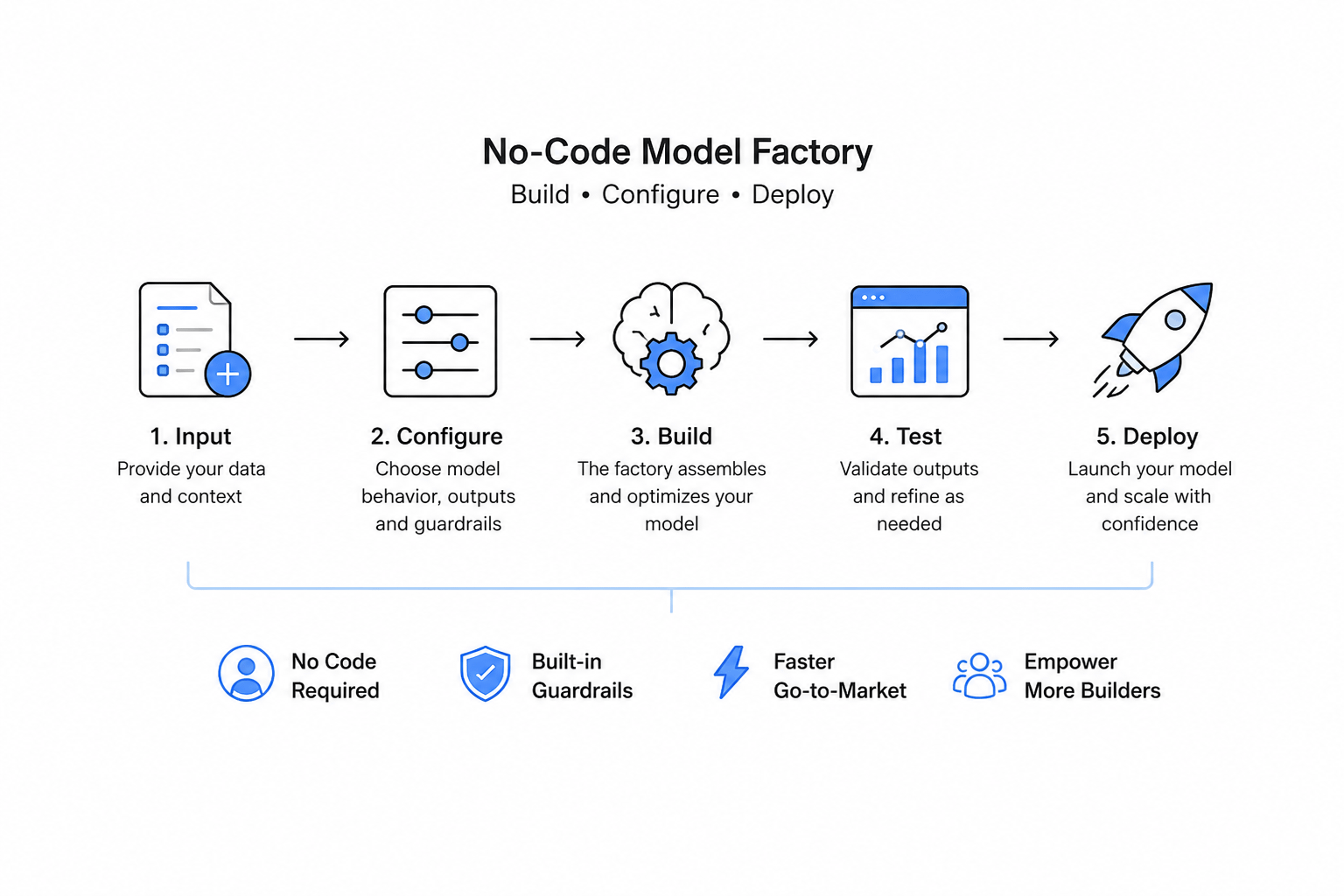
What I found worth paying attention to in the Model Factory setup was that it did not pretend the complexity did not exist. The structure acknowledged that you are making real decisions even when you are not writing code. Choosing how your model interprets inputs, what kind of outputs it prioritizes, what guardrails you want in place... these are not trivial choices dressed up in easy UI. They are consequential, and the tool treated them that way. That felt like a signal worth noting. 🔍
There is a strong point here that I think gets underappreciated in conversations about builder tools. Ease of use and depth of control are usually treated as opposites. You either get something simple that you cannot customize... or something powerful that takes months to understand. The more interesting design challenge is creating a layer of abstraction that preserves real control without requiring you to understand everything underneath it. That is genuinely hard to build, and most products in this space have not solved it.
Whether the Model Factory has fully solved it is a fair question to keep open. What I can say is that it made the right attempt. The workflow did not collapse into vague dropdowns with no visible logic. There was enough transparency in the process that I could understand what I was actually configuring... even without deep technical knowledge.✅
Another thing worth raising directly is the question of output quality. A no-code model is still a model... and models are only as useful as what they produce. Building something quickly is not the same as building something good. The honest concern I carried into this was whether the Factory would give me speed at the cost of reliability. After testing it with a focused use case, the outputs were more coherent than I expected. Not flawless. But coherent in a way that suggested the underlying model architecture was being taken seriously.🧠
For builders specifically, this matters more than it might for casual users. If you are building something with real users on the other side, you need outputs that hold up under pressure. A tool that gets you to sixty percent quality in ten minutes might actually be more valuable than a tool that theoretically gets you to ninety percent but requires six months of learning first... the tradeoff is real. For early-stage builders trying to validate an idea quickly, that speed has genuine strategic value. 💡
I keep coming back to one fundamental question that this whole category of product raises. Who is actually building in Web3 right now... and what do they actually need? The loudest voices in the space are often the most technically sophisticated ones...... But the actual distribution of people trying to build things skews much more toward non-technical founders, community organizers, marketers, and creators who understand their domain deeply but cannot hire an engineering team. Tools built for that population are not lesser tools. They might be the more important ones.🤝
OPEN with this Model Factory appears to be making a bet on that population. Whether that bet pays off depends on execution over time... not just on a clean initial product experience. But the initial experience was honest enough to make me take the longer-term question seriously, which is more than most new products manage to do.....👊




#OpenLedger @OpenLedger #cryptouniverseofficial #CryptoVibes