

I’ll admit something.
For a long time, whenever I heard the phrase “AI agent,” I expected disappointment.
Not because AI is overrated. Not because the technology is not improving. But because most products calling themselves agents felt like chat interfaces wearing a more expensive outfit.
Ask a question. Get an answer. Generate a summary. Repeat.
Useful? Sure.
Revolutionary? Not quite.
That was the feeling I had until I started looking deeper into what OpenLedger is trying to build and why OctoClaw feels different from the usual AI narrative.
Because for the first time in a while, the conversation seems to be moving away from “AI that talks” and closer to “AI that actually does.”
That difference matters more than people realize.
For the last two years, AI has been everywhere.
Every product became AI-powered.
Every startup became AI-first.
Every token became an AI infrastructure project.
But beneath all the headlines, most experiences still looked the same. Open a chat. Type instructions. Receive output. Then manually continue the work yourself.
People called that automation.
In reality, most users still became the execution engine.
And that is exactly where the idea behind AI agents becomes interesting.
The promise was never that AI would answer questions faster.
The promise was that AI could eventually help complete tasks.
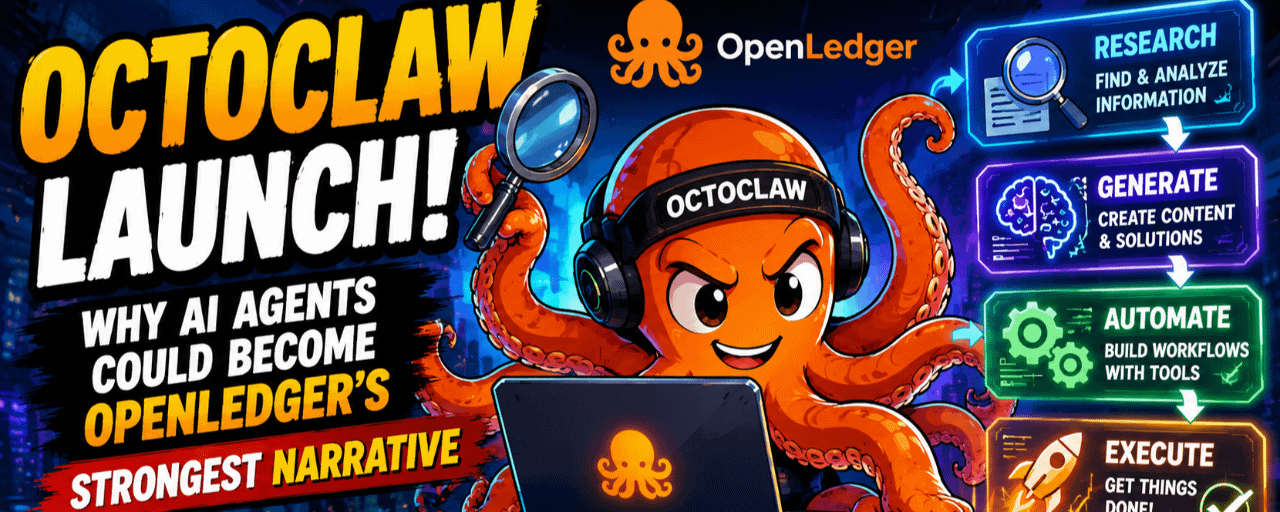
Research.
Generate.
Execute.
Move from intent to action.
That transition is what separates a smart assistant from something that behaves more like an actual digital worker.
This is where OctoClaw enters the conversation.
OpenLedger has already been positioning itself around an AI infrastructure vision where data, models, and agents can coexist inside a blockchain environment.
At first glance, that sounds technical.
But underneath all the infrastructure language, the idea is surprisingly simple.
Data creates intelligence.
Models process intelligence.
Agents turn intelligence into action.
Most AI discussions stop at the model layer.
OpenLedger appears to be extending the conversation further.
If agents can access data, interact with models, execute tasks, and operate inside a system where contributions can be tracked and rewarded, then AI becomes more than a tool.
It starts becoming an economy.
And that changes how people think about value.
Because right now, many AI products create outputs.
But fewer create outcomes.
There is a big difference.
Outputs are easy.
Generate a paragraph.
Generate an image.
Generate a summary.
Outcomes are harder.
Complete research.
Run workflows.
Coordinate actions.
Deliver results.
That gap between output and outcome is where agent infrastructure starts becoming interesting.
OctoClaw feels aligned with that direction.
Not because it promises magical automation.
But because it moves the conversation toward execution.
That may sound small.
It is not.
Execution is where technology stops being impressive and starts becoming useful.
And usefulness is ultimately what determines whether narratives survive.
Crypto has seen this pattern before.
Infrastructure cycles appear.
Attention arrives.
Tokens run.
Excitement peaks.
Then one question remains:
“What can people actually do with this?”
Projects that answer that question usually last longer.
Projects that cannot eventually fade into noise.
That is why I think OpenLedger’s positioning deserves attention.
It is not presenting itself as another isolated AI application.
It is trying to build a framework where AI activity becomes composable.
Data feeds models.
Models empower agents.
Agents perform work.
The network records value.
If that loop becomes usable, then the opportunity becomes larger than a single product launch.
OctoClaw then becomes something more important.
Not the destination.
The demonstration.
A visible example people can understand.
Because explaining data attribution or decentralized model economics to most people is difficult.
But showing an AI system that researches, automates, and executes?
That connects instantly.
Of course, there are still challenges.
AI agents today are not perfect.
They misunderstand context.
They create unnecessary complexity.
Sometimes they confidently move in the wrong direction.
Sometimes they behave like productivity machines powered entirely by chaos.
So execution quality matters.
Trust matters.
Safety matters.
Real utility matters.
But none of those concerns change the bigger direction.
The industry is slowly moving from intelligence to action.
From generating content to completing workflows.
From answering questions to producing outcomes.
And if OpenLedger successfully connects data, models, ownership, and execution inside one environment, then OctoClaw could become one of the clearest examples of that shift.
Because in the end, nobody wakes up hoping for another AI that speaks beautifully.
People want something that helps them move faster, build faster, and finish what they started.
Data is the fuel.
Models are the brain.
Agents are the hands.
And OctoClaw feels like OpenLedger saying:
Enough theory.
Let’s make AI move.
