

The more time I spend watching AI markets and crypto infrastructure evolve side by side, the more I start to think most people are looking in the wrong direction.
Everybody talks about AI models now. Bigger models. Faster models. Smarter assistants. Every week there’s another company claiming they’ve solved intelligence itself because their chatbot writes emails slightly better than the last one. Meanwhile crypto keeps chasing narratives at full speed like it always does memecoins one month, AI agents the next, then back to whatever catches liquidity for a few weeks.
But beneath all the noise, there’s a different layer forming quietly in the background.
Infrastructure.
Coordination systems.
Execution layers.
And honestly… that changes everything.
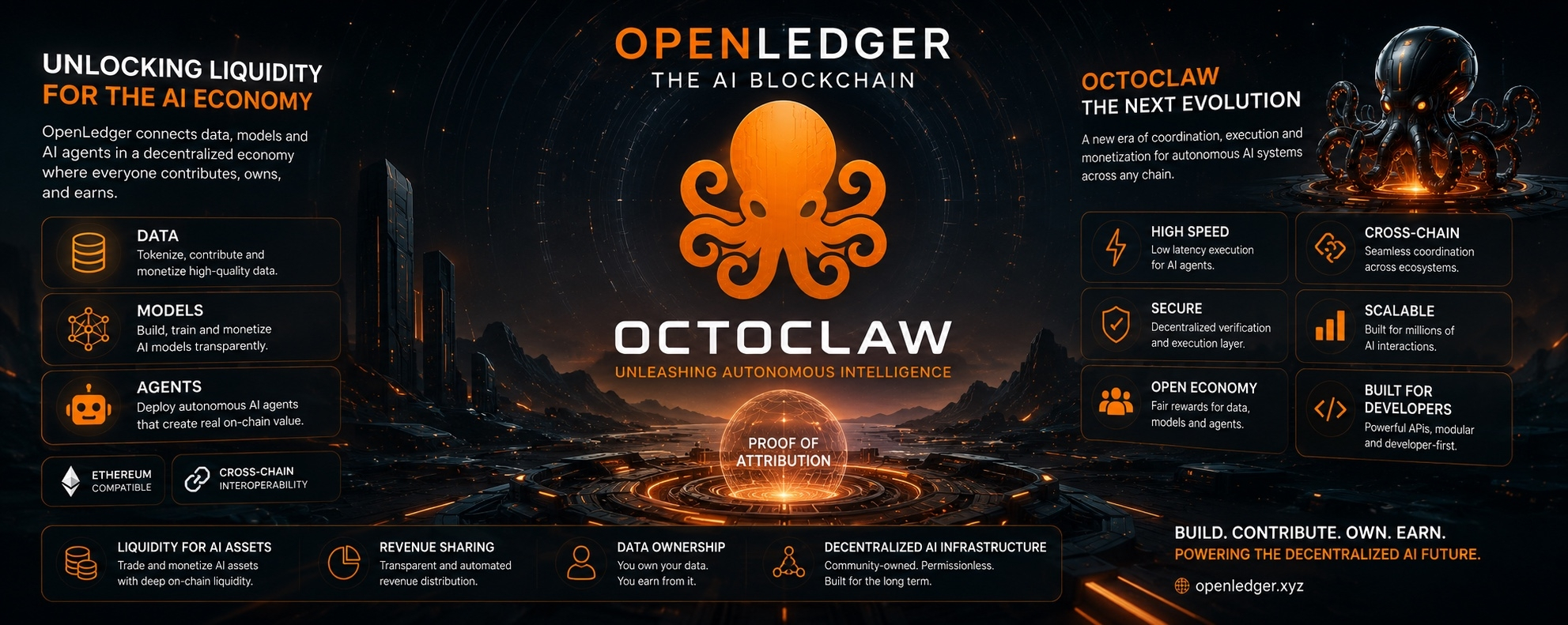
That’s partly why I ended up spending more time researching OpenLedger and its Octoclaw launch than I initially expected. At first glance it looks easy to dismiss. Another AI blockchain project. Another token attached to another futuristic vision. The market is flooded with those already. Most of them will disappear because building actual infrastructure is brutally difficult, especially when the idea sounds cleaner in theory than it behaves in production.
But the deeper I looked into the OpenLedger thesis, the more interesting the questions became.
Not because the answers are obvious.
Because they aren’t.
And that uncertainty is exactly what makes this category worth watching.
The core idea behind OpenLedger is relatively simple on paper: an AI Blockchain designed to coordinate data, models, agents, attribution, and execution across decentralized systems. But once you unpack what that actually implies, the conversation stops being about another crypto token and starts becoming a much larger discussion about how future AI economies may function altogether.
That’s where Octoclaw enters the picture.
The Octoclaw launch feels important not because of branding or hype, but because it represents a shift toward autonomous execution infrastructure. Most people still think of AI as an assistant sitting inside a chat window helping users answer questions or summarize text. But markets are already moving toward something more aggressive autonomous agents capable of making decisions, coordinating across systems, interacting with protocols, and eventually executing financial or operational strategies with minimal human involvement.
That sounds exciting until you think about the consequences.
Because the moment AI agents move from “helping” to acting, the entire infrastructure stack changes.
Now latency matters differently.
Cross-chain communication matters differently.
Verification matters differently.
Security becomes existential.
And execution becomes the actual product.
The infrastructure layer is the part most people ignore.
Retail traders usually focus on outcomes. Which token pumped. Which AI bot made money. Which protocol got attention. But infrastructure investors tend to focus on the hidden layers underneath the rails enabling those outcomes in the first place.
That’s where OpenLedger’s thesis becomes difficult to ignore completely.
If autonomous AI agents eventually become economic actors instead of passive tools, they’ll need environments where they can coordinate transactions, verify data sources, attribute contributions, share revenues, access liquidity, and operate across fragmented blockchain ecosystems without constant manual oversight.
That’s a massive coordination problem.
And crypto, despite all its flaws, was always partially designed for coordination problems.
The interesting part is how quickly this could evolve beyond simple chatbot experiences. Right now most people still manually trade markets, manually bridge assets, manually monitor risk, manually rebalance portfolios. But AI agents are slowly moving toward systems that can observe conditions, execute trades, adapt strategies, monitor liquidity, hedge exposure, and interact with multiple protocols simultaneously.
Not eventually.
Now.
Very early versions already exist.
Most of them are clunky. Some are dangerous. A lot of them fail under real market pressure. But the direction feels increasingly obvious.
Strategy design may eventually matter more than manual execution itself.
And that changes the psychology of trading entirely.
For years, successful traders built advantages through speed, information asymmetry, emotional discipline, and pattern recognition. But autonomous systems compress all four over time. If agents can monitor markets continuously across chains while adapting strategies in milliseconds, human reaction speed stops being the edge.
The edge becomes infrastructure quality.
Execution reliability.
Data quality.
Model specialization.
Risk architecture.
That’s where projects like OpenLedger start positioning themselves less like traditional crypto applications and more like coordination infrastructure for machine-driven economies.
At least theoretically.
And theory is where many projects sound brilliant before reality destroys them.
Because execution risk here is enormous.
People underestimate how fragile autonomous systems become once real capital enters the equation. One failed smart contract interaction. One corrupted dataset. One malicious oracle feed. One hallucinated AI decision. One compromised bridge. Suddenly the “autonomous economy” narrative turns into catastrophic cascading failures across interconnected systems.
This is where the real question starts.
Can decentralized AI systems actually become more trustworthy than centralized ones?
Or do they simply introduce different forms of risk?
Centralized AI platforms already dominate because they control the full stack: compute, models, data pipelines, deployment, monetization, and governance. That concentration creates efficiency. It also creates dependency. A handful of companies increasingly control the infrastructure layer behind intelligence itself.
That should probably concern more people than it currently does.
Because data ownership is becoming one of the defining economic battles of the next decade.
Most people casually feed AI systems enormous amounts of behavioral, creative, and informational data without ever participating in the value creation process that follows. The models improve. The platforms monetize. Contributors rarely receive attribution, ownership, or economic participation.
OpenLedger’s focus on concepts like Proof of Attribution becomes interesting precisely because it tries to address that imbalance.
The idea is deceptively powerful: if datasets, models, and contributors can be transparently attributed and monetized, AI economies begin functioning differently. Data providers, model creators, domain experts, and infrastructure participants could theoretically share revenue streams rather than feeding centralized monopolies for free.
And honestly… that concept alone could become much bigger than people realize.
Because the future AI economy may not simply revolve around who builds the best model.
It may revolve around who coordinates contributors most effectively.
That distinction matters.
Especially once enterprise adoption enters the picture.
Enterprises don’t just need general intelligence. They need specialized intelligence. Financial models trained on financial workflows. Healthcare models trained on medical systems. Legal models trained on compliance structures. Logistics models trained on operational data.
This is where OpenLedger’s “Datanets” concept becomes strategically important.
Specialized domain AI models could eventually behave more like industry-specific intelligence networks than generalized assistants. But specialized systems require specialized data pipelines, attribution systems, revenue incentives, governance structures, and permission layers.
Again, infrastructure.
Always infrastructure.
The infrastructure layer is the part most people ignore.
And yet historically, infrastructure layers often capture the deepest long-term value because they become difficult to replace once ecosystems build around them.
Ethereum became valuable partly because developers coordinated around it. Cloud providers became dominant because businesses built operational dependency on their infrastructure. Payment networks became powerful because merchants integrated into their rails.
Coordination compounds over time.
That seems to be part of OpenLedger’s broader ambition not merely becoming “another AI coin, but positioning itself as coordination infrastructure for decentralized AI systems.
Whether that succeeds is an entirely different question.
Because compatibility alone doesn’t guarantee adoption.
Execution quality matters more.
OpenLedger’s Ethereum compatibility is strategically smart because isolated ecosystems rarely survive long term anymore. The future probably belongs to interoperable environments rather than closed systems. Autonomous agents interacting across chains, protocols, and liquidity layers will require smooth coordination across fragmented infrastructures.
But interoperability also multiplies complexity.
Cross-chain execution sounds elegant in architecture diagrams. In reality it introduces synchronization risks, latency issues, bridge vulnerabilities, governance conflicts, and cascading security assumptions that most retail users never think about.
That’s why I remain cautious.
The vision makes sense conceptually.
The implementation challenge is brutal.
And crypto history is filled with projects that understood the future correctly but failed operationally because scaling infrastructure is far harder than writing narratives about it.
Still, something about decentralized AI feels increasingly inevitable long term.
Not because decentralization is morally superior.
Because concentration creates pressure.
If AI becomes deeply integrated into finance, governance, logistics, media, labor markets, and autonomous digital economies, society eventually starts asking uncomfortable questions about control, ownership, transparency, and economic participation.
Who owns the data?
Who trains the models?
Who captures the value?
Who controls the agents?
Who becomes replaceable?
And what happens when autonomous systems begin participating economically at scale?
That last question sounds futuristic until you realize we are already approaching early versions of it now. AI agents trading markets. AI systems negotiating prices. AI-driven execution frameworks optimizing liquidity strategies. Autonomous workflows coordinating across APIs and blockchain protocols.
Machines are slowly becoming economic participants.
Not conscious participants.
But functional ones.
That distinction matters.
Regulators are going to struggle massively with this transition. AI regulation alone is already complicated. Crypto regulation alone is already fragmented globally. Combining both creates an entirely new category of uncertainty. Autonomous financial agents operating across decentralized systems don’t fit neatly into existing legal frameworks.
Who becomes liable for failed execution?
Who governs autonomous market behavior?
What counts as financial advice when AI systems generate strategies dynamically?
What happens when decentralized agents coordinate globally beyond traditional jurisdictional boundaries?
Nobody really has clean answers yet.
And markets hate uncertainty.
But they also reward infrastructure positioned ahead of structural shifts.
That tension is what makes projects like OpenLedger fascinating to watch from a distance.
Not because success is guaranteed.
Far from it.
Most AI crypto projects will fail because vision is easier than execution. Building coordination infrastructure for decentralized intelligence systems may turn out to be one of the hardest engineering and governance problems of the next decade.
But sometimes difficult ideas matter precisely because they force markets to confront where technology is actually heading underneath the surface narratives.
That’s what Octoclaw ultimately made me think about.
Not price.
Not short-term speculation.
Infrastructure direction.
Because if autonomous agents become normal economic actors, if attribution-based AI economies emerge, if decentralized coordination layers become necessary for trust and interoperability, then the real value layer may not sit inside flashy consumer AI products at all.
It may sit underneath them.
Quietly.
Invisible to most people at first.
The coordination layer.
And maybe that’s what OpenLedger is really trying to build.
Or maybe it becomes another ambitious project crushed by complexity before the market fully arrives.
Right now, both outcomes still feel possible.
That uncertainty is real.
But so is the curiosity.