@OpenLedger The more I study the AI industry, the more I feel the market is still thinking about artificial intelligence in an extremely early-stage way. Almost every major discussion revolves around the same narratives: bigger models, faster inference, more compute power, smarter autonomous agents, and larger ecosystems. For the last two years, the entire sector has behaved as if intelligence itself is the ultimate finish line, as if the projects capable of scaling performance the fastest will automatically dominate the future. At first, I agreed with that idea because early technology revolutions usually reward raw capability before anything else. Speed attracts attention, scale attracts investment, and performance becomes the easiest metric to market. But the deeper I looked into how AI is actually being integrated into real-world economic systems, the more I started feeling that the market may be overlooking a far more important issue hiding underneath all the excitement.
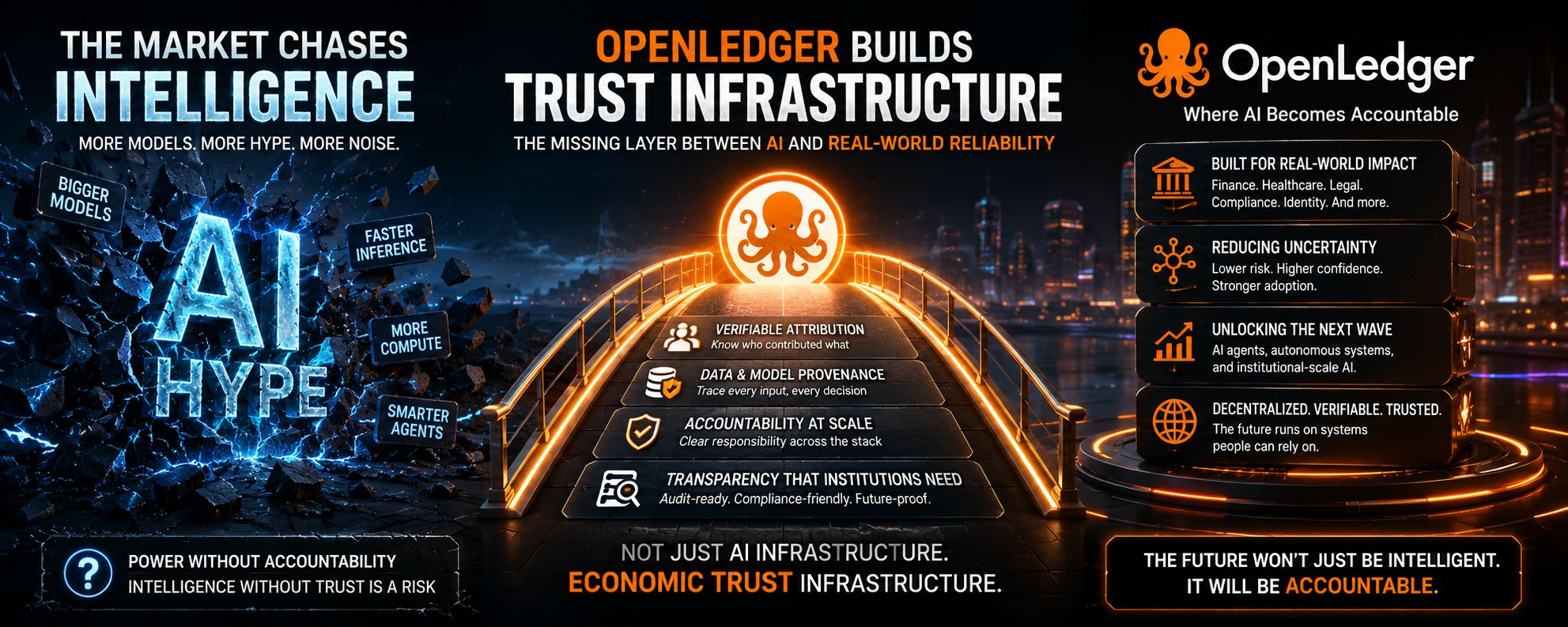
The real bottleneck may not be intelligence at all. It may be trust. Right now, AI still feels relatively safe because most people interact with it inside low-risk environments. They use models for research assistance, automation, entertainment, productivity workflows, image generation, or content creation. In those situations, imperfect outputs are frustrating but manageable. A weak answer or inaccurate result rarely creates large-scale damage. However, the moment AI begins influencing environments connected to financial systems, healthcare infrastructure, legal interpretation, compliance reviews, identity verification, insurance assessments, or autonomous transactions, the standard changes completely. At that point, nobody serious only asks whether the model is intelligent. They ask whether the system itself can be trusted under pressure, whether decisions can be traced later, and whether accountability still exists once real economic consequences enter the picture.
That is exactly why OpenLedger started standing out to me differently from many other AI-related crypto projects. Most people still describe it as AI infrastructure, which is technically true, but I increasingly think that framing misses the more important layer the project may actually be targeting. Modern AI systems are becoming deeply fragmented networks of contributors, datasets, retrieval layers, orchestration frameworks, inference providers, and autonomous agents interacting simultaneously. One company supplies foundational models, another fine-tunes them, another injects external context, and another builds downstream systems that make operational decisions based on those outputs. By the time a final result reaches the end user, responsibility often feels distributed across multiple invisible layers instead of sitting clearly with a single accountable entity. That fragmentation creates uncertainty, and uncertainty becomes extremely expensive once institutions, regulators, auditors, and compliance departments become involved.
Retail users can tolerate ambiguity if a product feels useful or innovative enough. Enterprises do not think that way. Large organizations evaluate technology through the lens of operational risk, governance structures, auditability, compliance obligations, escalation procedures, and legal accountability. The larger the economic consequences become, the more important those invisible trust layers start becoming. Nobody inside a serious compliance meeting says, “the AI output sounded convincing.” They ask much harder questions instead. Where did the data originate? How was the decision influenced? Can the process be audited later? Can problematic outputs be traced back through the system? Who becomes responsible if regulators investigate outcomes years later? Those questions may sound boring compared to the hype surrounding AI agents and compute races, but historically, boring infrastructure tends to become the most valuable layer once industries mature.
Financial markets followed a similar path. Early competition focused heavily on speed and expansion, but eventually trust architecture became inseparable from scale itself. Settlement systems, audit frameworks, compliance infrastructure, reporting standards, and operational transparency quietly became the foundation supporting trillions of dollars in economic activity. I think AI may eventually move in the same direction. Not because innovation is slowing down, but because economic systems cannot operate indefinitely on opaque assumptions. Institutions eventually require mechanisms capable of reducing uncertainty enough for large-scale adoption to feel operationally safe. That is where OpenLedger’s positioning becomes genuinely interesting to me. If the project is truly building infrastructure around attribution, provenance, and verifiable contribution systems, then its role in the future AI economy could become much larger than most current market narratives imply.
What makes this even more interesting is that attribution may ultimately evolve beyond being a contributor rewards mechanism and become a form of economic trust infrastructure itself. If two AI ecosystems offer similar levels of performance, but one provides stronger transparency, traceability, and governance around how outputs are formed, institutions may rationally choose the more reliable environment even if performance is slightly weaker. That dynamic already exists across multiple mature industries. Trusted supply chains outperform uncertain ones. Transparent financial infrastructure attracts more institutional participation than opaque alternatives. Reliable governance frameworks consistently outperform systems built purely around speed and speculation over long time horizons. AI may eventually follow the same pattern because confidence is what allows systems to scale economically.
Still, I do not think this challenge is easy at all. In fact, I think it may be one of the hardest infrastructure problems in the entire AI sector. Neural systems do not maintain clean records explaining exactly how influence flows through training data, models, retrieval layers, and outputs. Contribution mapping becomes incredibly difficult once systems scale into massive distributed environments. If attribution systems are implemented poorly, they risk becoming performative rather than genuinely reliable. Crypto ecosystems also introduce another layer of complexity because the moment attribution gains economic value, adversarial behavior naturally follows. Spam datasets, sybil attacks, artificial reputation farming, and manipulated contribution systems can quickly undermine trust mechanisms that are not designed carefully. That means OpenLedger is attempting to solve a problem that is not only technically difficult, but behaviorally and economically difficult as well.
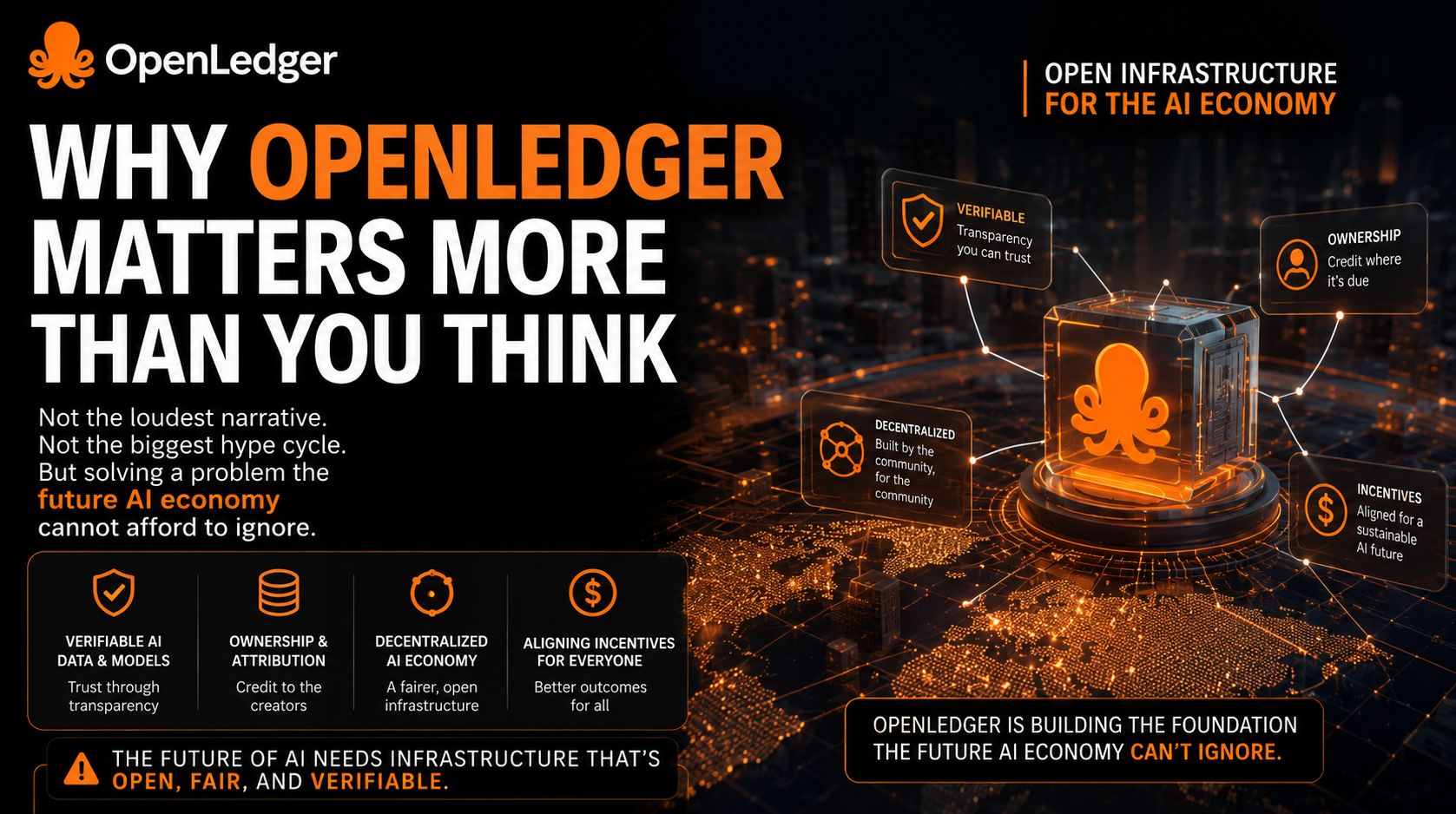
Even with those risks, I cannot shake the feeling that the broader AI market still looks heavily focused on phase-one thinking. Everyone continues competing to create faster models, larger ecosystems, stronger agents, and cheaper compute infrastructure. Those things absolutely matter, but history repeatedly shows that long-term technological revolutions are rarely sustained by raw capability alone. Eventually, the systems capable of creating trust at scale become the ones that matter most. That is why OpenLedger keeps feeling increasingly important to watch. Not because it promises the loudest narrative or the most aggressive hype cycle, but because it may be attempting to solve one of the few problems the future AI economy genuinely cannot afford to ignore.