
I have been around crypto long enough to recognize when the market starts repeating old emotions under new names. Every cycle feels different on the surface, yet deep down the same patterns keep resurfacing. New technologies appear, new founders arrive, and new promises dominate conversations, but the emotional rhythm rarely changes. Excitement turns into obsession, obsession turns into speculation, and speculation eventually collides with reality.
That is partly why OpenLedger (OPEN) caught my attention.
Not because I immediately believed the story, and not because I think every project connected to AI automatically deserves trust. Honestly, I have become more cautious with age in this industry. After watching multiple hype cycles explode and collapse, I no longer feel impressed by polished narratives alone. What interests me now is quieter. I pay attention to behavior. I watch the ledger. I study transaction patterns, fee generation, wallet activity, and the difference between genuine demand and temporary noise.
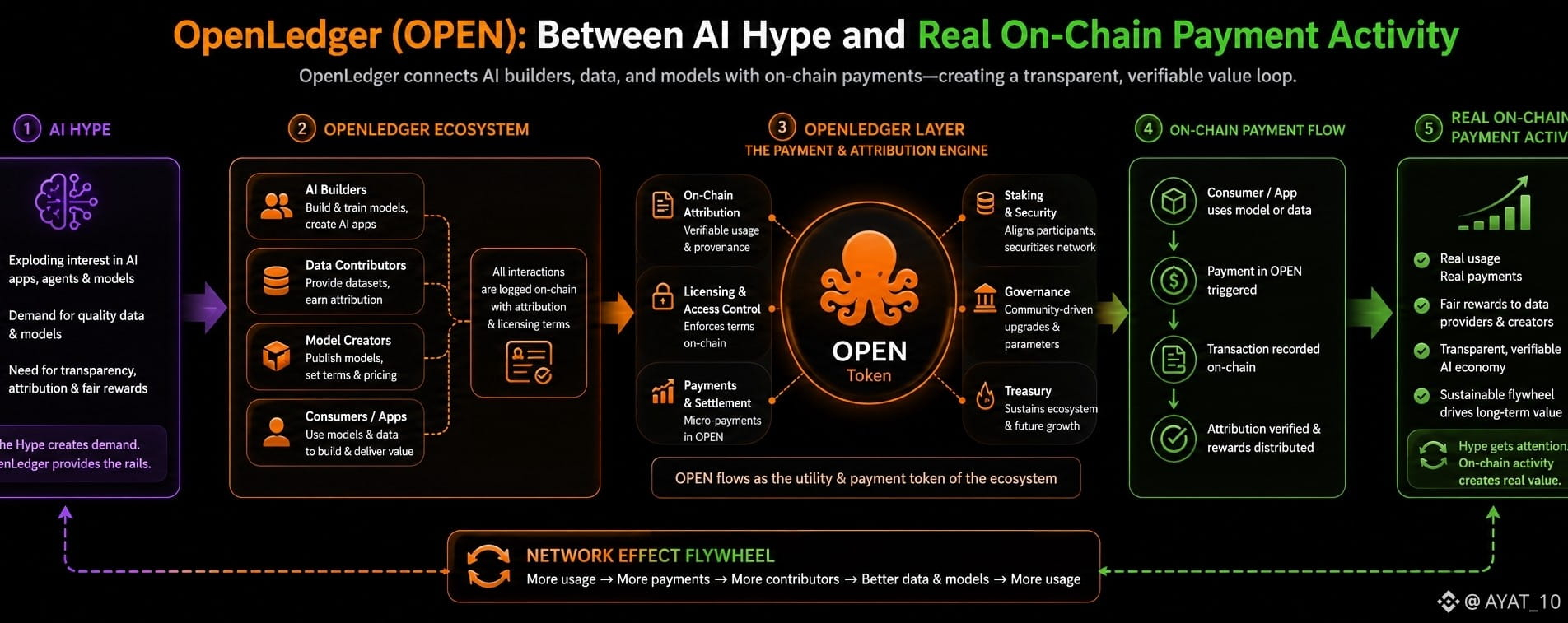
OpenLedger positions itself as an AI blockchain focused on unlocking liquidity around data, models, and agents. The idea sounds attractive in today’s market environment because it combines two narratives people desperately want to believe in right now. AI and payments.
That combination creates emotional momentum very quickly.
The market loves stories that sound practical during uncertain periods. When speculation becomes exhausting, investors naturally search for something that feels connected to real economic activity. That is usually when payment narratives return. Suddenly everyone begins talking about utility again. Transaction throughput becomes important again. Settlement layers become exciting again. The conversation shifts from pure speculation toward systems that supposedly support real world usage.
I understand why that happens.
Deep inside, many people in crypto still want validation that this technology can become more than trading screens and volatile charts. Payment focused blockchains appeal to that hope because payments feel tangible. They feel useful. They feel closer to everyday life than most speculative sectors inside crypto.
But this is also where my skepticism quietly appears.
I have seen countless periods where rising activity created the illusion of sustainable adoption. Wallet numbers surged. Transactions exploded. Communities celebrated what they called massive growth. Then months later the activity disappeared almost overnight because most of it was tied to incentives rather than real necessity.
That distinction matters more than people realize.
A blockchain can look incredibly active while still lacking authentic economic demand. Incentive programs can manufacture traffic very efficiently. Farming behavior can inflate user counts. Automated systems can generate endless transactions. On the surface, the network appears alive. Underneath, however, the foundation can be fragile.
This is why I struggle whenever people focus only on price action during these moments. Price tells you where attention is flowing. It does not necessarily tell you whether the system is becoming economically important.
I learned that lesson painfully during previous cycles.
Years ago, I used to get emotionally pulled into excitement the same way everyone else did. Rapid price movements created urgency. Strong narratives created conviction. Communities made every project sound inevitable. But over time I noticed something uncomfortable. The projects that survived were rarely the loudest during hype periods. The survivors were usually the ones quietly building consistent user behavior long after attention faded.
That changed the way I observe crypto completely.
Now when I study projects like OpenLedger, I care less about trending excitement and more about repetitive daily activity. I want to know whether people continue transacting when nobody is rewarding them to stay active. I want to know whether fees remain stable. I want to know whether users return naturally because the network solves a real problem.
Those signals matter far more to me than emotional optimism.
The AI angle surrounding OpenLedger adds another layer to this story. AI is currently experiencing the same kind of emotional expansion that decentralized finance experienced years ago. Investors want exposure to anything connected to artificial intelligence because they fear missing the next major technological shift. That fear alone can create enormous speculative energy.
But speculation and sustainability are not the same thing.
I think many people forget how quickly narrative momentum can distort perception. Once enough attention enters a sector, every metric suddenly gets interpreted in the most optimistic way possible. High transaction counts become proof of adoption. Increased wallet creation becomes proof of mainstream demand. Rising token prices become proof that the market understands the future.
Sometimes those assumptions turn out correct.
Many times they do not.
That is why I always return to on chain behavior itself. Transaction fees tell a more honest story than emotional commentary ever will. Fees reveal whether users are willing to pay for blockspace because they genuinely value the service being provided. Even modest but consistent fee generation can mean more than explosive temporary growth fueled by rewards.
Protocol income matters too.
Weak revenue signals often expose uncomfortable truths beneath strong narratives. A chain can process huge amounts of activity while capturing very little sustainable value. If the economic structure depends heavily on incentives, emissions, or speculative inflows, the ecosystem becomes vulnerable once market conditions cool down.
And markets always cool down eventually.
That is another lesson experience teaches you. Excitement in crypto feels permanent while you are inside it. Every cycle convinces people that this time adoption will continue endlessly. Yet once liquidity disappears, reality becomes visible very quickly. Activity slows. Users leave. Volumes collapse. Projects that looked unstoppable suddenly become silent.
I still remember the emotional emptiness that followed previous narrative booms. Entire sectors went from dominating conversations to barely existing within months. That memory stays with me whenever I evaluate new ecosystems.
OpenLedger may absolutely find meaningful adoption inside AI related infrastructure. I am not dismissing the possibility. In fact, the concept itself makes logical sense in several ways. If AI agents eventually transact autonomously, exchange data continuously, or monetize digital services at scale, specialized blockchain settlement systems could become genuinely useful.
But usefulness alone does not automatically justify long term token value.
That is another uncomfortable question I rarely see discussed honestly.
If payment activity increasingly revolves around stable digital assets, then what role does the native token truly serve? Is it essential infrastructure, or is it primarily a speculative asset attached to the ecosystem narrative?
I think that question deserves far more attention than it receives.
Many payment oriented chains face this tension eventually. Users may appreciate the network itself while having little emotional attachment to the token powering it. Stablecoin based payments often matter more to businesses and users because stability reduces friction. People trying to settle transactions usually care more about reliability than speculation.
That creates a difficult balancing act for projects like OpenLedger.
The network needs enough real economic activity to remain sustainable, but it also needs the native token to maintain relevance beyond temporary market excitement. Achieving both simultaneously is harder than most investors realize.
Another thing that concerns me is concentration risk.
Sometimes a network appears decentralized on the surface while most meaningful activity comes from a surprisingly small number of wallets, applications, or participants. That concentration creates hidden fragility. If a few dominant actors leave, usage can decline dramatically.
Artificial activity spikes create similar problems.
I have become deeply cautious around sudden transaction explosions because crypto has become very efficient at manufacturing temporary engagement. Incentive campaigns can produce astonishing growth metrics in short periods. But when rewards disappear, the real baseline demand finally becomes visible. That post hype collapse is often painful to watch because expectations were built on inflated activity rather than sustainable behavior.
Emotionally, I think this is what frustrates me most about crypto discussions during euphoric periods. Too many people stop asking difficult questions. Skepticism becomes unpopular. Caution gets mistaken for negativity. Everyone becomes obsessed with immediate upside while ignoring structural weaknesses underneath.
I cannot think that way anymore.
Maybe that comes from living through too many booms and busts. Maybe it comes from watching intelligent people lose perspective during periods of intense greed. Whatever the reason, I now trust consistency more than excitement.
That is why I continue studying transaction frequency, fee stability, wallet retention, and protocol income instead of emotional sentiment. Those indicators move slower, but they usually reveal reality earlier than price charts do.
When I look at OpenLedger today, I feel something more complicated than excitement. I feel curiosity mixed with restraint. The concept is interesting. The timing is understandable. The narrative is strong. But I also know how dangerous strong narratives can become when they move faster than sustainable adoption.
In the end, attention alone never guarantees survival.
Events may amplify visibility. Narratives may attract capital. Speculation may create temporary momentum. But none of those things can replace genuine user behavior over time.
What ultimately matters is whether people continue using the network consistently when the emotional intensity fades away. Real survival in crypto has always depended on that quiet daily activity happening beneath the noise.
Not the excitement.
Not the promises.
Not the hype.
Just the ledger telling the truth day after day.