
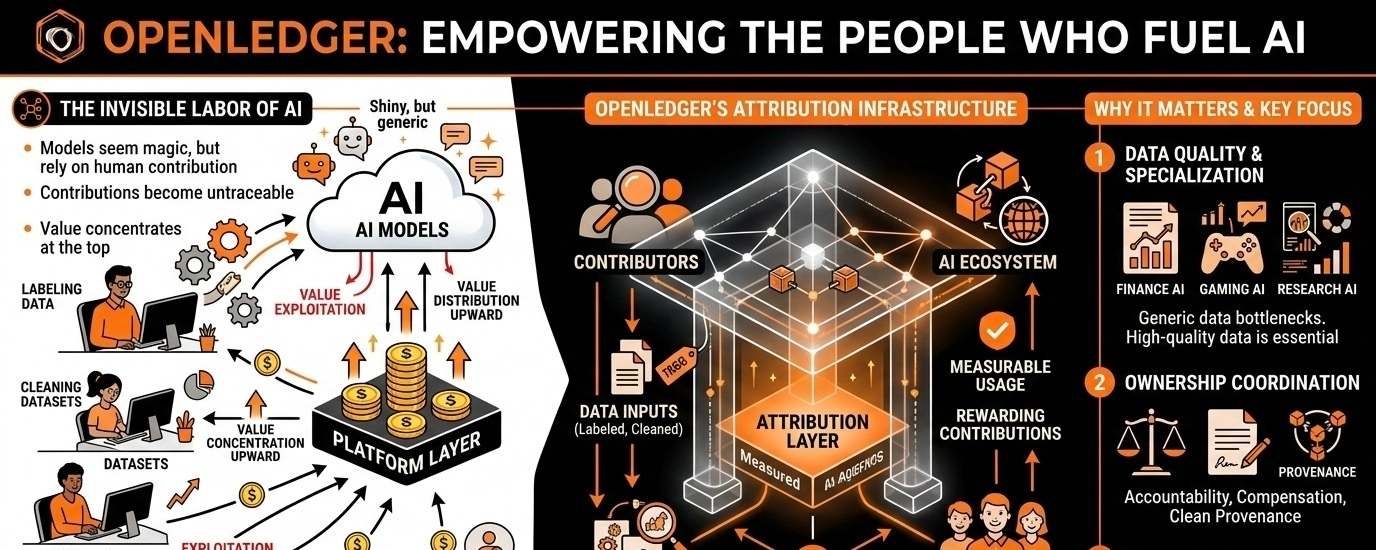
I think one of the biggest illusions in AI right now is the idea that intelligence appears out of nowhere. People talk about models like they are magic products. Smarter chatbot. Smarter agent. Faster automation. Better reasoning. Better search. Better prediction. The conversation almost always ends at the interface because that is the cleanest part to market.
But underneath every AI system is a pile of invisible labor. Someone collected the data. Someone cleaned it. Someone structured it. Someone labeled it. Someone refined the outputs. Someone tested the edge cases. Someone built workflows around it. Someone kept feeding the machine long after the hype cycle moved somewhere else. Most of those people never capture proportional value.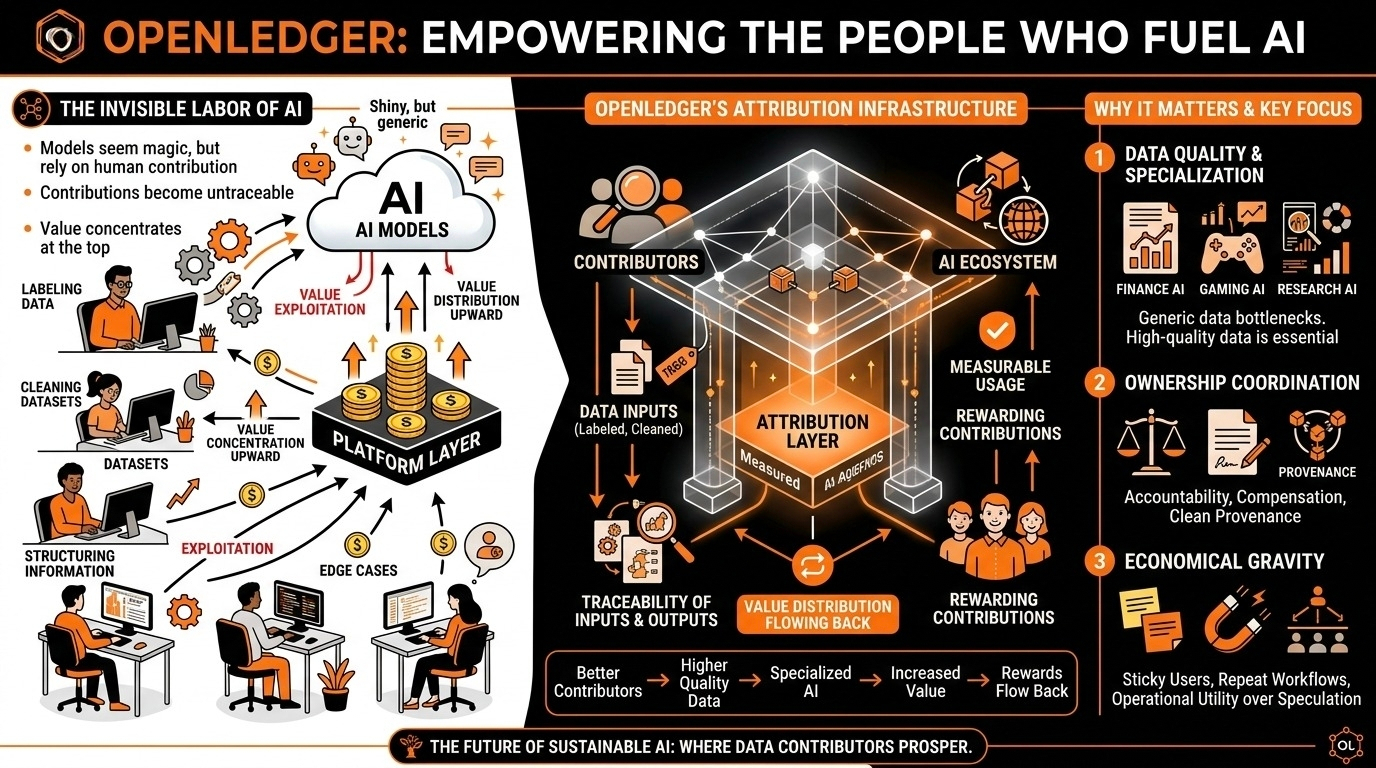
I have watched this happen repeatedly across both crypto and traditional tech. The people closest to infrastructure usually make the least noise while the platform layer absorbs most of the upside. The story gets framed around innovation and scale, but eventually the same pattern appears: contribution becomes difficult to track, ownership becomes vague, and value starts concentrating upward.
That is why OpenLedger caught my attention. Not because it uses the word AI. That barely means anything anymore. Every project now wants to position itself somewhere inside the AI narrative because the market rewards the label before it verifies the execution. I have seen ecosystems add “AI” to products that have almost nothing intelligent underneath them besides automated prompts and marketing decks.
OpenLedger feels different because the underlying question is more practical. If AI systems are built on top of human contribution, who actually gets rewarded when those systems become valuable? That is a much harder conversation than launching another chatbot or another agent framework. And honestly, it is also the conversation most of the industry avoids.
The AI boom has created an economy where models consume enormous amounts of information while the origins of that information become increasingly invisible. The internet spent years training people to post, create, organize, review, discuss, and contribute for free. AI accelerated that dynamic because now information itself can become machine fuel at scale.
The problem is that contribution without attribution eventually creates imbalance. OpenLedger is trying to build around that imbalance instead of pretending it does not exist. The core idea is surprisingly simple when stripped down: datasets, models, agents, and applications should not behave like disconnected black boxes. There should be traceability between inputs and outputs. Contributions should have attribution layers. Usage should become measurable enough for value distribution to happen across the network instead of only at the top.
That sounds obvious until you realize how messy AI systems actually are. This is not blockchain accounting where one wallet sends tokens to another and everything becomes visible instantly. AI is probabilistic. Models evolve through millions or billions of tiny adjustments. One dataset can improve accuracy in one domain while weakening another. One contributor may provide raw information while another restructures it into something usable. Another may fine-tune the model. Another may build the interface that finally creates adoption.
Trying to map contribution across that stack is brutal. And that is exactly why I think OpenLedger is interesting. Not because the problem is easy, but because the problem is real.
I have become increasingly skeptical of crypto projects whose entire existence depends on narrative momentum. You can usually tell when something is built only for speculation because the language becomes detached from operational reality. Everything sounds revolutionary until you ask where the sustained usage comes from. OpenLedger at least appears to understand where the real friction lives.
Data quality is becoming one of the most important bottlenecks in AI. That matters more than people think. The early AI race was dominated by scale. Bigger datasets. Bigger models. Bigger compute. But the market is slowly moving toward specialization now. Industry-specific models. Research agents. Financial agents. Security systems. Gaming AI. Automation tools trained on highly specific workflows.
Those systems cannot rely entirely on generic internet data forever. A trading agent needs financial context. A gaming AI needs behavioral interaction data. A research assistant needs structured domain knowledge. Enterprise automation systems need reliable operational inputs. Specialized AI becomes more dependent on high-quality, contextual information.
And high-quality information is expensive. The internet just spent years pretending otherwise. That is why I keep coming back to OpenLedger’s focus on attribution and incentives. If contributors know their inputs can be tracked and monetized, the network potentially creates a stronger reason to participate. Better contributors improve datasets. Better datasets improve models. Better models improve applications. Better applications attract users. User activity generates value that can theoretically flow back through the ecosystem.
At least in theory. Theory is the easy part. The hard part is turning that loop into something durable.
I have seen too many crypto ecosystems collapse because they solved the whitepaper before they solved human behavior. Builders underestimate how quickly users abandon systems that introduce friction. Contributors lose interest if rewards feel delayed or symbolic. Developers avoid ecosystems that complicate deployment. Speculators arrive faster than real participants. Eventually the token starts trading independently from the actual utility layer underneath it.
That risk absolutely exists here too. OpenLedger still has to prove that attribution can function at scale without becoming overly complex. It still has to prove that contributors actually remain active long term. It still has to show that developers want to build inside that environment instead of defaulting to easier centralized platforms.
And most importantly, it has to prove that the network creates genuine economic gravity. That part matters more than almost anything else. Crypto projects survive when participants need the system, not when they temporarily speculate on it.
I keep asking the same questions whenever I look at AI-related networks now: Where are the sticky users? Where are the repeat workflows? Where are the applications people continue using after the excitement disappears? Where does the token become operationally necessary instead of emotionally speculative?
Those questions eventually expose whether a project has infrastructure value or just narrative liquidity. OPEN still needs to answer them over time. Because the market always rotates away from stories eventually. Always.
I think a lot of projects secretly assume attention is permanent. It never is. Narratives move fast. Capital moves even faster. AI is dominant now, but eventually the market will become more selective and start separating systems with actual utility from systems built mainly around momentum.
That filtering process is brutal. But it is healthy. And honestly, OpenLedger seems positioned closer to infrastructure than spectacle, which gives it a better chance than many AI-related projects floating around right now.
I also think the project is smart not to frame itself as a direct competitor to the largest AI companies. That would be suicidal. Competing on raw model scale against trillion-dollar ecosystems is not realistic for most decentralized networks.
The more intelligent angle is ownership coordination. Who contributed? How was the data used? Which models generated value? Which agents executed tasks? How do incentives continue moving as AI systems interact with each other? That layer becomes increasingly important as AI economies mature.
Right now the AI conversation is still dominated by outputs because outputs are easier to sell. People see generated text, generated images, autonomous agents, and automation workflows. But underneath all of it sits a growing need for provenance, accountability, compensation, and coordination. The accounting layer eventually matters. Especially once real money starts flowing through autonomous systems.
And I think that is the deeper bet OpenLedger is making. Not that AI grows bigger. That part already looks inevitable. The real bet is that AI eventually becomes too economically important to operate on vague ownership assumptions forever. Contributors will want attribution. Developers will want transparent sourcing. Networks will want measurable incentive structures. Businesses will want cleaner provenance around the systems they depend on.
AI does not just need intelligence. It eventually needs infrastructure around contribution itself. That is the lane OpenLedger appears to be targeting.
I am still cautious because the gap between a meaningful idea and a durable ecosystem is enormous. The crypto market has buried countless projects that sounded important in theory but failed to create enough real-world pull.
But I do think OpenLedger is pointing at a legitimate structural issue most people are still underestimating. The internet trained everyone to think data was free. AI may be the force that finally proves it never was.
@OpenLedger #OpenLedger #openledger $OPEN
