I spent some time checking out AI crypto systems this week and I kept seeing the same thing.
Most of them seem like systems trying to look like AI infrastructure.
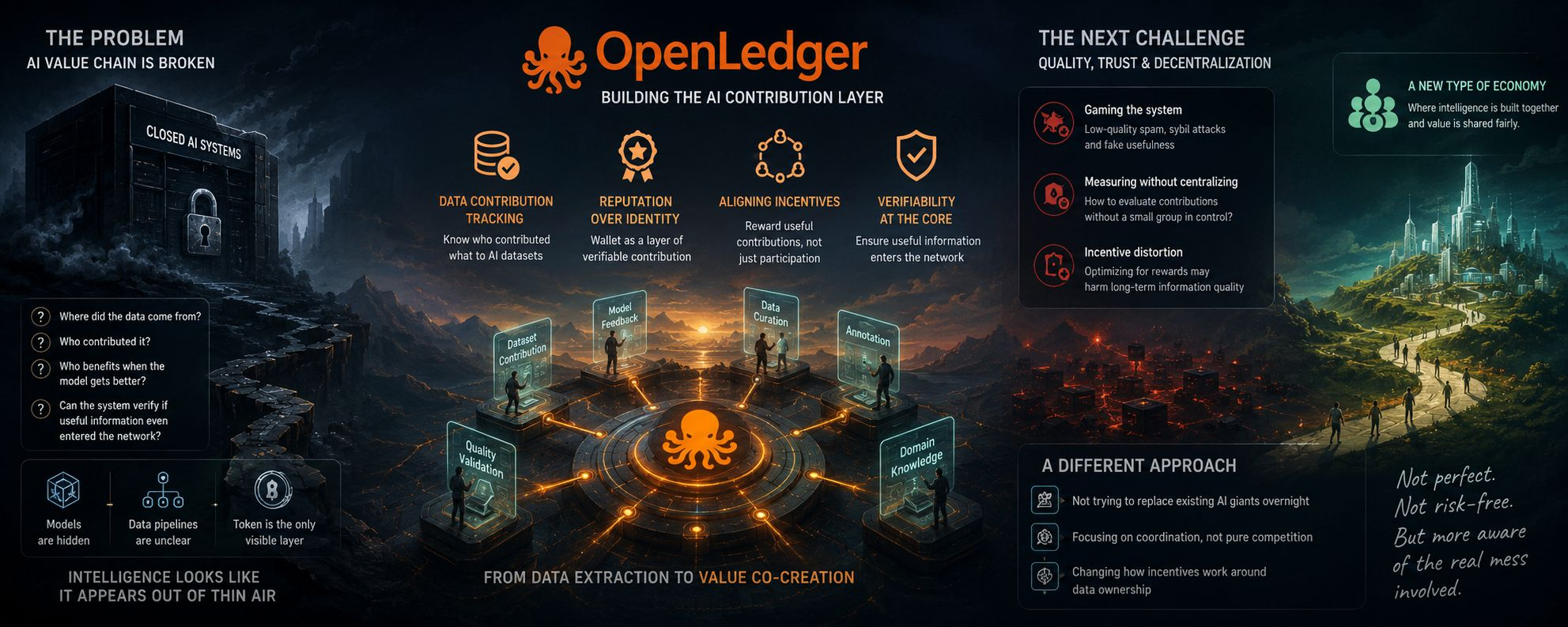
The model is hidden somewhere. The data pipeline is unclear. The token is what people focus on because its the part they can interact with. Everything else seems vague. Closed off.
That's why OpenLedger kept coming to mind.
Not because it looks perfect. Mostly because the project seems focused on where AI value comes from not just making GPU access into another market for speculation.
The strange thing about AI crypto projects is that they treat intelligence like it appears out of thin air. Bigger model. Bigger computer. More partnerships. Then a token is supposed to tie everything
The real bottleneck in AI right now doesn't feel like compute alone anymore.
It feels like trust.
Where did the data come from?
Who contributed it?
Who benefits when the model gets better?
Can the system verify if useful information even entered the network?
That part still looks weak in systems.
OpenLedger seems to be exploring that layer directly. The project is pushing toward tracking who contributed what to AI data not just focusing on how the model can make predictions or how big it is.
That changes how the network feels a bit.
The wallet stops looking like a place to store things and starts acting like a layer that shows what you've contributed. Not your identity like on media. More like a reputation for doing things.
I think that's where things get interesting and a bit risky.
Because once AI systems start rewarding people for contributing the next problem shows up away.
People will try to game the system.
They always do. Low-quality data spam is everywhere online. If rewards are attached to datasets then fake usefulness becomes a market quickly. That puts pressure on systems that verify information and rank it. Suddenly the hardest part isn't building the network. It becomes filtering out the noise without making the system centralized.
I kept wondering about that while reading OpenLedger discussions.
How does a network really measure contributions without slowly becoming dependent on a small group deciding what's good behind the scenes?
That tension feels unresolved.
It's still more honest than projects that pretend decentralization fixes everything.
Another thing I noticed is how OpenLedger talks less about replacing existing AI companies and more about changing how incentives work around data ownership.
That sounds subtle. It matters.
Crypto AI stories still sound like they want to build decentralized versions of OpenAI overnight. Realistically that feels unlikely now. The gap in infrastructure is still huge.
OpenLedger feels more aware of that limitation.
The system appears to focus on coordination than pure competition. That may actually be the direction even if it sounds less exciting to traders looking for instant stories.
There's also something underneath all this.
If AI contribution becomes a thing then intelligence itself slowly turns into an extractive economy. People may start optimizing knowledge creation for rewards of usefulness. That could distort information quality over time the same way engagement farming distorted platforms.
I don't think enough AI crypto projects talk about that risk honestly.
OpenLedger at least seems close to the data layer that these problems can't be ignored forever.
Maybe that's why the project feels different when you stay around it longer.
Not cleaner. Not safer. More aware of the actual mess involved in building AI systems around human participation.
Honestly that may be more valuable, than another ecosystem promising infinite scale while hiding all the fragile parts underneath.