

Lately I’ve been noticing something weird in the market. Even with Bitcoin holding strong and liquidity slowly rotating back into altcoins, people still seem mentally exhausted. You can feel it on Crypto Twitter, in Telegram groups, even in the way traders react to new narratives now. The excitement is still there, but the blind belief isn’t. Everyone’s searching for something that actually makes sense beyond a quick pump.
That’s probably why OpenLedger caught my attention faster than I expected.
At first I ignored it. Honestly, I almost scroll past every project that combines “AI” and “blockchain” now because most of them feel engineered around attention instead of utility. Same recycled language. Same “decentralized intelligence” pitch. Same ecosystem promises with no real explanation about why blockchain even needs to be involved.
But the more I looked into OpenLedger, the more I realized the project is trying to solve a very real problem that’s becoming bigger every month.
AI is growing insanely fast right now, but ownership inside the AI economy still feels broken.
That’s the core issue.
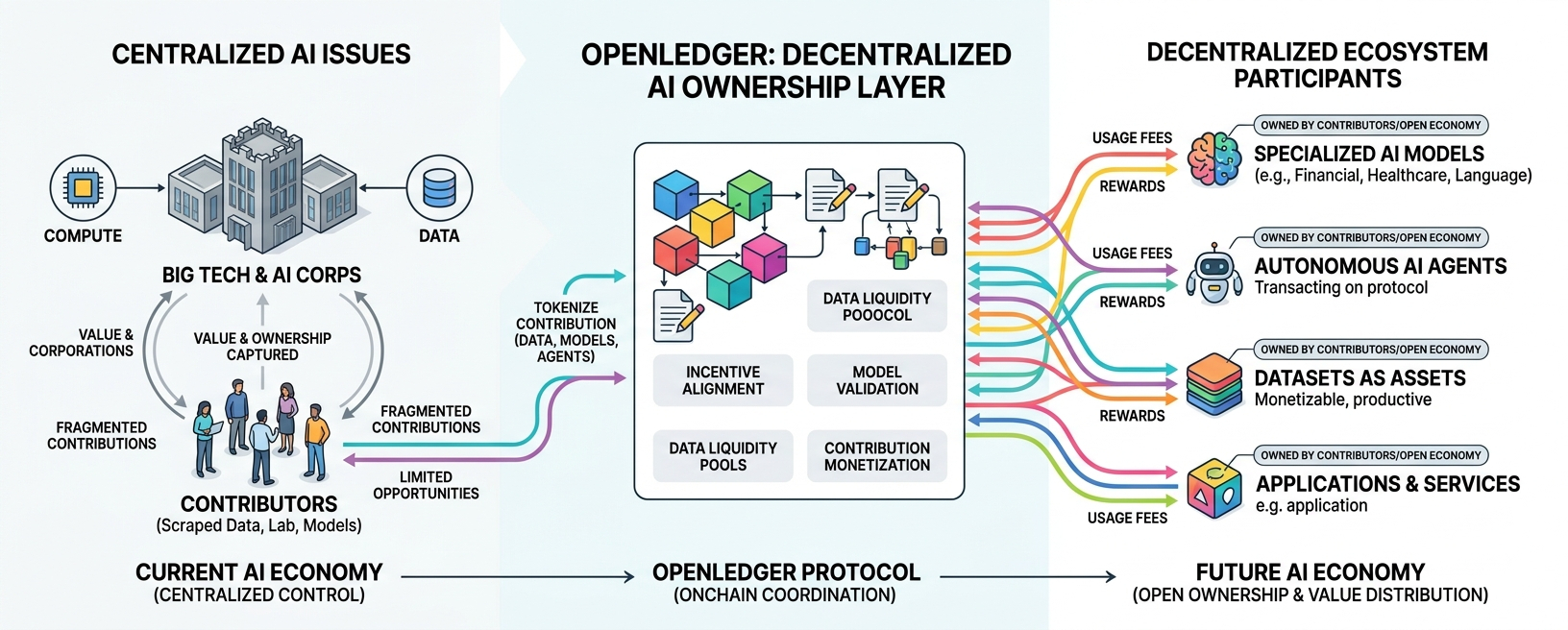
A handful of centralized companies control most of the infrastructure, most of the compute, most of the distribution, and increasingly, most of the value capture. Meanwhile the people actually contributing to these systems, whether through datasets, model improvements, niche training inputs, or agent development, often don’t really own anything meaningful.
And I think that imbalance eventually becomes unsustainable.
What OpenLedger seems to understand is that AI isn’t just a technology race anymore. It’s becoming an economic system. Once you see it that way, the whole project starts making more sense.
From what I’m seeing, OpenLedger is essentially trying to create an onchain coordination layer where data, AI models, and autonomous agents can become monetizable assets instead of isolated tools locked inside centralized ecosystems.
That sounds technical when you first hear it, but honestly the concept is pretty human if you strip away the crypto language.
Imagine you spend months training a specialized AI model for financial analysis, medical research, or regional language translation. Today, your options are limited. Either you integrate with a centralized platform, raise funding, sell subscriptions, or hope a larger company acquires your technology.
OpenLedger is exploring another path where those models can plug directly into a decentralized economic network. Contributors can potentially earn based on usage, validation, participation, or network demand instead of relying entirely on corporate intermediaries.
I think that idea feels relevant right now because the market is slowly shifting away from pure speculation narratives and back toward infrastructure narratives again.
Not fully, obviously. Memecoins still dominate attention because they move emotionally faster than utility projects ever will. But underneath that noise, I’ve noticed smarter capital quietly positioning around sectors connected to long-term structural trends.
AI is one of those trends.
The difference now is that people are becoming more selective about which AI projects actually matter.
A year ago almost anything with “AI” in the name could attract liquidity. Now investors want clearer economic logic. They want to understand where demand comes from, why a token exists, and whether the infrastructure solves something meaningful.
That’s where OpenLedger feels different to me compared to a lot of AI-related crypto projects.
It’s less focused on showcasing intelligence and more focused on monetizing contribution.
That distinction matters more than people realize.
Most conversations around AI still revolve around models themselves. Bigger models. Smarter models. Faster models. But eventually the real battle may revolve around ownership layers and coordination systems around those models.
Who controls the data?
Who validates outputs?
Who captures the value generated by AI activity?
Who gets rewarded when systems improve?
Those questions are becoming extremely important now.
One thing I found interesting while researching OpenLedger is how much emphasis seems to be placed on data liquidity and contribution incentives. And honestly, I think the market still underestimates how valuable data is becoming.
The internet has already been heavily scraped for training material. High-quality datasets are increasingly scarce. Specialized datasets are fragmented across industries and geographies. AI companies need more data constantly, but sourcing reliable information ethically and efficiently is becoming harder.
OpenLedger appears to be trying to create infrastructure where datasets themselves can become productive assets inside an open economy.
That’s a fascinating idea because data has always generated enormous value online while the actual contributors usually receive very little of the upside.
Crypto historically solved value transfer problems.
AI is now facing contribution and ownership problems.
This project sits right in the middle of those two worlds.
What also caught my attention is the modular nature of the ecosystem. OpenLedger doesn’t seem to be positioning itself as one giant consumer-facing AI app. It feels more like infrastructure designed to support many different models, agents, and applications simultaneously.
I think that’s the smarter direction honestly.
The future of AI probably won’t belong entirely to one universal model. We’re already seeing the rise of smaller specialized systems optimized for particular industries or tasks. Financial AI, healthcare AI, coding agents, legal analysis systems, regional language models. These ecosystems are becoming increasingly fragmented and specialized.
If that trend continues, coordination layers become incredibly important.
Because eventually all these systems need ways to exchange value, validate trust, access datasets, and monetize outputs efficiently.
That’s where blockchain infrastructure actually starts making practical sense instead of feeling forced.
And I didn’t expect myself to say that because I’ve become pretty skeptical of AI crypto projects lately.
Another underrated aspect here is the possibility of AI agents themselves becoming economic participants. We’re moving toward a world where autonomous systems may transact, negotiate services, analyze markets, purchase compute resources, or interact with protocols independently.
Traditional infrastructure wasn’t really built for autonomous machine economies.
Blockchain might be.
I think that’s one of the deeper long-term ideas hiding underneath projects like OpenLedger. It’s not just about creating tokens around AI. It’s about preparing infrastructure for environments where intelligence itself participates economically.
Still, I’m trying to stay balanced because this space comes with serious risks.
Execution risk is huge here.
Building decentralized AI infrastructure sounds great conceptually, but coordinating honest participation at scale is difficult. Preventing spam datasets, low-quality models, exploitative incentives, or governance capture becomes extremely complicated once networks grow larger.
And then there’s competition.
OpenLedger isn’t operating alone. There are dozens of projects working on decentralized compute, AI agents, inference markets, data marketplaces, and AI-native blockchain infrastructure. Some have stronger funding. Some already have larger developer communities. Some move faster operationally.
Centralized AI companies also remain massive competitors whether crypto likes it or not.
That reality matters because centralized systems still have enormous advantages in speed, capital access, compute ownership, and user adoption.
Regulation is another thing I keep thinking about.
Governments globally are still figuring out how to regulate AI itself. Data ownership laws, copyright enforcement, model accountability, and cross-border compliance issues could eventually impact decentralized AI ecosystems in unpredictable ways.
Most retail investors honestly don’t think deeply enough about those risks yet.
Then there’s the token side of things. Like every crypto project, sustainability eventually matters more than early narrative momentum. Unlock schedules, emissions, staking incentives, validator economics, and ecosystem demand all need to align long term. Otherwise even strong narratives can collapse under market pressure.
I’ve seen that happen too many times already this cycle.
But despite those concerns, I still think OpenLedger represents something important conceptually.
The project feels like part of a broader shift happening quietly across crypto right now. For years this industry focused mostly on tokenizing finance. Stablecoins, DeFi, payments, liquidity, lending. Now we’re slowly entering a phase where people want to tokenize intelligence, contribution, and digital productivity itself.
That changes the conversation completely.
One personal observation I can’t stop thinking about is this: AI and crypto are both coordination technologies at their core.
AI coordinates information and decision-making.
Crypto coordinates trust and ownership.
When those systems merge properly, entirely new economic structures become possible online.
Most projects still approach that merger superficially. Either the blockchain component feels unnecessary, or the AI integration feels cosmetic. OpenLedger at least seems aware that the real opportunity sits inside incentive alignment and contribution ownership.
And honestly, I think that’s the part many people are still missing.
The future AI economy may not just reward whoever builds the smartest model. It may reward whoever creates the fairest systems around participation, ownership, and value distribution.
That’s a very different kind of race.
Right now OpenLedger still feels experimental. There’s ambition here, but also uncertainty. There’s a compelling narrative, but the execution path remains difficult. The project could evolve into meaningful infrastructure for decentralized AI economies, or it could struggle under the pressure of competition and adoption challenges.
I genuinely don’t know yet.
But I do know this: the fact that crypto is now seriously asking who should own intelligence says a lot about where this industry is heading next.
And maybe that’s the bigger story unfolding here.
Not whether OpenLedger becomes the dominant AI blockchain.
But whether the next generation of AI infrastructure ends up being owned by a handful of corporations again… or by the people actually contributing to it in the first place.
