

I’ll be honest, when I read the whitepaper and details around OpenLedger, my first thought was not “this is the next big hype project.” My first thought was more practical: Web3 already has too many tools, too many chains, too many bridges, and too many promises. So the real question is not whether OpenLedger sounds powerful on paper.The real question is whether @OpenLedger can actually make Web3 workflows easier for builders, traders, developers, and normal users.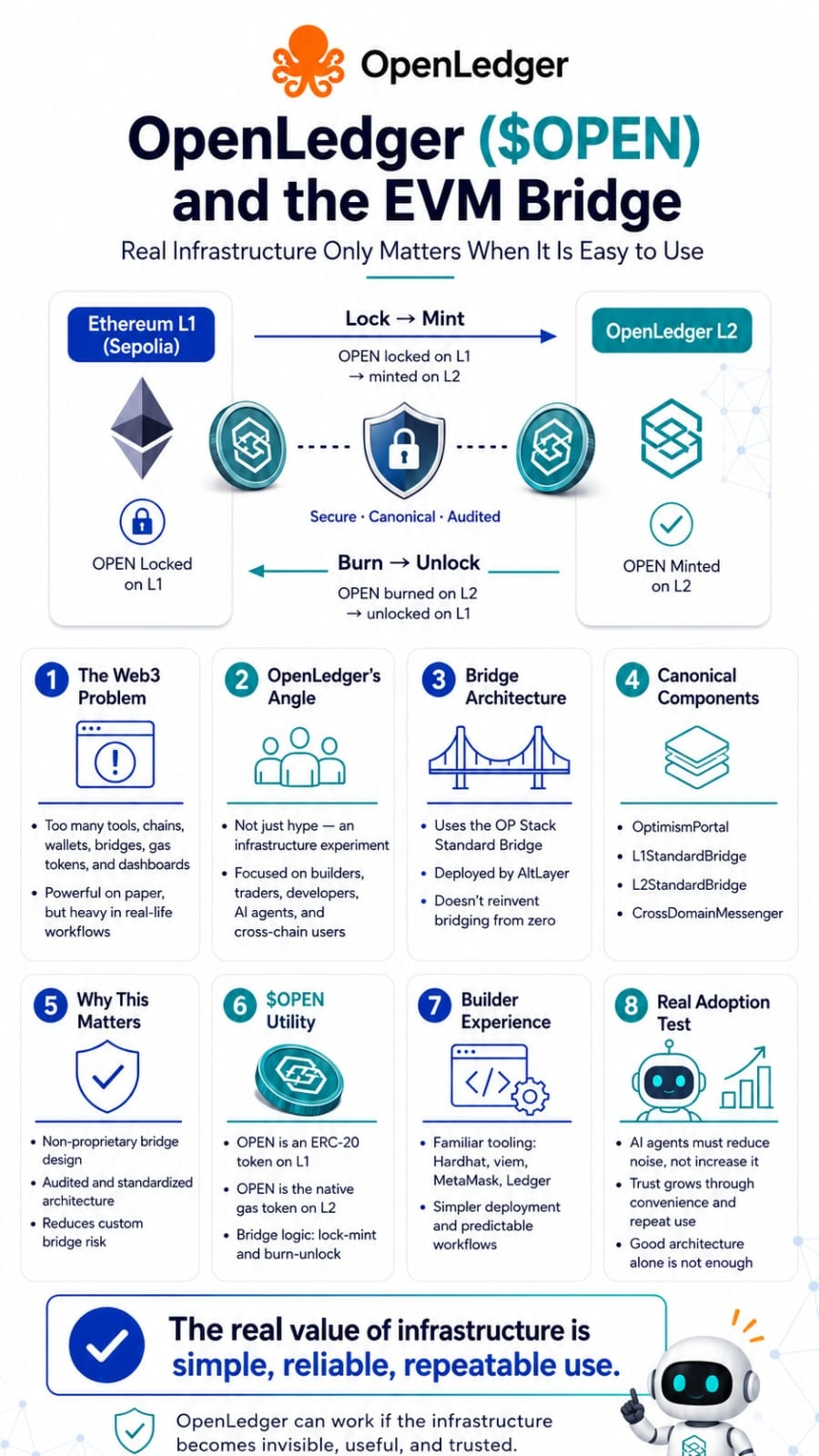
The biggest problem in Web3, for me, is not only technology.The problem is that a normal user, trader, builder, and even developer already has too many tools. One chain is separate, the wallet is separate, the bridge is separate, the gas token is separate, the data is separate, and for decision-making there are ten different dashboards. On paper, everything looks powerful, but in real life, the workflow becomes heavy.
This is why many infrastructure projects start with strong promises but fail to become part of daily behavior. They build features first, but try to understand user behavior later. The result is that the product is technically impressive, but the user thinks: “Why would I need this every day?”
For me, the better angle to look at OpenLedger is this. It should not be seen like a hype coin, but as an infrastructure experiment. The idea of OPEN becomes interesting when we connect it with practical use cases around AI, agents, builders, and cross-chain movement.
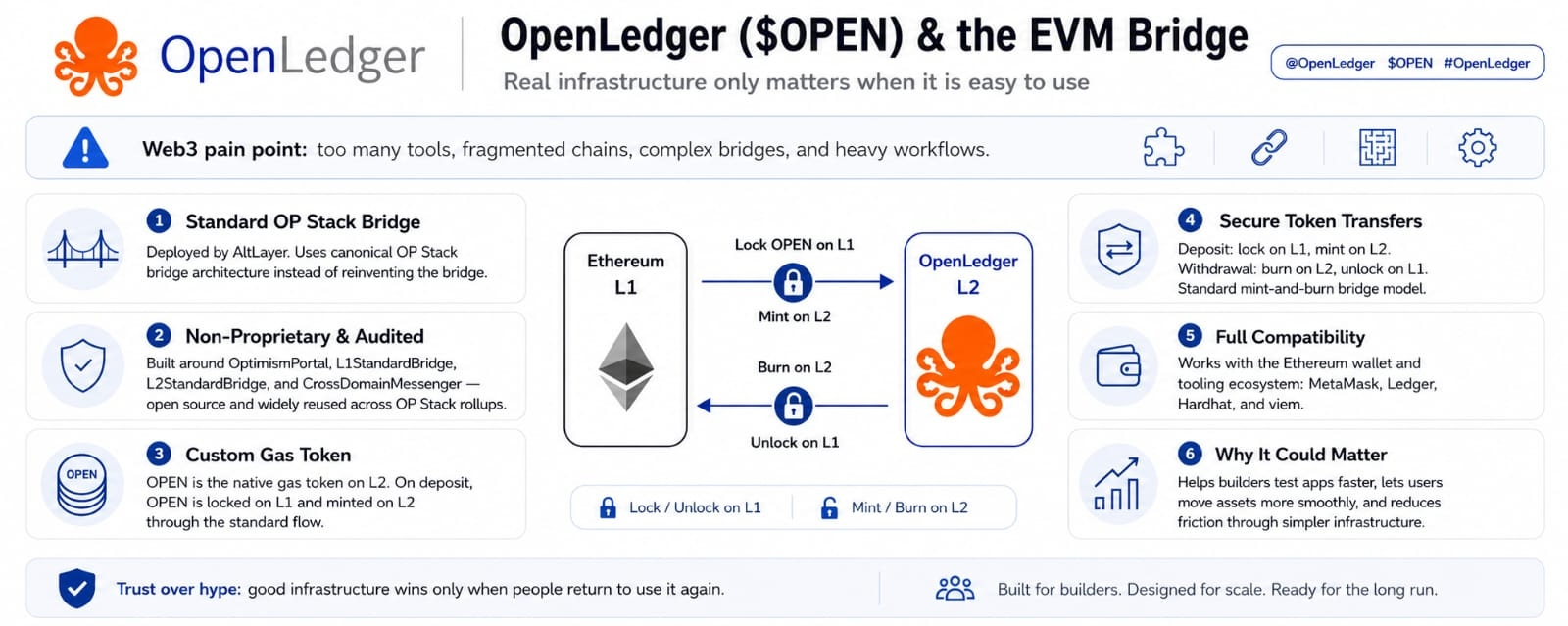
If a builder wants to test an app, then fast deployment, familiar tooling, and a predictable bridge experience become important. This is where the role of an EVM Bridge and OP Stack based standard bridge architecture comes in. OpenLedger utilizes the OP Stack Standard Bridge, deployed by AltLayer, which means it is not trying to reinvent bridging from zero. Canonical components like OptimismPortal, L1StandardBridge, L2StandardBridge, and CrossDomainMessenger are already used in the broader OP Stack ecosystem.
I find this part important because custom bridge risk is always a serious topic in Web3. When a project creates a completely new bridge of its own, building trust becomes even more difficult. OpenLedger’s approach appears to move in a relatively safer direction because it uses non-proprietary, audited, and standardized bridge components instead of changing the core bridge architecture.
The role of $OPEN also fits naturally here. The OPEN ERC-20 token is deployed on L1 and is used on L2 as the native gas token. In the testnet flow, OPEN tokens are locked in the OptimismPortal contract on Sepolia, then minted on L2. At the time of withdrawal, L2 OPEN is burned and unlocked on L1. In simple words, the bridge follows a lock-mint and burn-unlock logic.
Now the question is whether all of this can become useful for real users.
From a trader’s angle, AI agents are useful only when they reduce noise, not increase it. If an agent is only giving random suggestions, then it becomes just another distraction. But if an agent simplifies workflows, organizes market conditions, shows risk clearly, and makes the execution path smoother, then it becomes something users may return to.
The same logic applies to developers as well. Developer tools should be powerful, but they should also be simple. Compatibility with familiar ecosystems like Hardhat, viem, MetaMask, and Ledger means builders do not have to learn a completely new mental model. This matters more than people think, because developer adoption often starts from comfort, not from hype.
Communities also value tools only when they feel repeatedly useful. The first try happens because of curiosity. The second try happens because of convenience. Regular use happens because of trust.
The real challenge for #OpenLedger is exactly this. Having good architecture is not enough. Maintaining reliable infrastructure in a fast-changing crypto market is difficult. Bridges must remain secure. Agents must actually be helpful. Builders need a reason to build here. Users need a reason to move assets and come back.
My grounded takeaway is simple: OpenLedger can be useful for builders, traders, AI-agent users, and communities that want to use complex Web3 workflows in a simpler form. It might work if infrastructure becomes invisible, reliable, and repeatedly useful. But even with good intentions, it can fail if real usage, developer activity, and user trust do not grow beyond the initial narrative.
#OpenLedger #openledger $OPEN @OpenLedger
