
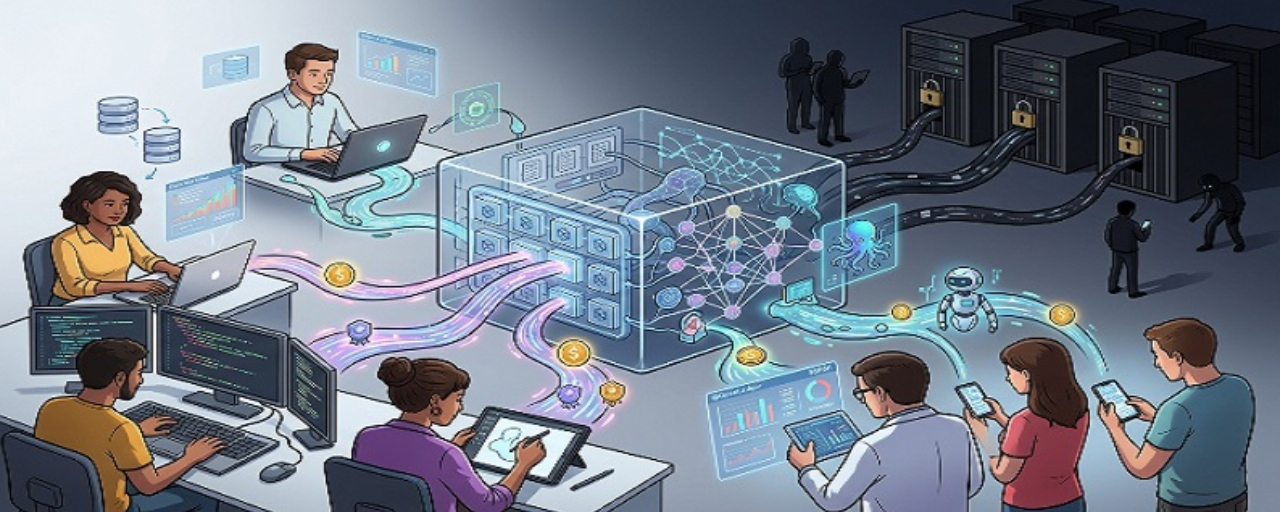
I keep thinking about how casually people give away data online now.
Not just social media posts or browsing habits.
Even deeper things like preferences, corrections, conversations, reactions, and patterns. Tiny human behaviors that seem meaningless individually but become incredibly valuable once AI systems absorb them at scale.
What’s strange is that most people still don’t see themselves as contributors to AI economies.
But they already are.
Every search, every interaction, every uploaded file quietly feeds larger systems somewhere in the background. The value keeps accumulating, just usually not for the people creating it.
That imbalance feels more obvious lately.
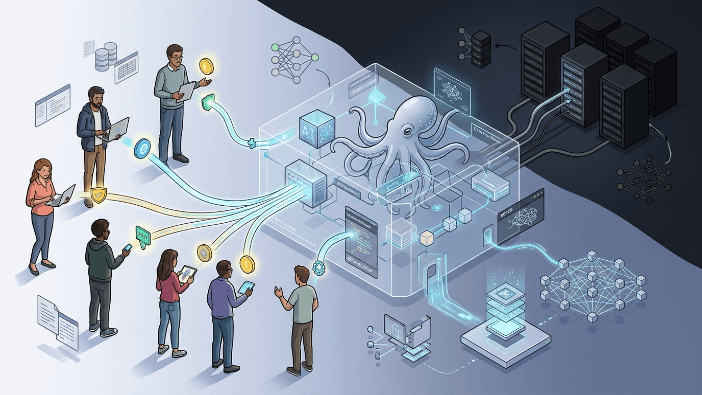
While reading about @OpenLedger , I noticed the project keeps circling back to one idea that honestly makes more sense the longer I think about it: data itself is becoming a form of digital labor.
Not in a dramatic way.
Just realistically.
AI models don’t appear from nowhere. They depend heavily on information produced by real people, communities, niche experts, researchers, and ordinary internet activity. Without that layer, even the most advanced systems eventually become hollow.
Yet most of the internet still treats data contributors as invisible.
That’s why the idea behind #OpenLedger caught my attention more than expected. It feels less focused on “AI replacing people” and more focused on building a structure where participation actually matters.
I noticed something interesting about the way open AI economies are evolving.
At first, everyone focused on models themselves.
Which model is smarter.
Which one is faster.
Which company has the biggest infrastructure.
But slowly the conversation is shifting toward the quality and ownership of the data underneath those models.
And honestly, that shift feels important.
Because future AI systems probably won’t compete only on intelligence. They’ll compete on trust, transparency, and access to meaningful datasets.
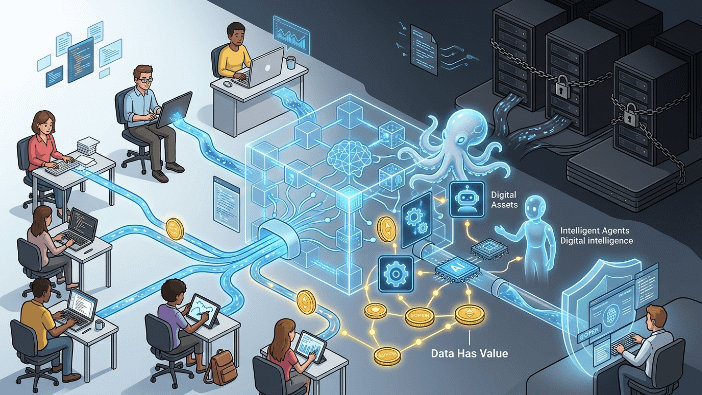
That changes the entire economy around AI.
With $OPEN , the ecosystem seems to treat datasets, models, and agents almost like interconnected assets rather than isolated products. Data can move, contribute, generate value, and remain traceable inside the network instead of disappearing into centralized systems forever.
That creates a very different feeling compared to traditional AI platforms.
More balanced somehow.
I might be wrong, but open AI economies only work long term if contributors feel visible inside the process. Otherwise the system eventually becomes extractive.
And people are already starting to notice that tension.
Especially creators.
Writers, artists, coders, educators, researchers. Many of them are realizing their work indirectly trains or improves AI systems without clear ownership paths attached to it.
The internet normalized that arrangement for years.
But I’m not sure it stays sustainable forever.
That’s partly why decentralized infrastructure around AI keeps becoming more relevant. Not because decentralization magically solves everything, but because transparency changes incentives.
You can actually trace participation.
You can verify origins.
You can build economic relationships around contribution instead of silent extraction.
That feels closer to how digital economies probably should function.
I also think people underestimate how much hidden value exists in smaller datasets.
Everyone talks about massive training pools, but highly specific human knowledge is often more useful than endless generic information. Local expertise, technical communities, niche industries, real-world experience. Those things are difficult to replicate artificially.
In open systems like #openledger , smaller contributors may end up becoming more important than people expect.
Not because they produce the most data.
But because they produce meaningful data.
And maybe that becomes one of the biggest shifts in AI over the next few years.
The realization that intelligence isn’t only built through scale.
It’s built through quality participation.
That’s probably why projects connected to verifiable and open AI infrastructure feel increasingly relevant to me lately. They seem more grounded in how value is actually created online.
Quietly.
Collectively.
By millions of people who rarely receive recognition for it.
Feels like the internet is slowly rediscovering where intelligence really comes from.