

Bigger context windows. Better reasoning. Faster inference.
That’s fine. But I think the economic layer is still the more interesting unsolved problem.
Because intelligence alone doesn’t explain value capture.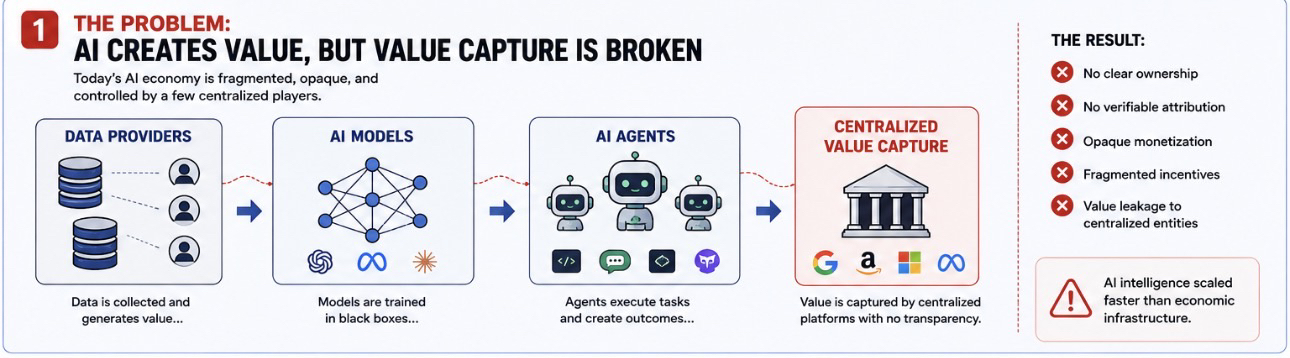
Data providers generate raw inputs.
Model builders create usable systems.
Agents increasingly execute tasks, automate decisions, and interact with applications.
Yet most of that value chain still feels structurally lopsided.
Contribution gets blurred.
Attribution becomes vague.
Monetization gets absorbed by centralized platforms.
That imbalance is exactly why OpenLedger caught my attention.
Not because it says “AI + blockchain.” Plenty of projects say that.
The more interesting part is the infrastructure thesis behind it.
OpenLedger is positioning itself as an AI blockchain designed to unlock liquidity across data, models, and autonomous agents—basically turning disconnected AI components into economic participants with verifiable attribution.
That’s a much stronger narrative than generic AI token speculation.
Think about how messy today’s AI ecosystem actually is.
A dataset contributes training value.
A model transforms that into usable intelligence.
An agent deploys that intelligence into execution.
Now ask a harder question:
Who gets paid?
And based on what proof?
That’s where most current systems become uncomfortable black boxes.
OpenLedger’s architecture seems to attack that exact friction.
Dataset registries.
Model registries.
Attribution infrastructure.
Agent execution layers.
Settlement logic.
That matters because if attribution becomes native instead of improvised, the economics change.
Data stops being invisible labor.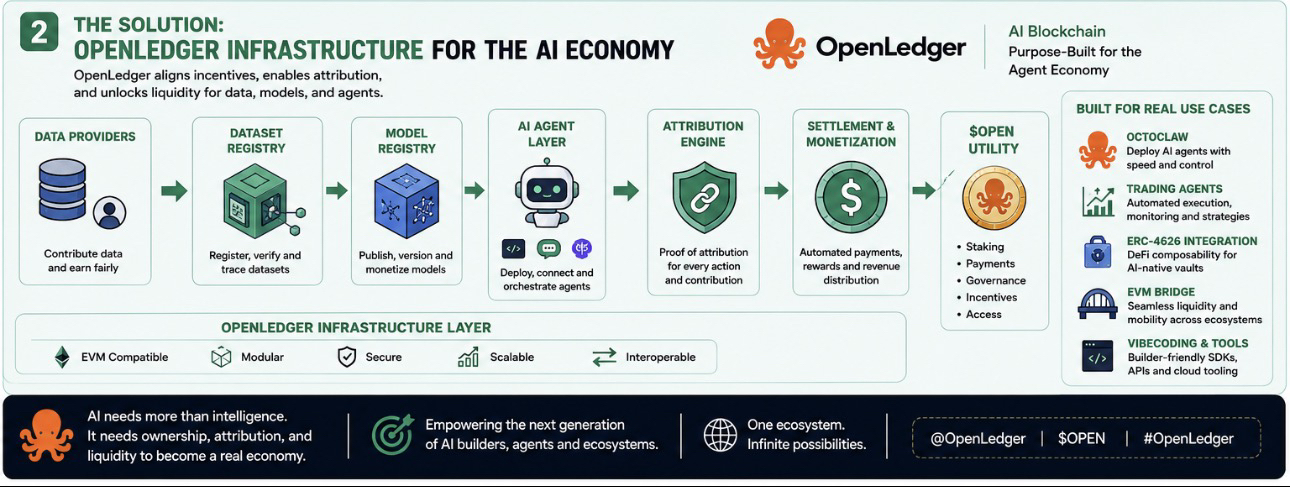
Model builders gain clearer monetization pathways.
Agents stop being toy experiments and become actual economic actors operating inside programmable infrastructure.
That’s where features like Octoclaw make practical sense.
A lot of agent narratives sound exciting until deployment complexity enters the room.
Execution friction kills experimentation fast.
If Octoclaw lowers that friction for builders, that’s tangible utility—not narrative fluff.
Same with trading agents.
People hear “AI agents” and imagine abstract futuristic demos.
But automated monitoring, strategy execution, and machine-assisted workflows? Traders immediately understand that use case.
That’s grounded.
The EVM bridge matters too, because isolated infrastructure rarely scales well.
If liquidity and applications stay fragmented, AI-native ecosystems hit growth ceilings early.
Interoperability isn’t a cosmetic feature. It’s survival infrastructure.
ERC-4626 integration is another interesting signal.
Not because standards sound exciting on social media—but because composability matters if OpenLedger wants meaningful interaction with DeFi capital.
Infrastructure compounds when systems can actually connect.
And honestly, this is where most weak AI narratives fall apart.
They talk intelligence.
They ignore monetization.
They talk disruption.
They ignore incentive design.
OpenLedger’s bigger bet seems different:
AI needs an economic operating system.
Not just smarter models.
If autonomous agents become meaningful participants in digital economies, attribution and settlement won’t be optional layers—they’ll be foundational.
Still early, obviously.
Execution matters more than narrative.
But I’d rather watch infrastructure trying to solve economic coordination than another project shouting “AI revolution” with no rails underneath it.
That’s the part worth paying attention to.